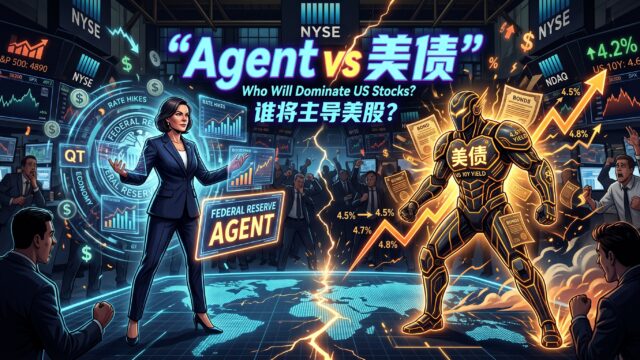
AI Agents vs. Treasury Yields: The Battle Splitting US Stocks in Two
TREE NEWS reports: The US equity market has fractured into two opposing worlds: an AI-driven boom led by agentic AI models, and a bond-market rout that is crushing rate-sensitive assets. Meta’s release of its agentic AI model, Muse, added roughly $220 billion to the company’s market capitalization in a single week, pushing its total value back above $2 trillion and powering the Nasdaq 100 to the strongest performance among major indices. Yet persistent upward pressure on Treasury yields has kept the S&P 500 pinned near 7,700, unable to break out, while the Russell 2000 has lagged significantly.
The divergence is extreme. Excluding AI-related names, the S&P 500 actually fell about 1% for the week. New lows on the New York Stock Exchange have outnumbered new highs for nine consecutive sessions—the longest such streak since October 2023.
AI Agent Frenzy and Record Concentration
Meta’s Muse model is the week’s biggest catalyst. The launch lifted the entire AI supply chain, with semiconductors leading on expectations that the “inference economy” will drive hardware demand. Goldman Sachs’ Agentic AI basket (GSXUAGNT) rose, and high-beta momentum baskets notched a ninth straight day of gains.
Market concentration has reached historic extremes. Ten US TMT companies in the S&P 500 now carry market caps above $1 trillion, up from just three when the AI cycle began three years ago. The Magnificent Seven’s gains were nearly triple those of the remaining 493 S&P 500 constituents.
Breadth Collapse and Internal Divergence
Beneath the AI euphoria, market breadth has deteriorated sharply. Energy and financials lagged while technology stood alone. The “diffusion trade” is effectively dead: NYSE new lows have exceeded new highs for nine straight days, the longest stretch in nearly three years.
Even within AI, cracks are appearing. AI power-related stocks weakened, moving in near-perfect negative correlation with the probability of Democrats winning the House in the midterms—a sign that investors fear data-center projects could be shelved indefinitely under a Democratic House. Meanwhile, hyperscaler credit spreads widened notably even as their equity valuations stayed elevated. The gap between hyperscaler credit risk and Nasdaq implied volatility has widened to abnormal levels.
Treasury Yields: The Biggest Obstacle
Rising Treasury yields are the core variable preventing a breakout. After two months of consolidation near 7,700, the S&P 500 showed signs of an upside break on Tuesday, only to be knocked back to square one by the bond market that evening. Goldman Sachs’ global head of hedge fund coverage, Tony Pasquariello, described the situation as a “frustrating cat-and-mouse game” between stocks and rates: each time equities try to break higher, yields jump, suppressing risk appetite and tightening financial conditions.
The Russell 2000 has underperformed the S&P 500 for six consecutive weeks, with small caps facing persistent selling from long-only funds and wealth management channels. On valuation, the median forward P/E for AI infrastructure stocks has fallen from 32x in April 2026 to 22x now, suggesting some pessimism is already priced in.
Key Takeaways for Investors
- Hedge the rate risk: Pasquariello advises that investors holding significant long equity exposure should pair it with a simple short Treasury position. He rates speculative long positioning at +3 on a -10 to +10 scale, suggesting crowding is not extreme.
- Watch for a catalyst: If an upside breakout catalyst emerges, fast money will be forced to chase. Until then, the tug-of-war between stocks and rates continues.
- Beware narrow leadership: Record concentration means index performance increasingly depends on a handful of AI names. A rotation or disappointment in AI could hit indices hard.
- Monitor policy risk: Midterm election outcomes could materially affect AI infrastructure spending and related equities.
The market’s message is clear: AI agents are winning the narrative, but Treasury yields still hold the leash.