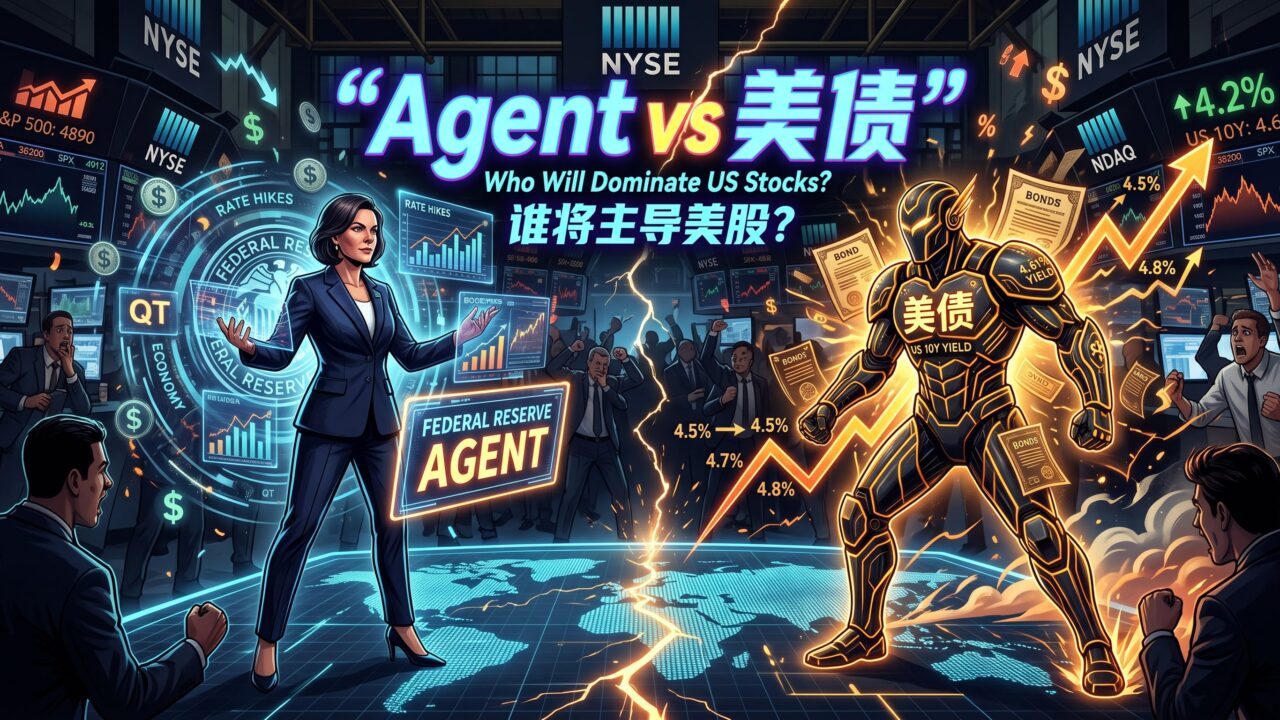
AI Agents vs. Treasuries: The Battle Reshaping US Equities
A surge in AI agent adoption has added roughly $220 billion to Meta’s market capitalization, while rising Treasury yields continue to pressure small-cap stocks. The S&P 500 is locked in a tug-of-war around the 7,700 level, with market internals showing extreme divergence between AI-driven megacaps and rate-sensitive laggards.
News Summary
The AI agent wave has become a powerful valuation catalyst for select mega-cap technology names, with Meta capturing the bulk of recent gains. At the same time, elevated Treasury yields are acting as a persistent headwind for small-cap equities, which are more dependent on cheap financing. Goldman Sachs has warned that equity holders need to hedge against Treasury risk, noting that the market is searching for a catalyst to break out of its current range.
Industry Analysis and Implications
The divergence is not merely a rotation story — it reflects a structural shift in how capital is being allocated. AI agents, which can autonomously execute tasks, negotiate, and transact, are being priced as a new productivity layer. Companies that demonstrate credible AI agent integration are commanding premium multiples, while those without a clear AI narrative are being de-rated.
- Concentration risk: Gains are increasingly concentrated in a handful of AI-linked megacaps, making the index vulnerable to earnings disappointments from a few names.
- Rate sensitivity: Small caps remain hostage to Treasury yields. Any sustained rise in yields could trigger further underperformance and broader risk-off moves.
- Hedging imperative: Goldman’s warning underscores that equity exposure alone may no longer be sufficient; investors are being pushed toward Treasury-linked hedges or rate derivatives.
The AI agent narrative is also spilling into crypto markets, where on-chain AI agents and decentralized compute networks are attracting capital. This creates a feedback loop: TradFi AI enthusiasm boosts crypto AI tokens, which in turn reinforces the narrative in public equities.
Forward-Looking Perspective
The S&P 500’s 7,700 level has become a psychological battleground. A decisive break above it likely requires either a meaningful decline in Treasury yields or a new AI-driven earnings catalyst. Until then, expect continued volatility and extreme dispersion within the index. Investors should watch for AI agent monetization milestones, Federal Reserve signaling on rates, and whether small-cap earnings can stabilize. The market is no longer about broad beta — it is about picking the right side of the AI-versus-rates divide.