A Fresh Trail in an Old Investigation
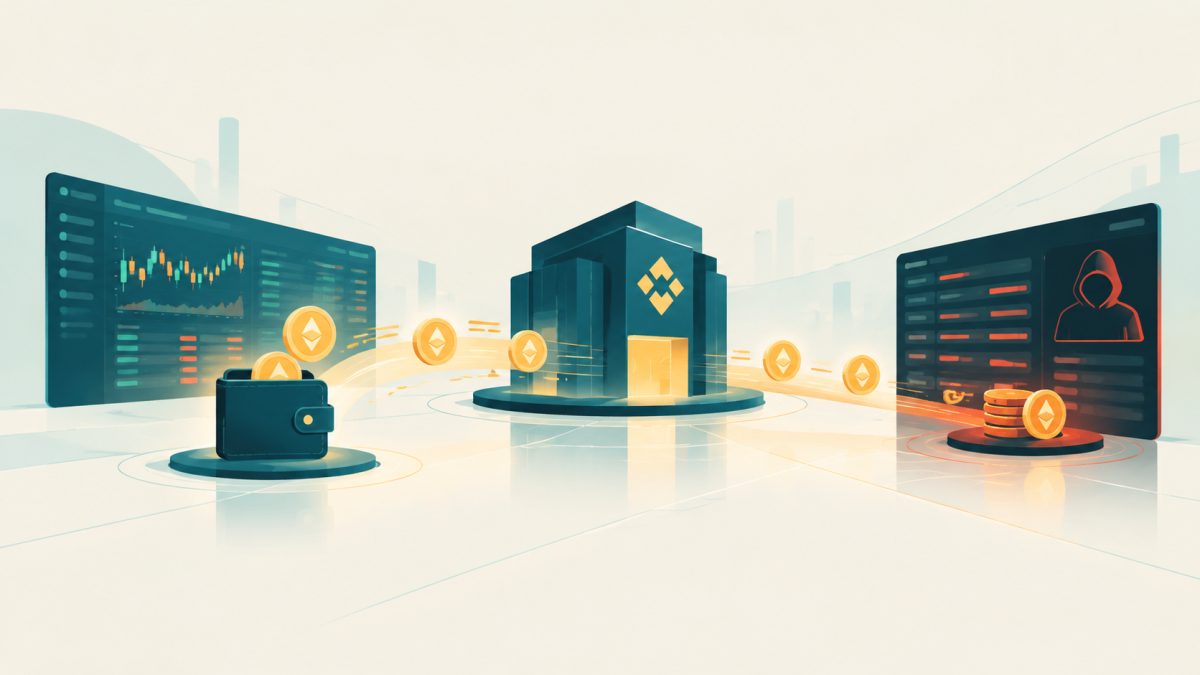
TREE NEWS reports: On-chain monitoring has surfaced a new fund flow connected to the Bitget exploit investigation. A wallet identified as 0x4885 withdrew 257.6 ETH and 545,000 USDT from Binance roughly eleven hours before the transfer was flagged, then swapped the stablecoins into 200.2 ETH. One hour before the alert, the address consolidated 457.9 ETH — worth roughly $1.23 million — into a wallet suspected of belonging to the Bitget hacker.
Why the Routing Matters
The mechanics here are as instructive as the dollar figure. The funds did not sit idle in a self-custody address; they passed through a major centralized exchange, were converted from a dollar-pegged asset into a volatile one, and only then moved to the destination wallet. That sequence suggests a deliberate attempt to break the on-chain continuity between source and endpoint.
- Exchange ingress: Withdrawing from Binance means the deposit side of the transaction is opaque to public observers — the original funding source may sit behind an internal exchange ledger.
- Stablecoin-to-ETH conversion: Swapping USDT for ETH changes the asset fingerprint, complicating address-clustering heuristics that track stablecoin flows.
- Consolidation before transfer: Gathering 457.9 ETH into a single hop reduces the number of traceable outputs and simplifies downstream layering.
The Attribution Problem
It is worth stressing that “suspected Bitget hacker wallet” is an attribution, not a conviction. Blockchain analytics firms label addresses based on behavioral clustering, counterparty graphs, and prior incident reports. Labels can be wrong, and funds can be routed through wallets that merely appear associated. What the data does establish is a directional relationship: value moved from an exchange withdrawal into an address that investigators have previously linked to the Bitget breach.
The $1.23 million figure is also small relative to the scale of major exchange breaches, which often run into the tens or hundreds of millions. That size is itself a signal — it looks less like a headline heist and more like incremental laundering, test transactions, or a fee-and-gas funding operation for a larger set of addresses.
What to Watch Next
Three things will determine whether this becomes a footnote or a chapter. First, whether the destination wallet begins dispersing funds through mixers, bridges, or privacy-focused chains. Second, whether Binance’s compliance team freezes or flags any linked accounts, which would require the exchange to trace the internal deposit record. Third, whether the receiving address interacts with any centralized venue that enforces sanctions or blacklist screening.
For the broader market, the takeaway is structural rather than dramatic. Exchange hacks no longer end at the moment of the breach — they become long-running on-chain investigations in which every hop, swap, and consolidation is public. That transparency is a deterrent, but it also pushes attackers toward more sophisticated obfuscation, raising the compliance burden for every exchange in the path.