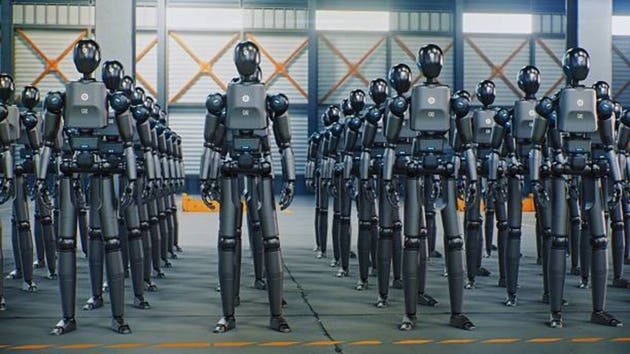
The Little Humanoid Robots That Could
TREE NEWS reports: A wave of humanoid robot developers is moving from viral demo videos to genuine commercial deployment, with a growing list of manufacturers targeting pilot programs in warehouses, automotive plants and logistics hubs over the next 12–24 months. The shift marks an important inflection point: the sector is transitioning from a research curiosity into an early-stage industrial supply chain, and capital markets are beginning to price that transition.
The story is no longer about whether a bipedal machine can walk across a stage. It is about unit economics, actuator supply, battery life, and whether a robot can work a full shift at a cost per hour below a human’s. Several developers now claim hardware costs in the $20,000–$50,000 range at scale, a threshold that would make payback periods competitive with traditional automation for the first time.
Why This Matters Now
Three forces are converging. First, advances in large language and vision models have given robots far better generalization — they can be instructed in natural language rather than painstakingly programmed. Second, the cost of the core components — harmonic drives, planetary roller screws, high-torque actuators, and lithium batteries — has fallen sharply as Chinese and Japanese suppliers scaled. Third, labor shortages in manufacturing and logistics across the US, Europe and Japan have made automation a board-level priority rather than a cost-cutting exercise.
Market Implications
Equities
The clearest near-term beneficiaries are not the robot makers themselves, most of which are private or thinly traded, but the component supply chain. Companies producing precision reducers, servo motors, tactile sensors and rare-earth magnets are the “picks and shovels” of this theme. Several listed industrial automation names in Japan, Germany and China have already begun to see order-book commentary referencing humanoid programs. Conversely, traditional industrial robot incumbents face a genuine competitive threat if general-purpose humanoids prove more flexible than fixed-arm automation.
Bonds and Rates
The macro read-through is slower but meaningful. If humanoids meaningfully lift manufacturing productivity in the late 2020s, they would be disinflationary for goods prices while supporting higher real wage growth in service sectors — a combination that complicates the rate outlook. For now, the effect is too small to move Treasury yields, but it strengthens the structural case for higher real rates over the long run.
Crypto and AI Tokens
This is where the story intersects most directly with digital assets. Humanoid robots require enormous training data and inference compute. Decentralized compute networks and GPU marketplaces — which tokenize idle processing capacity — have a plausible role to play in training and simulation workloads, particularly for smaller robotics developers priced out of hyperscaler contracts. Tokens tied to decentralized physical infrastructure networks (DePIN) and on-chain AI agent protocols have already shown sensitivity to robotics and embodied-AI headlines.
Investors should be careful, however: most of these tokens have weak links to actual robot deployments. The narrative is powerful, but revenue is scarce. Treat AI-and-robotics crypto exposure as a high-beta thematic bet, not a fundamental one.
Commodities and Currencies
Humanoid robots are rare-earth-intensive. Each unit requires significant quantities of neodymium, praseodymium and dysprosium for high-performance magnets. A genuine scale-up would add meaningful incremental demand to an already tight rare-earth market, reinforcing the strategic value of non-Chinese supply chains. Copper, lithium and specialty steels would also see demand pull. On currencies, the biggest beneficiary would likely be the yen and the renminbi, given Japan’s and China’s dominance in precision components and rare-earth processing.
Key Takeaways for Investors
- Focus on the supply chain, not the headline names. Actuators, reducers, sensors and rare-earth magnets are where revenue is actually being booked today.
- Watch for pilot-to-production milestones. A single large automaker or logistics operator committing to thousands of units would be a genuine re-rating catalyst.
- Treat crypto AI exposure as a satellite position. The DePIN and decentralized-compute thesis is real but unproven; size accordingly.
- Monitor rare-earth prices. They are the cleanest real-time proxy for humanoid scaling.
- Expect volatility. This is a long-duration theme with a 5–10 year payoff horizon, and it will trade on narrative as much as earnings for the foreseeable future.
The little humanoid robots may indeed be the ones that could — but the investable opportunity today lies in the parts they are built from, not the machines themselves.