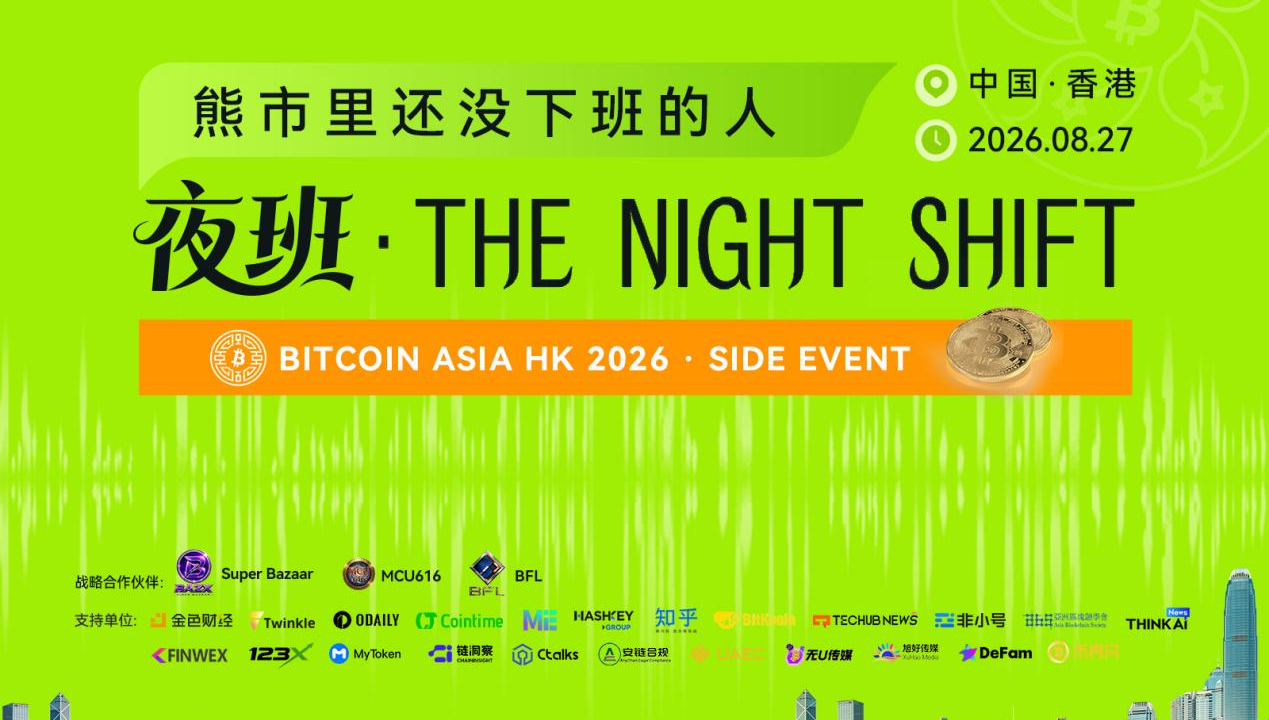
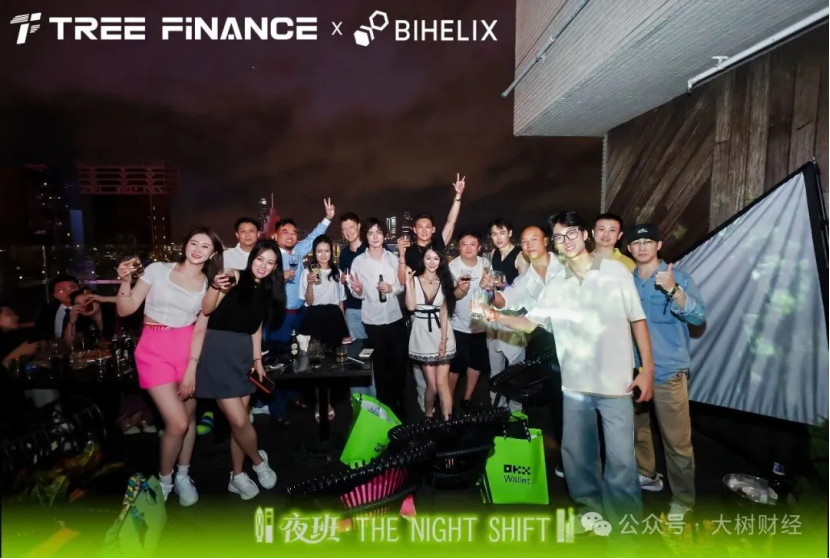
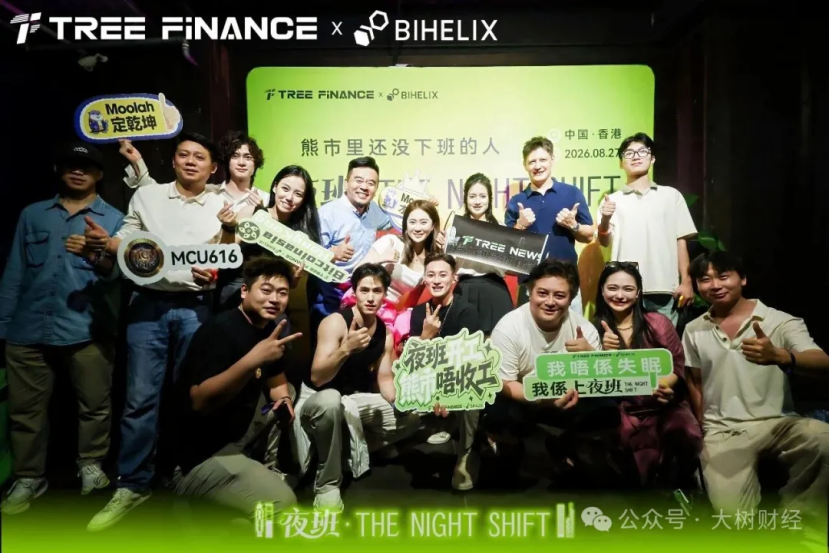
TREE NEWS reports: August 27th evening, Causeway Bay, Hong Kong, 31st floor of V Point.
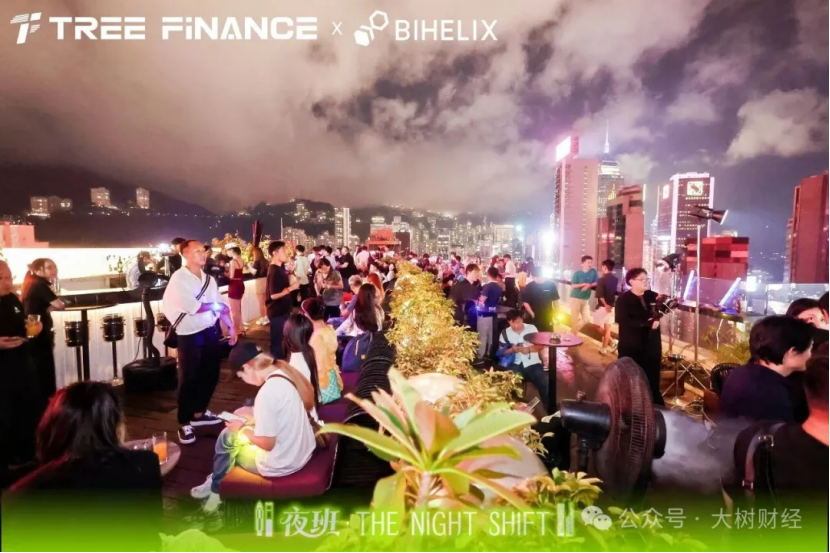
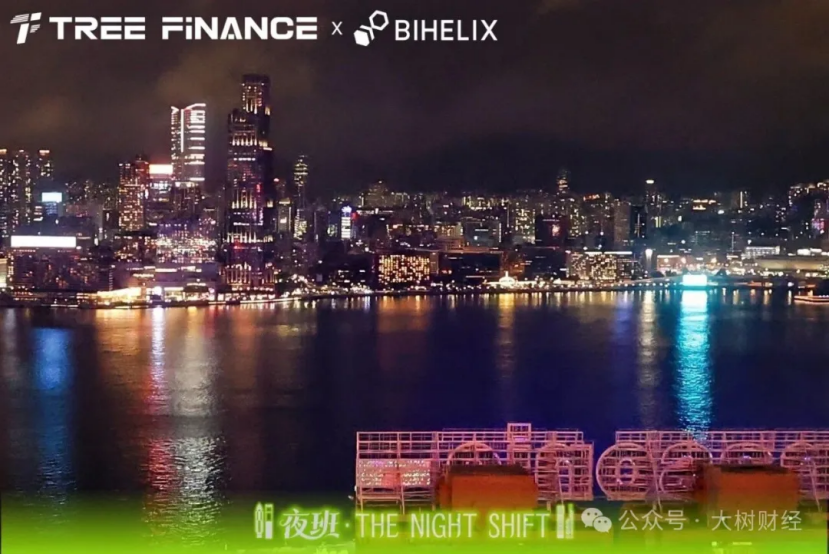
The main venue of Bitcoin Asia had emptied out early that day. The lights in the convention center dimmed one by one, the crowd surged toward the subway station, and a full day of discussions about Bitcoin’s future came to an end. But over five hundred people didn’t leave. They headed east from Wan Chai, entered this building, and went up to the 31st floor—outside the glass stretched the entire Victoria Harbour, lights spread out in a vast expanse. This was “THE NIGHT SHIFT,” co-hosted by Tree News and BiHelix, a Side Event of Bitcoin Asia’s Hong Kong session, and also Tree News’s sixth international AfterParty, working the conference’s session for the second consecutive year.
The theme was just one sentence: those still on the clock in a bear market. The host, Crypto Yuji, opened with a set of numbers: in the first half of the year, the total crypto market cap evaporated by nearly $900 billion; listed mining companies sold 32,000 Bitcoin in a single quarter, more than in all of last year. Mining rigs stopped, GPUs started—what’s really changing shifts this year is hashpower itself. Some people leave, some change tracks. The group standing on the 31st floor that night belonged to the latter. Over the next four hours, seven speakers took the stage. Looking back, they were actually speaking to different segments of the same line: how assets return to Bitcoin, how they flow once they’re back, what can grow once they flow, and—what kind of people this all requires.
1. Brik: USDT Was Born on Bitcoin in the First Place
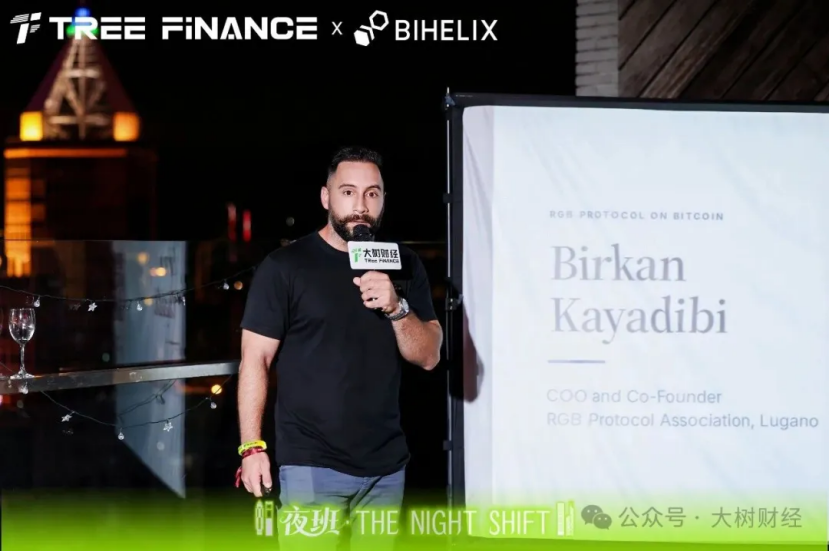
The first to take the stage was Birkan Kayadibi, co-founder and COO of RGB Protocol Association, who flew in from Lugano. He opened with a piece of history almost forgotten by the industry. USDT was originally issued on Bitcoin. In 2014, via Omni Layer, back when Ethereum hadn’t even launched its mainnet. But it later left—today about 85% of USDT supply is on Tron and Ethereum. Brik said this isn’t an ideological issue, it’s an arithmetic one: Omni wrote asset data directly into Bitcoin’s block space, and the cost couldn’t hold up. And now, it’s coming back. Tether has announced plans to issue USDT on Bitcoin’s RGB protocol. RGB 0.11.1 has been open-sourced and is live on Bitcoin mainnet. Why will it work this time? Brik offered a concise judgment: Bitcoin handles verification, Bitcoin doesn’t handle storage. RGB uses client-side validation—only a cryptographic commitment goes on-chain, the ledger itself doesn’t, privacy is structural, not additive. No new chain, no new token, no cross-chain bridge, no consortium, and no need to first buy a gas asset to spend a dollar. Security is inherited directly from Bitcoin; there’s no set of validators that can be lobbied, pressured, or shut down. Layer Lightning Network on top: channels handle execution, Bitcoin handles settlement. Instant, cheap, private. At the end he mentioned a point in time—September 2025, the first RGB atomic swap on Lightning Network mainnet, completed by KaleidoSwap. That line neatly handed the mic to the next speaker.
2. WALTER: The Day the Bridge Broke, the Industry Realized the Problem
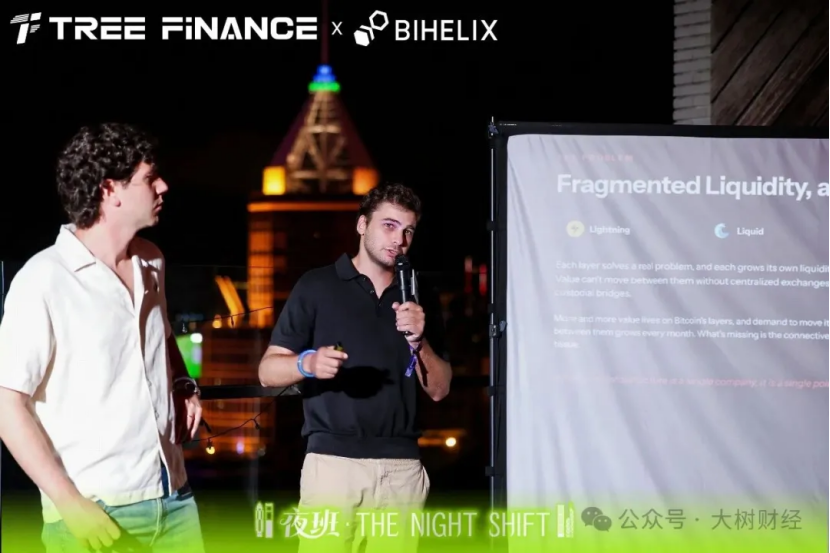
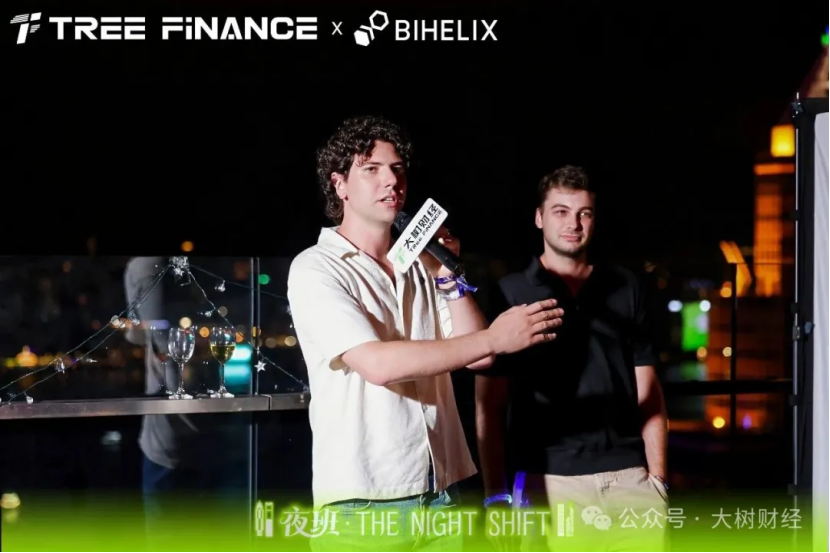
KaleidoSwap’s WALTER took the stage next, with the topic “Trustless Trading on Lightning Network.” He started with a real incident. Boltz, the industry’s most widely used non-custodial swap service provider, went offline. Overnight, Breez SDK, Bull Bitcoin, Arkade, Aqua, and more products simultaneously lost swap capability—channels couldn’t easily rebalance, and from Lightning Network to Liquid or Arkade, there was no non-custodial path. The essence of the problem: when core infrastructure is a company, it’s a single point of failure. Every layer of Bitcoin solves real problems and grows its own liquidity pool. But for value to move between them, it either goes through centralized exchanges or custodial bridges. More and more value lives on Bitcoin’s various layers, and the demand for cross-layer flow rises every month—what’s missing is the connective tissue. KaleidoSwap’s answer, WALTER put it bluntly: not another service provider, but a protocol. Peer-to-peer atomic swaps on Lightning Network, structurally trustless—either both sides settle, or both sides refund. It’s an open standard, not a company. Anyone can run a swap node to join the network; one node falls, the network doesn’t. Implementation is already running: a swap engine written in Rust, built for 24/7 market making; native Bitcoin stablecoins, supporting USDT on Liquid and RGB; Liquid, RGB, Arkade, and Spark four layers accessed through the same API. Currently on signet, mainnet testing underway, swap functionality expected to open officially in October 2026. He also showed the browser extension wallet in beta, and a rather special layer in the tech stack—KaleidoMind and KaleidoAgent, a self-custodial AI layer that can do automated trading and rebalancing. For the first time, Bitcoin’s layers have a way to connect without relying on anyone.
3. BiBo: Bitcoin’s Third Evolution
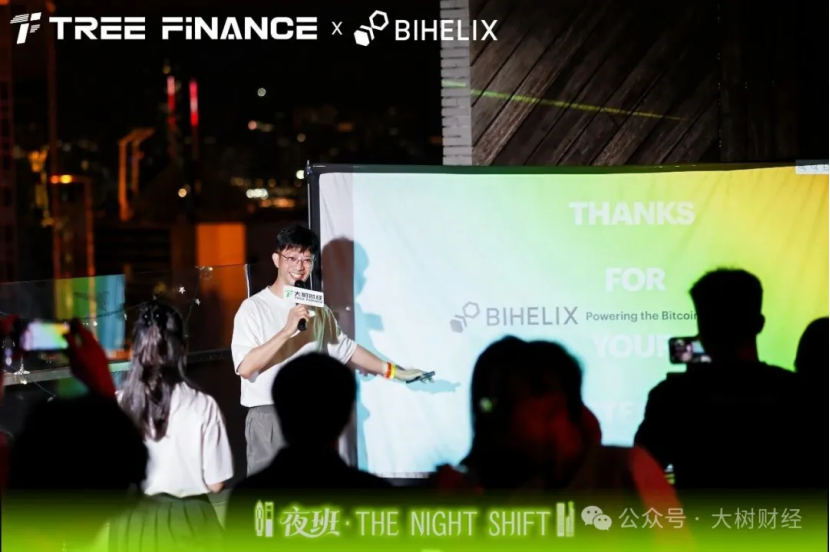
BiHelix CEO BiBo, co-host of the event, took the stage to discuss a larger framework: from BTC to the BTC economy. He broke Bitcoin’s evolution into three stages:
· Bitcoin 1.0 is store of value, establishing a global permissionless value network, positioned as digital gold.
· Bitcoin 2.0 is payment network, with Lightning Network solving payments and high-speed flow.
· Bitcoin 3.0 is economic network, with RGB protocol granting it native asset issuance and complex application capabilities.
He quoted Satoshi Nakamoto: I’m sure that in 20 years there will either be very large transaction volume or no volume. BiHelix’s architecture corresponds to four layers: the value layer is BTC itself, the issuance layer is RGB, the routing layer is Lightning Network, and on top is the economic engine—AI, DeFi, DEX, and commercial applications. Then BiBo pointed out the gap. Institutional capital only solves the problem of BTC as an “asset.” But from RGB assets to market trading, to AI and DeFi applications, there’s a missing piece—liquidity. His conclusion was direct: if assets cannot be efficiently traded and seamlessly flow between each other, assets remain isolated islands. The next stage of Bitcoin’s competition is not just asset issuance, but whether liquidity can truly flow. And USDT returning to Bitcoin is an important signal. At this point, the first three speakers had actually pieced together a complete picture: Brik said assets must return, WALTER said once back they must flow, BiBo said once flowing it becomes an economy.
4. Elma: Why Media Must Show Up Every Time in Winter
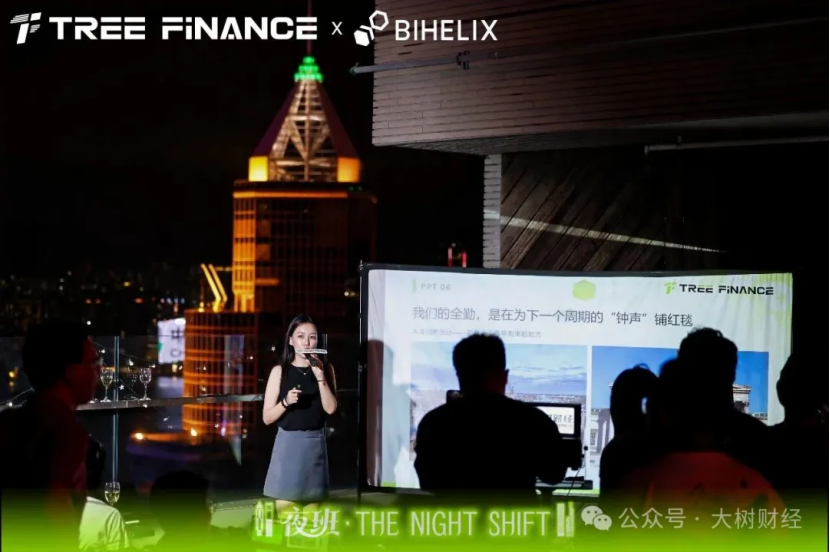
After the first round of lucky draws, the atmosphere relaxed. Tree News COO Yiyi Elma took the stage to talk about the hosts’ own business. She said the most frequently asked question this year was: the market is so cold, why do you keep holding event after event? Her answer started with a judgment: media is not a bystander, but a preacher. Consensus is never built in the cloud, but among people. She showed two old photos, one of an early Ethereum team group photo, one of a screenshot of Changpeng Zhao preaching Bitcoin in Shanghai years ago—those consensuses that later changed the industry were initially spoken face-to-face in specific rooms. Then she explained why Tree News repeatedly appeared in two places this year: Hong Kong and Cambridge. Hong Kong is the source of capital, universities are the source of ideas. Showing up every time in winter is to stand on the most valuable information high ground. The most weighty part of the speech was a metaphor—media has two ways to live, one is “time teller,” one is “clock builder.” The time teller tells you what time it dropped; the clock builder constructs the foundation of trust. She said Tree News chose to be the latter: showing up all year is rolling out the red carpet for the next cycle’s bell. And the Oxford and Cambridge events are where spring arrives earliest. Finally she left a line that became the most discussed of the night: the excellent people of the future are no longer those who know more answers, but those who can ask better questions and use AI to create value.
5. MingYang: The Long Road of Building a Bitcoin Community
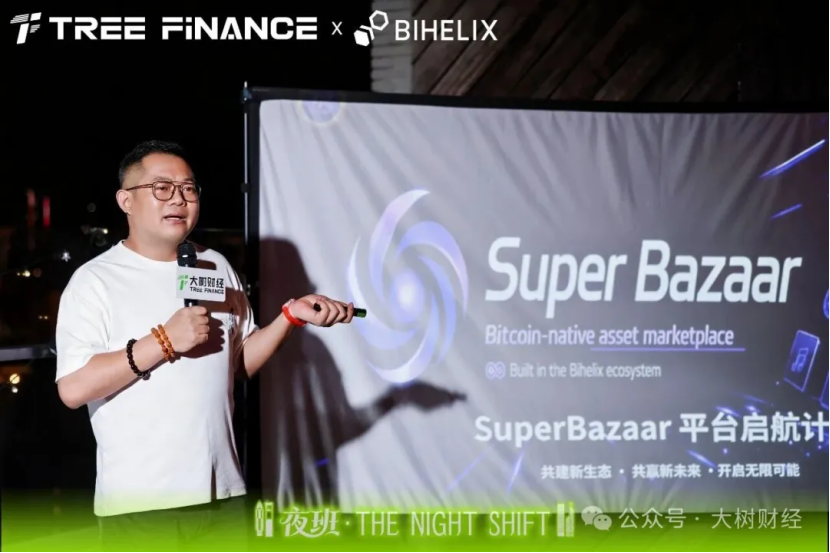
Next were the three strategic partners of the night. The first was MingYang from Super Bazaar. He has been deeply involved in internet and distributed trust technology for over a decade, long focused on blockchain underlying architecture and industrial digitalization, and has fully experienced the entire cycle of domestic blockchain from R&D exploration to industrial implementation. Someone who has been in technology for over a decade talking about how to build a community has a different perspective. Super Bazaar is the flagship application launched by BiHelix’s native ecosystem, positioned as a decentralized trading market based on order book mode, designed specifically for Bitcoin native assets. Technically it’s a combination of “Bitcoin native + RGB + Lightning Network”: anchored to Bitcoin mainchain settlement inheriting security, using RGB to create and transfer complex assets off-chain for scalability and privacy, using Lightning Network for second-level confirmation and extremely low fees. MingYang used an easier-to-understand phrase—the Uniswap of Bitcoin: letting all on-chain assets find ample liquidity here. He also mentioned BiHelix’s capital background: it has received strategic investment from 21 global institutions, led by Satoshi Labs, with investors including Waterdrop Capital, UTXO Management, LK Venture, etc. But what he talked about most was the word “consensus”—lowering the threshold for asset issuance and trading, making developers and entrepreneurs willing to come in, so the ecosystem has a chance to grow.
6. Wu Zibin: Hashpower Is Changing Shifts
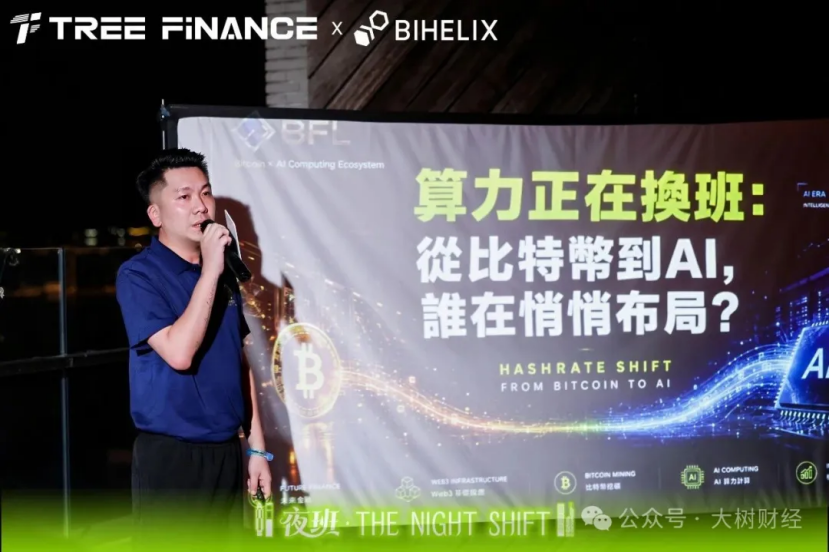
The second was Wu Zibin, representative of BFL Greater China. He has been deeply involved in traditional industries for over a decade. Three years ago, he made a decision that people around him found “incomprehensible”—all-in on Bitcoin. The reason is simple: trust is the most expensive cost in business, and Bitcoin solves the trust problem with technology. His speech was titled “Hashpower Is Changing Shifts: From Bitcoin to AI, Who Is Quietly Positioning?”—which neatly picked up the judgment the host threw out at the opening. He first laid out the current situation: Bitcoin fell from $126,000 to around $60,000, the crypto market evaporated about $890 billion in half a year, market sentiment is in extreme fear. But he said a bear market is not the end, but a window for repositioning. Then he gave three signals.
Signal one, who is quietly entering—retail risk appetite declines, capital flows out, but institutions are doing long-term allocation and ecosystem expansion. Capital is being reallocated.
Signal two, policy is redefining market expectations—regulatory framework upgrades, compliance standards rise, global policy coordination, market structure reshapes accordingly, and investment logic is shifting.
Signal three, small holders are selling, large holders are buying—on-chain data shows that in the past 30 days, whale accumulation totaled about $2.75 billion, large transactions above $1 million grew 38.6%, and the number of whale addresses grew 21.4%. Then came the core of the speech—hashpower repricing. The bear market pushed costs down: energy costs fell 28.6% year-on-year, while network efficiency improved 35.4%. The energy structure is reorganizing, equipment is being repriced, and global hashpower is being redistributed. And hashpower hasn’t disappeared, it’s migrating. The past was the Bitcoin Mining era: decentralized network, ASIC efficient hashpower, energy-driven, proof-of-work securing safety. The future is the AI Computing era: GPU clusters, high-performance computing, infrastructure upgrades, infinite application scenarios. The same electricity, the same factories, running a different kind of computation. BFL’s positioning is built on this judgment: based on Bitcoin hashpower, integrating AI intelligent computing, building the next generation of digital asset liquidity infrastructure. He also showed real photos of mining farms and satellite positioning—real containers, cooling equipment, sites. Real hashpower, supporting future value.
7. Cai Ge: Actually Getting Applications Running
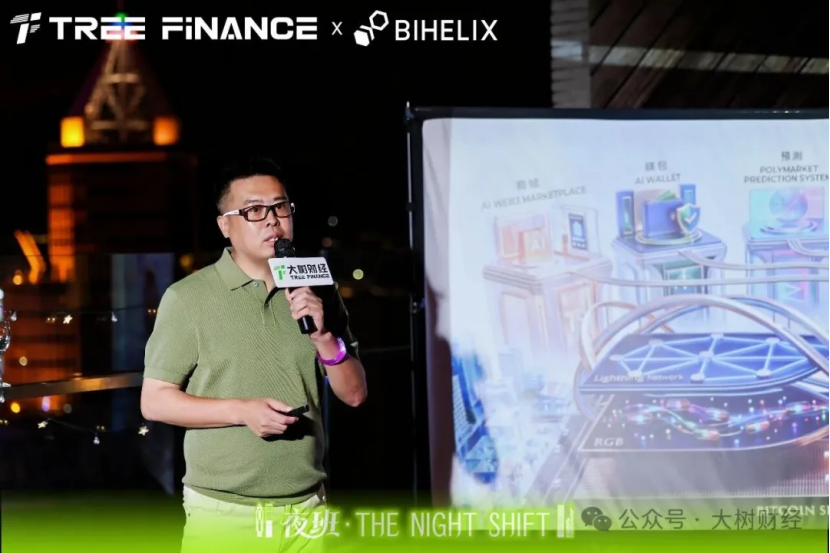
The last content session was Cai Ge from MCU616. He entered the crypto industry in 2016, an early Bitcoin holder, and has fully experienced three bull markets. In 2022 he began investing in Bitcoin ecosystem building, in 2024 became a consensus builder of Bitcoin Layer 2 networks, and now also promotes the combination of Web3 and AI. Few people can stay in this industry for three full cycles and still be building. He talked about the application layer of Layer 2: using Bitcoin mainnet as the security and settlement foundation, combining RGB protocol and Lightning Network, providing infrastructure for digital assets, smart contracts, and ecosystem applications. The architecture has five layers—settlement layer is Bitcoin, asset layer is RGB, payment layer is Lightning Network, above is the application framework layer, and on top is the application itself. He detailed four technical features: relying on Bitcoin UTXO and client-side validation, asset states anchored to mainnet, reducing dependence on cross-chain bridges and centralized custody; introducing programmable assets and application frameworks, expanding Bitcoin from store of value to applications; through client-side validation and self-custody, users always retain control of assets; RGB and Lightning Network dual engines, one for scalability and privacy, one for fast low-cost payments. Then he showed several applications already in progress: SuperTalk is an AI-native secure communication and collaboration platform, integrating chat, voice, live streaming, meetings, AI meeting minutes, and digital wallet; SuperMALL is an AI-native Web3 mall, connecting physical consumption, digital content, and community activities; and a prediction market and analysis system. From protocol to application, the technical chain of the night closed here.
8. After the Lights Came On
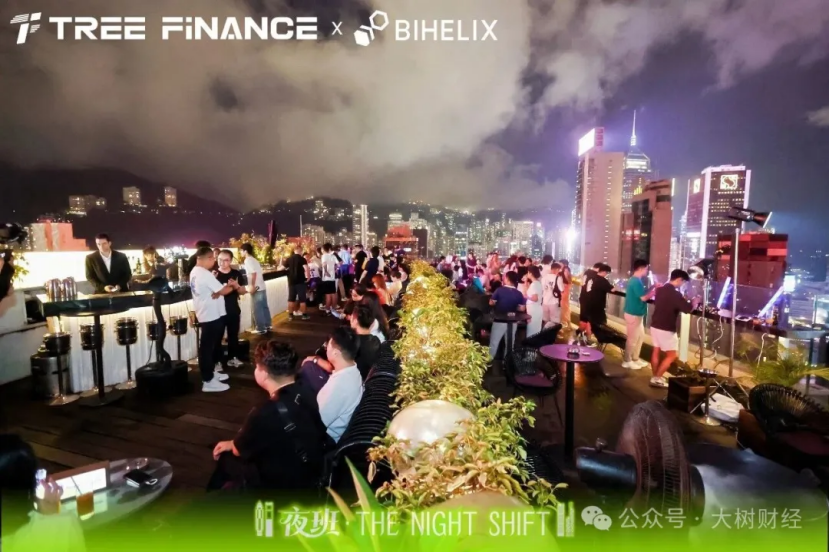
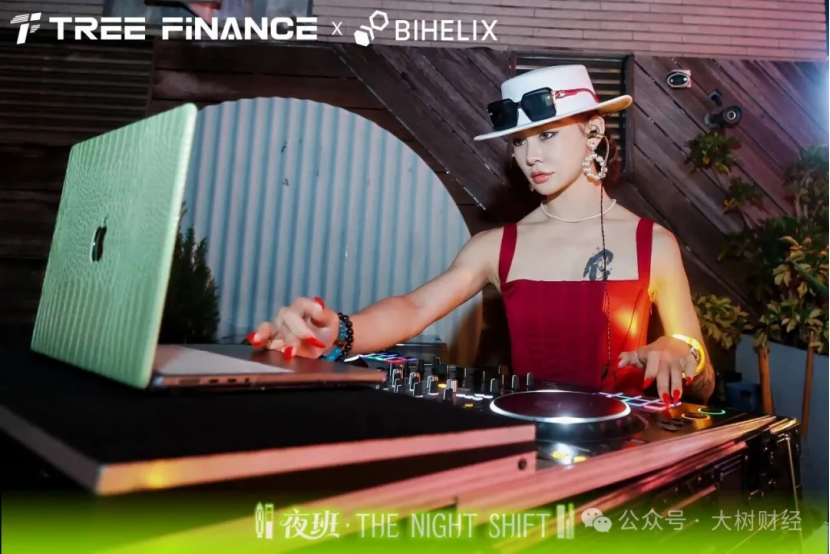
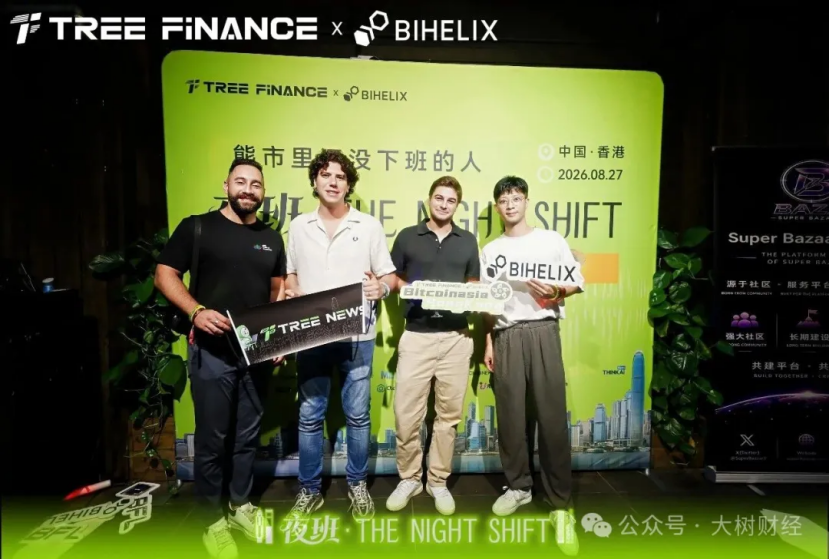
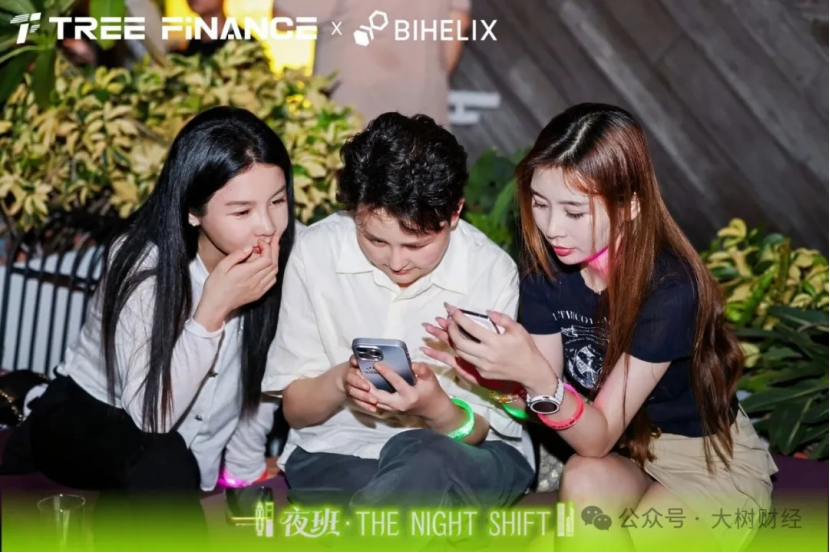
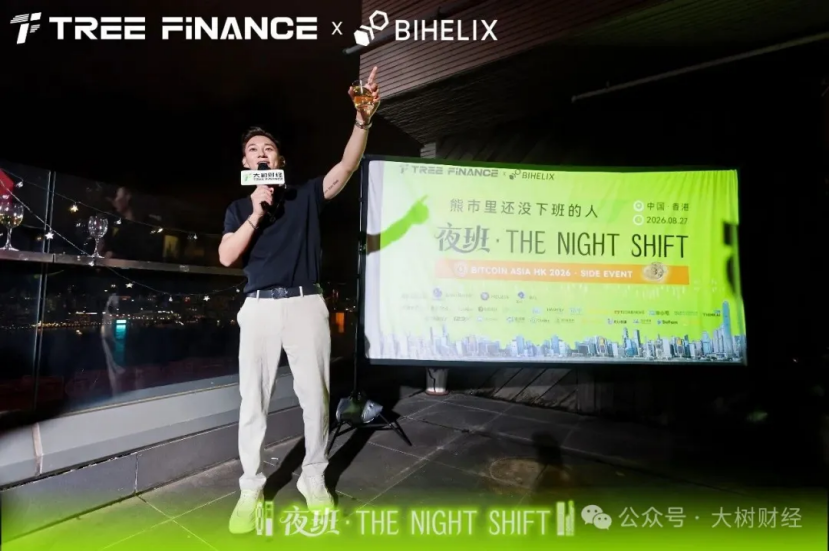
After the main prizes were drawn, the food and drinks opened, and the DJ took over. Among the over five hundred people that night were project teams, investment institutions, mining and hashpower practitioners, exchanges, and media. Tree News never held this event just for people to listen and leave—inviting by role quota, controlling density, precisely so that each type of person could find someone worth talking to on site. Near midnight, outside the 31st floor windows, the lights of Victoria Harbour still shone. Looking back at the seven talks that night, they actually answered the same question: in a bear market, what exactly are people building? Brik is bringing assets back to Bitcoin, WALTER is making assets flow across layers, BiBo is building a complete economic network, MingYang is building a trading venue, Wu Zibin is connecting hashpower to AI, Cai Ge is actually getting applications running. And Elma said the media’s position is to build clocks—when these things happen, stand on site, record it, and let consensus flow. The future won’t suddenly arrive; it’s happening every day. On the last Thursday of August, on the 31st floor in Hong Kong, we worked the night shift again.
About Tree News
Web3 / AI / Macro Finance Media and Event Brand, the node connector toward the future.
Host: TREE FINANCE × BIHELIX Strategic Partners: Super Bazaar · MCU616 · BFL Supporting Units: Jinse Finance · Twinkle · ODAILY · Cointime · ME GROUP · HashKey · Zhihu · TECHUB NEWS · Feixiaohao · Asia Blockchain Society · THINKAI · FINWEX · 123X · MyToken · Chain Insights · Ctalks · Anlian Compliance · WuU Media · Xuhao Media · DeFam Twitter: @TreeFinanceCN | Website: www.treefinance.co | WeChat Official Account: Tree News