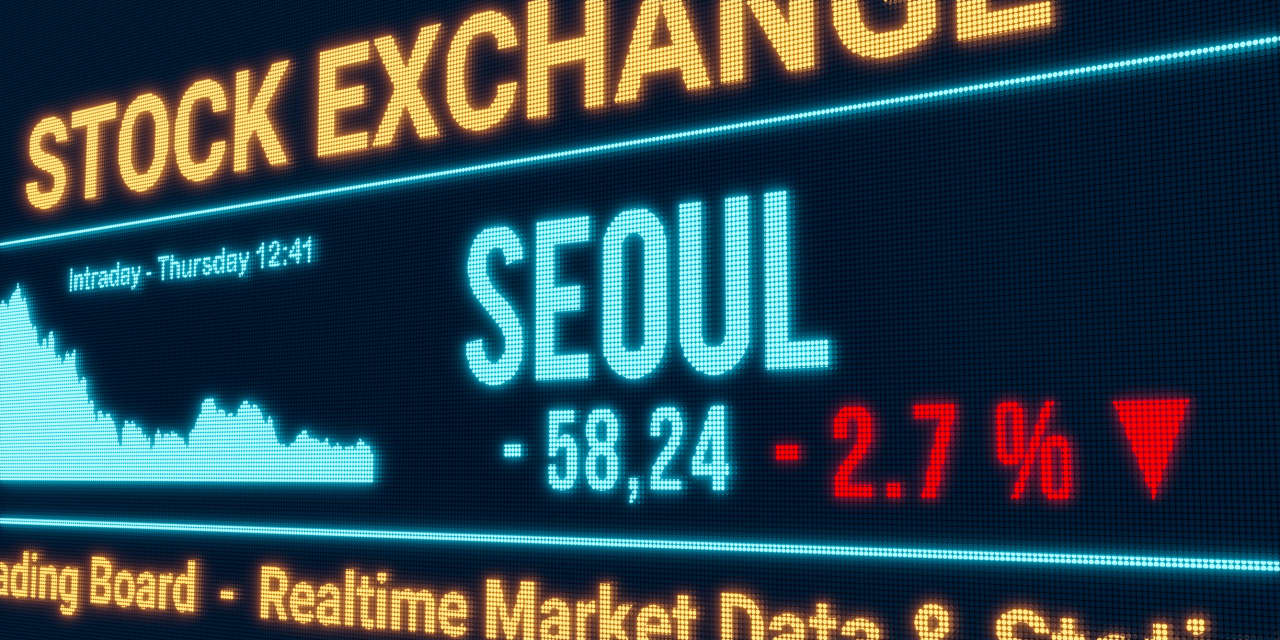
South Korean Stocks Plunge as Semiconductor Cycle Doubts Mount
TREE NEWS reports: South Korea’s equity market has entered a sharp selloff, with the KOSPI and the tech-heavy KOSDAQ falling hard as investors reassess the durability of the semiconductor upcycle that has driven Korean benchmarks for much of the past two years. The move is being framed less as a single-event shock than as a sentiment reversal: Korean stocks have long risen and fallen on expectations for chip-industry profitability, and right now skepticism about how long that profitability can be sustained is rising quickly.
What Happened
Korean equities, which are unusually concentrated in memory-chip and semiconductor-equipment names, have been hit by a wave of downgrades and position unwinding. The trigger is a familiar one for Seoul watchers — the market’s valuation rests almost entirely on the assumption that AI-driven demand for high-bandwidth memory (HBM) and advanced DRAM will keep pricing firm and margins elevated. As that assumption is questioned, the index that giveth on chip optimism also taketh away.
Foreign investors, who have been heavy buyers of Korean tech during the AI trade, appear to be trimming exposure. That outflows pressure the Korean won, which in turn makes foreign selling more attractive, creating a reflexive loop that amplifies drawdowns.
Market Implications
- Equities: Direct pain is concentrated in memory makers and their suppliers. But the read-across matters globally — Korean chip names are a high-beta proxy for the AI hardware trade, and weakness there often telegraphs caution for US and Taiwanese semiconductor complexes.
- Bonds: A Korean risk-off impulse typically supports government bonds (KTBs) via a flight-to-quality bid, and can pull global yields marginally lower if the selloff broadens into a broader tech de-rating.
- Currencies: The won is the pressure valve. Sustained foreign equity outflows weaken KRW, which in turn raises imported inflation and complicates the Bank of Korea’s easing path.
- Crypto: Korea is one of the world’s deepest retail crypto markets, and Korean traders are famously momentum-driven. A domestic equity drawdown can pull speculative capital out of altcoins and into cash or stablecoins, at least temporarily. Conversely, if the selloff is read as “bad news for AI, good news for rate cuts,” bitcoin could catch a bid as a liquidity hedge — the reaction function is not one-directional.
- Commodities: Semiconductor weakness is bearish for the industrial metals tied to electronics demand (copper, silver, certain rare earths) and indirectly for energy if it signals slower global capex.
Why This Matters
The Korean market is a leading indicator for the global semiconductor cycle because it is the purest, most liquid way to express a view on memory pricing. When Seoul sneezes, the AI supply chain catches a cold. For investors, the key question is whether this is a sentiment-driven pullback within an intact uptrend, or the early stage of a genuine cycle rollover. The distinction is enormous: the first is a buying opportunity, the second is a regime change.
Three signals to watch: HBM contract pricing, Korean export data for semiconductors, and foreign net flows into KOSPI. If pricing holds and exports stay firm, the selloff is likely positioning noise. If pricing cracks, the AI trade’s earnings foundation is in question — and that would ripple far beyond Seoul, into US mega-cap tech, Taiwanese foundries, and the entire global risk complex.
Key Takeaways
- Korean equities are selling off on fading confidence in semiconductor profitability, not a single shock.
- The won is the pressure valve; currency weakness can feed back into foreign selling.
- Watch HBM pricing and Korean chip export data as the decisive tells.
- Crypto and commodities are second-order but real transmission channels — direction depends on whether the market reads this as growth fear or rate-cut hope.