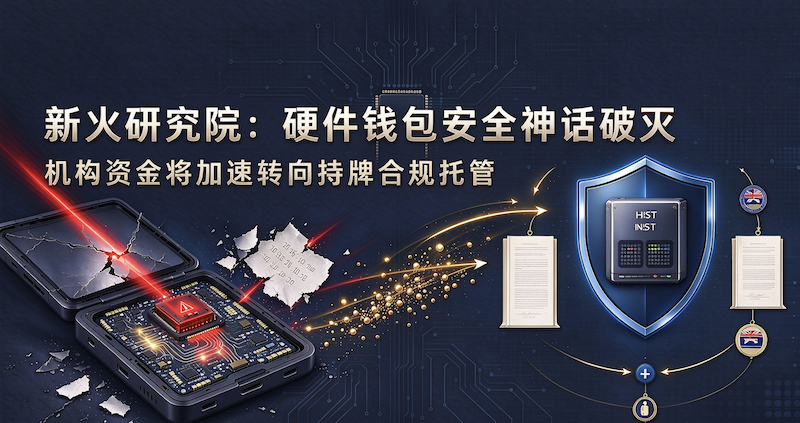
Hardware Wallets Are Not the Fortress Retail Investors Believe
A string of security incidents involving Ledger, Trezor and Coldcard has shattered the long-held assumption that consumer-grade self-custody hardware is the gold standard for protecting digital assets. New Huo Research, analyzing all three cases together, argues that the vulnerabilities are not isolated bugs but structural weaknesses embedded in the supply chain, firmware update pipelines and third-party service dependencies that define how these devices are built and maintained.
Three Devices, Three Attack Surfaces
- Supply chain: Tampered or substituted components can be introduced before a device ever reaches a buyer, defeating the premise that the private key never leaves the user’s hands.
- Firmware: Mandatory or auto-updating firmware creates a centralized point of failure — a single compromised release can silently undermine thousands of devices at once.
- Third-party services: Recovery, cloud backup and analytics integrations expand the attack surface far beyond the physical device itself.
The common thread is that consumer self-custody pushes ultimate responsibility onto the individual, while the actual security architecture depends on vendors, logistics partners and service providers the user can neither audit nor control.
Why Institutions Are Reassessing Self-Custody
For retail holders, a compromised device is painful but bounded. For funds, family offices and corporate treasuries, the calculus is entirely different. A single firmware exploit or supply-chain compromise can translate into eight- or nine-figure losses, regulatory scrutiny and fiduciary liability. The three incidents collectively undermine the narrative that “not your keys, not your coins” automatically equals superior security.
Licensed custodians and statutory trusts offer a layered defense model that consumer hardware cannot replicate: segregated cold storage with multi-party computation or multi-signature governance, geographically distributed key shards, insurance coverage, audited operational controls, and — critically — legal recourse under a regulated framework. When something goes wrong, there is an accountable entity, not an anonymous forum thread.
The Compliance Pull
Regulatory momentum reinforces this shift. As jurisdictions tighten rules on how institutions may hold client assets, unregulated self-custody becomes harder to justify in an audit or a prospectus. Licensed custody and trust structures convert a technical risk into a governed, insurable and reportable one.
Forward Outlook
Hardware wallets will remain a useful tool for individuals, but the era of treating them as an institutional-grade solution is ending. Expect accelerating migration of high-net-value and institutional capital toward regulated custody and wealth-succession frameworks, with multi-layer defense — legal, operational and cryptographic — becoming the baseline expectation rather than a premium add-on.