Profits Up, Cash Down: The New Big Tech Paradox
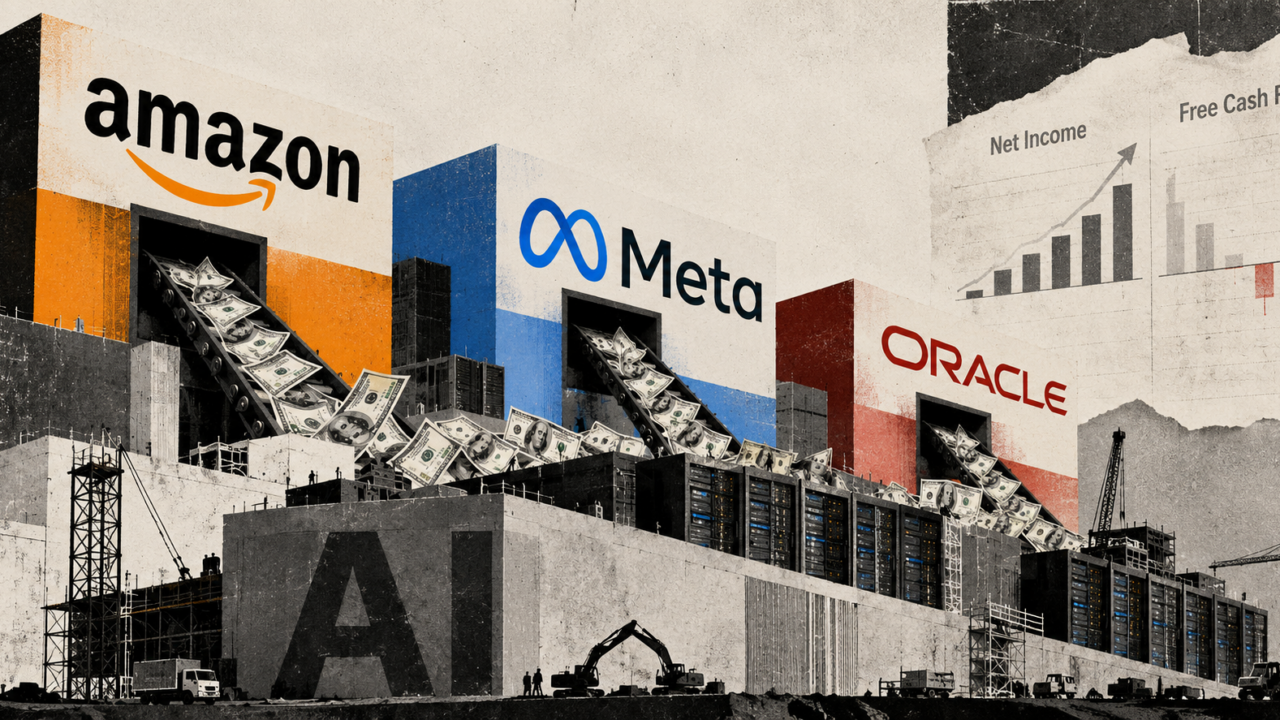
Amazon earned $135 billion in net profit over the twelve months ending June 2026, with operating margins at their highest level in 40 quarters. Yet free cash flow for the same period was negative $7.6 billion — a sharp reversal from positive $18.2 billion in the prior twelve months. The divergence between accounting profit and cash generation is the defining financial story of the AI infrastructure boom, and Amazon is its clearest case study.
Why the Cash Is Disappearing
The explanation lies in capital expenditures. Amazon, Meta, and Oracle are all pouring tens of billions into data centers, custom silicon, and power infrastructure to support AI training and inference. These outlays hit the cash flow statement immediately but are depreciated over years on the income statement, flattering near-term earnings while draining liquidity. For Amazon, the buildout of AWS AI capacity — including massive GPU clusters and proprietary Trainium chips — has pushed capex to levels that outstrip operating cash generation.
Meta faces a similar dynamic, with capital spending guidance repeatedly revised upward as it races to build AI infrastructure for both internal models and cloud offerings. Oracle, meanwhile, has seen its backlog swell from AI cloud contracts, but the upfront investment required to service those contracts is enormous. The common thread: profits are real, but they are increasingly an accounting artifact of depreciation schedules rather than a reflection of cash available to shareholders.
Market Implications
- Valuation scrutiny: Investors accustomed to valuing Big Tech on free cash flow must now grapple with negative or shrinking FCF. Price-to-FCF multiples become meaningless, forcing a shift to EBITDA or revenue-based metrics — a regime change that historically precedes volatility.
- Debt markets: With cash flow constrained, these companies are increasingly tapping bond markets to fund capex. Amazon, Meta, and Oracle have all issued substantial debt in recent quarters. Rising leverage at the world’s largest companies could tighten credit conditions more broadly.
- Capex discipline risk: If AI revenue does not materialize on the anticipated timeline, companies face a choice between cutting investment (and ceding competitive ground) or sustaining cash burn (and angering shareholders).
The Crypto Connection
This dynamic has direct implications for crypto markets. AI infrastructure spending is a key driver of demand for high-performance compute, which intersects with decentralized GPU networks and AI-focused crypto tokens. If hyperscaler capex slows, it could pressure the narrative around decentralized compute alternatives. Conversely, if cash constraints force Big Tech to seek external capacity, it may open opportunities for on-chain compute marketplaces and tokenized infrastructure providers.
Forward-Looking: When Does AI Pay Back?
The critical question is timing. Amazon’s AWS AI revenue is growing, but not yet fast enough to offset the capex surge. Meta’s AI investments are largely defensive — necessary to maintain advertising competitiveness rather than direct revenue generators. Oracle’s backlog provides visibility, but execution risk is high. Investors should watch three signals: capex guidance revisions, FCF inflection points, and the pace of AI revenue recognition. Until free cash flow turns positive again, the market’s patience with the AI investment cycle will be tested — and the companies that blink first may reshape the competitive landscape for a decade.