The Memory Paradox: Why AI Knows Everything About Humanity but Can’t Remember Yesterday
TREE NEWS reports: Large language models can ingest the entirety of human knowledge, yet they struggle to remember what happened yesterday. This fundamental contradiction lies at the heart of a pressing challenge in artificial intelligence: how to maintain coherent, continuous decision-making across time when the system cannot carry its entire past with it.
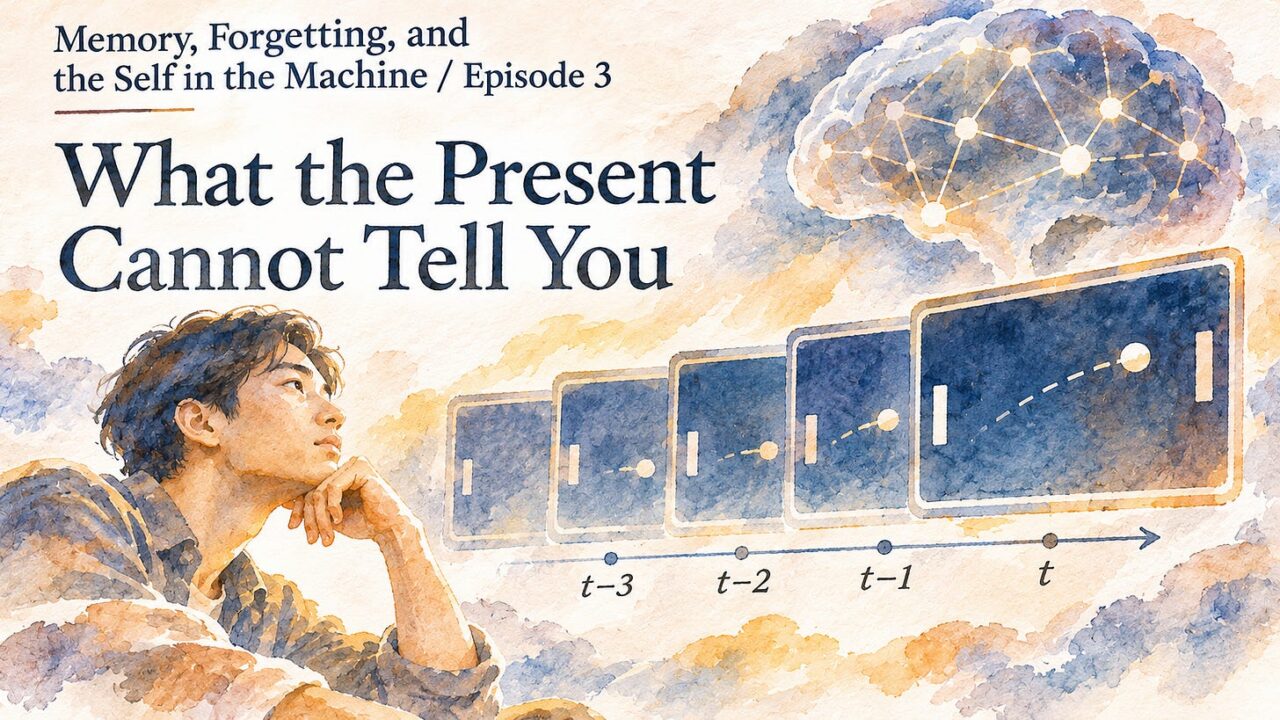
The issue is not new. In 2015, researchers Matthew Hausknecht and Peter Stone highlighted the problem in the context of Atari games. A single frame of Pong reveals only the positions of the paddles and ball, not the ball’s velocity. Without knowing the direction of travel, an agent cannot decide where to move its paddle. The observation is not the state—and the gap between them is where memory must intervene.
DeepMind’s DQN agent, which learned to play dozens of Atari games from raw pixels, faced this exact dilemma. The researchers acknowledged that many emulator states are “perceptually aliased”: two different situations can produce identical screens. The fix was simple but blunt: stack the last four frames as input. Motion became visible as a change in position, but the memory window was fixed. Anything beyond four frames was irretrievably lost.
The Hard Boundary of Context
This four-frame compromise exposes a deeper truth. Whether the window is four frames or four million tokens, any fixed context imposes a hard boundary. Information outside that boundary is physically erased. For today’s LLMs, the context window—now stretching to millions of tokens—is still a sliding window. It captures a summary of the past, but the selection of what to include is dictated by what the model needs to predict next. Details omitted from that summary can never inform future decisions.
The implications for autonomous agents are profound. In dynamic environments—trading floors, robotics, customer interactions—agents must compress their history into a state that is both compact and predictive. This is not merely an engineering challenge; it is a fundamental trade-off between memory and computation. As agents move from static knowledge retrieval to continuous interaction, the ability to distill the past into a useful state will determine their success.
Forward Outlook
Researchers are exploring solutions: recurrent architectures, external memory banks, and retrieval-augmented generation. Yet each approach faces the same constraint—finite resources. The goal is not to remember everything, but to remember what matters. In the crypto world, where AI agents are increasingly deployed for on-chain analysis and trading, this limitation is particularly acute. An agent that cannot recall the market conditions of the past hour is like a Pong player blind to the ball’s direction. Bridging the gap between observation and state remains the key to building truly persistent, autonomous intelligence.