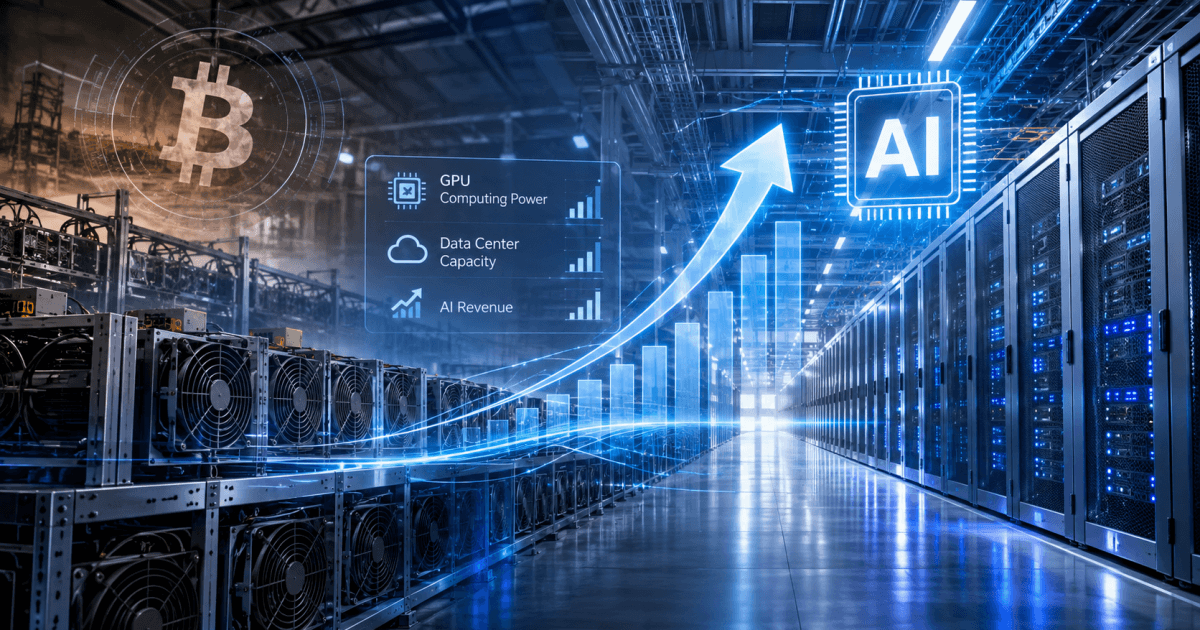
Bitcoin Miners Bet on AI as Mining Economics Tighten
As Bitcoin mining margins compress under the weight of coin price volatility, rising network hash rate, and stubborn electricity costs, a growing number of mining firms are repurposing their power contracts and data-center infrastructure for artificial intelligence workloads. The latest signal comes from IREN, which reported that AI cloud revenue reached $200 million in its most recent quarter—nearly 90% of total revenue—while Bitcoin mining revenue fell about 88% year-over-year. The revenue mix reversal marks a strategic shift from Bitcoin miner to AI infrastructure provider.
The Scale of the Pivot
IREN’s transformation is not merely a side experiment. The company disclosed a contracted backlog of $20.3 billion and an annualized revenue target exceeding $4 billion. Yet the same quarter showed a net loss of $263 million, highlighting the capital-intensive nature of the transition. Building and equipping data centers for GPU-dense AI workloads requires heavy upfront spending, and revenue recognition lags behind capital deployment.
Other miners are watching closely. Companies with large power interconnects—especially in Texas, the Pacific Northwest, and the Nordic region—are being valued increasingly on their potential as AI hosting providers rather than pure-play Bitcoin producers. The logic is straightforward: AI training and inference demand is surging, and grid-connected sites with existing cooling and security infrastructure are scarce.
Is This a New Profit Model or a Risk Transfer?
The critical question is whether the pivot creates durable earnings or simply shifts capital-intensive risk from one volatile sector to another. Bitcoin mining risk is tied to hash price and network difficulty; AI infrastructure risk is tied to GPU obsolescence, customer concentration, and the possibility of an AI capex slowdown. Both require continuous reinvestment.
- Upside: Long-term contracts with AI cloud customers can provide more predictable cash flows than spot mining economics.
- Downside: Heavy debt and equity financing needs, plus execution risk in a fast-moving technology cycle.
- Watch item: Whether IREN and peers can convert backlog into revenue before depreciation and financing costs erode margins.
Forward Look
The miner-to-AI pivot is likely to accelerate as Bitcoin halving cycles compress block rewards and institutional capital demands diversified revenue. Success will depend on execution—specifically, securing anchor tenants, managing GPU supply chains, and maintaining power cost advantages. If IREN can demonstrate sustained positive operating leverage on its AI segment, the model could become a template for the sector. If not, the industry may learn that escaping mining volatility means embracing a different kind of capital cycle.