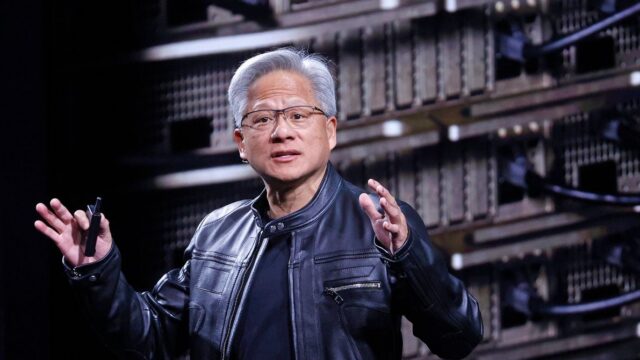
Nvidia’s Sudden Leadership Shakeup Rattles Markets
Nvidia shares fell 4.34% after the company announced a surprise leadership change, with CEO Jensen Huang stepping down effective immediately. The abrupt departure of the AI chip pioneer, who built Nvidia into a trillion-dollar juggernaut, left investors scrambling to assess the company’s succession plan and strategic direction. The news rippled across the semiconductor sector and broader equity markets, raising questions about the durability of the AI-driven rally that has powered Wall Street for much of the year.
Competitors Gain as Uncertainty Mounts
While Nvidia stumbled, rivals Advanced Micro Devices and Broadcom extended their winning streaks to five consecutive sessions, gaining 44% and 25% respectively over that period. The divergence underscores a rotation within the chip sector as investors hedge against Nvidia-specific risk. AMD and Broadcom have been positioning themselves as alternative beneficiaries of the AI infrastructure buildout, and the leadership vacuum at Nvidia may accelerate market share shifts, particularly in data center accelerators and custom silicon.
The succession question looms large. Nvidia has not named a permanent replacement, and analysts warn that a prolonged search could hamper decision-making at a critical juncture. The company’s next-generation GPU roadmap and its ability to lock in hyperscaler contracts will be closely watched. Any sign of execution slippage could embolden competitors and give customers more leverage in pricing negotiations.
Bond Market Sends a Warning
Adding to the risk-off tone, a poorly received 30-year Treasury auction pushed yields up to 5.4388%, a level that threatens to tighten financial conditions across the economy. The weak demand suggests investors are demanding higher compensation for duration risk amid concerns about fiscal deficits and persistent inflation. The yield spike weighed on rate-sensitive sectors and contributed to gold’s slide below $3,900 an ounce, as higher real yields reduced the appeal of the non-yielding metal.
Meanwhile, the Federal Reserve’s rate-setting calendar is shrinking. The 2027 policy meetings have been reduced to seven, and the October meeting will no longer include a vote on rates, a procedural shift that could alter market expectations around the timing of policy moves. Traders are parsing whether this reflects a more streamlined approach or a signal of reduced flexibility.
Oil Rises, but Headwinds Persist
West Texas Intermediate crude rose 2.55%, bucking the broader risk-off mood as supply concerns resurfaced. However, the energy rally may be short-lived if global growth fears intensify. For equity investors, the combination of a leadership crisis at the market’s most important company, a shaky bond market, and mixed commodity signals paints a cautious picture.
Forward Look: Succession, Spreads, and Strategy
Nvidia’s board faces pressure to name a successor quickly and reassure partners and shareholders. The company’s AI moat remains deep, but leadership transitions at firms with such concentrated market influence are rarely smooth. Investors should watch for any acceleration in AMD’s data center traction and Broadcom’s custom ASIC wins as signs of a shifting competitive landscape. Meanwhile, the bond market’s message is clear: fiscal and inflation risks are not going away, and the path for rates may be more volatile than consensus expects. For crypto markets, higher long-end yields could keep risk appetite in check, particularly for high-beta tokens, though gold’s dip may eventually draw safe-haven flows back if volatility persists.