
TREE NEWS reports: If a person’s decade of work experience could be organized into a set of skills that an Agent can invoke, would that decade of accumulation become more valuable, or more easily replaced?
This question is closer to an individual’s real situation than “Will AI take away jobs?”
Of course, we want tools to help us accomplish more. But when tools begin to learn work methods, reuse judgment processes, and even advance tasks without the person’s involvement, beyond convenience, a new question arises: when a capability can operate without its owner, will the value still return to the owner along the original path?
Skills becoming easy to use and skill owners being able to benefit continuously are two separate things that need to hold true independently.
The discussion of “skill assets” begins from this gap.
In the past, the value of a skilled practitioner was usually realized through providing services in person. Completing a proposal, handling an exception, or delivering a project all require time. Experience improves work quality and increases the value per unit of time, but time still limits the scope of service.
Organizing experience into methods is an old path to break through this limitation. Textbooks, software, standard processes, and training systems all attempt to let individual capabilities transcend individual time. The new question brought by AI Agents is whether these methods can further participate in execution: from a document for people to read, to a capability that can be invoked by systems to advance tasks.
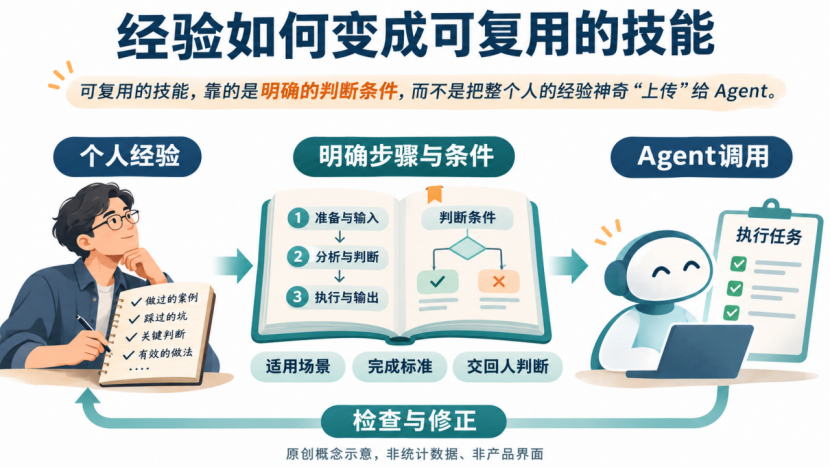
Here, a Skill can be understood as methods, rules, and ways of using tools organized around a specific task. It is not equal to saving a prompt, nor does it mean that all of a person’s experience can be fully loaded into a system. Its practical significance depends on what task it faces and which judgments can be explicitly expressed.
Consider a person familiar with procurement.
This practitioner’s experience might include how to compare quotes, how to identify delivery risks, and when to ask a supplier an additional question. Some of this can be organized into checklists, while other parts depend on specific context: the customer’s urgency, past cooperation records between the parties, or what a certain anomaly signal means.
If only “compare prices first, then judge delivery time” is recorded, the result may be a generic checklist. The truly useful part is often hidden in the conditions: under what circumstances the lowest price cannot be chosen, when missing information must lead to a pause, and which differences are worth handing back to a human for re-judgment.
Whether experience can be沉淀 into skills first depends on whether the conditions under which judgments occur can be clearly articulated.
This also explains why there is still a long distance between “knowing how to do it” and “being able to hand the capability to others for use.”
Skilled people often omit intermediate steps because these steps have become habits. But an Agent cannot automatically understand all unexpressed context from just a beautiful goal. Turning experience into reusable capability requires re-examining one’s own work: which parts are processes, which are judgments, and which are merely practices that happened to work.
This organizing process itself can create value. A person begins to be able to explain why they do things this way and can discover which steps are worth keeping and which need to be modified as the environment changes.
However, being invocable is not enough to prove that a skill has become an asset.
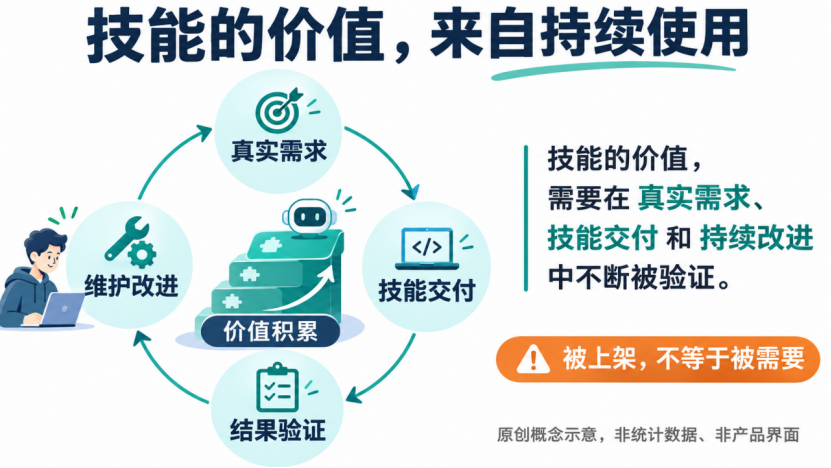
A process can run once but may not be suitable for repeated use. A method works in familiar scenarios, but with a different type of user or a different dataset, the results may differ. Calling it an asset requires further questions: who continuously needs it, how to know it is still effective, who maintains it when problems arise, and how contributions are recognized?
The word “asset” is attractive because it implies that accumulation can remain. But the value of an asset also needs demand and use to support it. Without actual tasks, even a complete capability catalog may just be a collection; without continuous maintenance, previously effective methods may gradually lose applicability.
Therefore, the value of a skill may include two levels.
One level is use value: can it help someone complete a job? The other level is the value of continuous accumulation: as it is used, fed back on, and improved, can it become more reliable and give contributors a reason to continue investing?
Between the two, a specific collaborative relationship is needed.
Users propose needs, developers organize capabilities, Agents participate in execution, and the platform undertakes tasks and records. If any link is missing, the entire chain may remain at the demonstration stage. Even if a task is completed, how to judge whether the result is qualified, how to handle failures, and how to identify the contributions of different participants still require clear rules.
This is also a step worth advancing when discussing Agents and skills at the Hangzhou event: when we say an Agent may participate in economic activities, are we discussing an execution capability, or have we already established the tasks, responsibilities, and distribution relationships around it?
The two cannot be equated merely by a name.
An Agent can participate in operations, but who sets the goal, who grants permissions, and who accepts the results all determine its actual position. “Economic subject” can serve as a direction for discussion, but the specific roles it undertakes still need to be developed within a collaborative structure.
Similarly, a set of skills can be repeatedly invoked, but whether contributors can continuously derive value from it also depends on arrangements beyond the capability itself. Whether invocation records are clear, whether someone is responsible for maintenance, and whether users are willing to choose it again all affect how far this accumulation can go.
In the introductory materials for ATM-related ClawCreek and RGST, one can see an attempt to address these issues: connecting the capabilities needed for Agent operation, the skill market, and task demands.
According to the approach described in the materials, the skill market provides invocable capabilities, the labor market connects tasks that need to be completed, and Agents participate in execution. RGST-related exploration further focuses on the usage results and value manifestation of skills.
What is worth discussing about this approach is that it attempts to create a continuous connection between “capability” and “demand.” The methods provided by developers need to encounter actual work; the results left by execution can then become the basis for judging whether the capability is useful.
If such connections can be continuously formed, skills have the opportunity to shift from one-time delivery tools to continuously maintained, repeatedly used capability accumulation. It may also leave room for different roles to participate: some develop, some provide scenarios, some help define tasks, and others are responsible for verifying results.
But the fact that a mechanism can be logically connected does not mean that the cycle in reality has been established.
The materials currently provided are not sufficient to prove that task demand can continue to grow, nor can they be used to judge the delivery quality of skills in different scenarios. How to distinguish effective capabilities from repetitive packaging, how to handle failed tasks, and how contribution records can be transformed into continuous cooperation all require actual operation and longer-term observation.
A skill being listed only means it has entered a position available for selection; whether it can be repeatedly selected is what relates to demand. A task being completed also requires further examination of completion standards, the degree of human participation, and usage costs. Only when these conditions are clearly explained can “skill assets” have content that can be discussed and verified.
For ordinary people, the significance of this change does not need to start with “Should I develop an Agent?”
Many people’s accumulation does not exist in the form of code.
Customer service knows where users are most likely to misunderstand rules, operations are familiar with how an event goes from registration to the venue, and finance staff understand which vouchers need to be checked for an expense. Whether this experience can help AI work needs to be tried item by item, but identifying problems, explaining processes, and judging results are themselves part of participation.
The difficulty is that people often underestimate what they are already familiar with. A problem that can be handled effortlessly every day seems too ordinary, seemingly not worth recording. It is only when handing over to a newcomer or trying to let AI assist that one discovers there are many unexpressed details.
Therefore, a realistic starting point is to choose a small task that you repeatedly complete, record its inputs, processing steps, qualified results, and when it must be handed back to a human for judgment.
For example, when organizing event materials, you can first clarify which information comes from a confirmed agenda and which is only a historical plan; which names must be checked against original documents and which missing items can be temporarily retained. The clearer these conditions are written, the clearer the space for tools to participate in the work.
Trying with a small number of cases first and then checking the results against the original approach is more meaningful than rushing to name and package the capability. If it truly reduces repetitive work and does not hide errors, then consider how to make it serve more scenarios.
In this process, what individuals need to accumulate also includes the ability to express their own experience.
When general tools can help more people complete basic operations, clearly explaining an industry’s problems, defining task completion standards, and identifying deviations in results are still worth investing in. The value of skills may also gradually become clear through these repeated explanations, verifications, and corrections.
On November 19, “RGST · Smart Fusion of All Things | Skill Era · Hangzhou Set Sail” will be held in Hangzhou for exchange.
For a series that continuously organizes cross-city dialogues, coming to Hangzhou again also means bringing new questions back to actual work and collaboration. Between enterprises, product teams, and communities, the same capability may be given different expectations: builders care about how to organize capabilities, users care about whether problems can be solved, and participants care about whether their contributions can remain.

At this event, SEEK will present “From Tool to Economic Subject: How AI Agents Reconstruct Web3’s Transactions, Collaboration, and Value Distribution”; Dr. Ding will share “Form-Giving Constraints: The Underlying Laws of AI Agents.” The two topics respectively provide entry points for discussing collaboration and value relationships, and capability and constraints. The specific viewpoints remain to be unfolded by the guests on site.
The roundtable on “Skills are both tools and assets—what should we do in the era of AI economic transformation?” will further ground the questions in practice:
Which experiences can be organized into reusable skills, and which judgments must retain understanding of specific contexts? When a capability can be invoked by multiple people, on what basis can contributors continuously retain their value? After an Agent participates in a task, who defines and accepts the delivery? How can a person without a development background verify whether their experience is truly useful to others?
These questions determine whether “skill assets” can become a way of accumulation with actual content.
Returning to the beginning, the fact that ten years of experience can be invoked by an Agent does not naturally mean increased value, nor does it necessarily mean the individual is replaced. The key lies in whether this experience is expressed more clearly, whether it serves real needs, and whether the owner can continue to participate in its improvement and use.
The first step worth taking is to clearly explain something you truly know how to do, and then see whether it can still help others do things well outside of yourself.