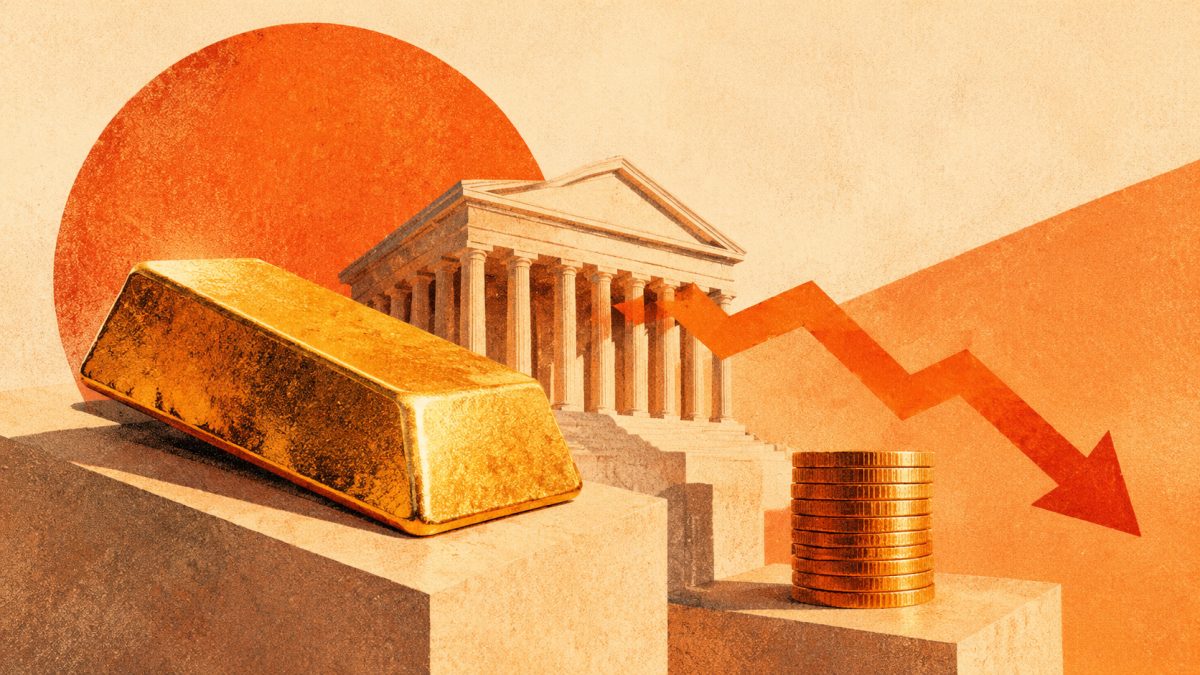
Gold’s Worst Year Since 2015: Why the Metal Is Losing to a 5% Treasury
TREE NEWS reports: Gold prices have tumbled to a one-year low, putting the metal on track for its worst annual performance since 2015. The catalyst: U.S. Treasury yields have surged past 5%, and futures markets now price a 95% probability of another Federal Reserve rate hike. In a world where risk-free government debt offers a real, inflation-beating return, the opportunity cost of holding a non-yielding asset like gold has become too high for many investors to stomach.
The News in Brief
The yellow metal’s decline accelerated as the 10-year Treasury yield breached the 5% threshold for the first time since 2007. Fed funds futures jumped to price a near-certain hike at the next policy meeting, with traders citing persistent inflation and a resilient labor market. Gold, which pays no coupon, has historically thrived in low-rate environments; the current regime has flipped that dynamic on its head.
Why Gold Is Losing the Battle
The mechanics are straightforward: when a risk-free asset yields 5%, the bar for holding a non-yielding store of value rises dramatically. Gold’s appeal rests on its role as a hedge against inflation, currency debasement, and geopolitical turmoil. But with short-term rates now offering a tangible return, institutional allocators are rotating toward Treasuries and money-market funds. The U.S. dollar’s strength, itself a function of higher rates, has added another headwind, making gold more expensive for foreign buyers.
Central banks, however, remain a notable exception. Official-sector buying has been robust, particularly from emerging-market institutions seeking to diversify reserves away from the dollar. That demand has provided a floor, but it has not been enough to offset the exodus from exchange-traded funds and speculative positioning. Retail investors in Asia have also stepped in, viewing the dip as a buying opportunity, though their purchases have been modest relative to institutional selling.
Implications for Crypto and RWA Markets
The gold-Treasury dynamic carries lessons for the digital-asset space. Bitcoin, often pitched as ‘digital gold,’ faces a similar headwind: higher real yields reduce the appeal of non-yielding assets. Yet crypto’s correlation with gold has been inconsistent, and Bitcoin’s recent resilience suggests its narrative is increasingly driven by ETF flows and halving-cycle expectations rather than pure rate sensitivity. For tokenized real-world assets, the story is different: platforms offering tokenized Treasuries are seeing inflows as investors seek on-chain exposure to the very yields that are hurting gold. The convergence of TradFi yields and DeFi rails is accelerating precisely because 5% is an attractive number, even in crypto.
Forward Outlook
Gold’s near-term trajectory hinges on the Fed’s next move. If the central bank signals a pause or a peak in rates, the metal could find relief. But until real yields meaningfully decline, gold will struggle to compete with guaranteed 5% returns. For crypto investors, the takeaway is clear: in a high-rate world, narratives about ‘store of value’ must contend with the simple arithmetic of opportunity cost. The assets that will thrive are those that offer either explicit yield or a compelling non-monetary utility. Gold’s pain is a reminder that macro regimes, not marketing, ultimately set the price of scarcity.