Inside the Prop Trading Boom: Tech Arms Race, Cheating Wars, and the On-Chain Future
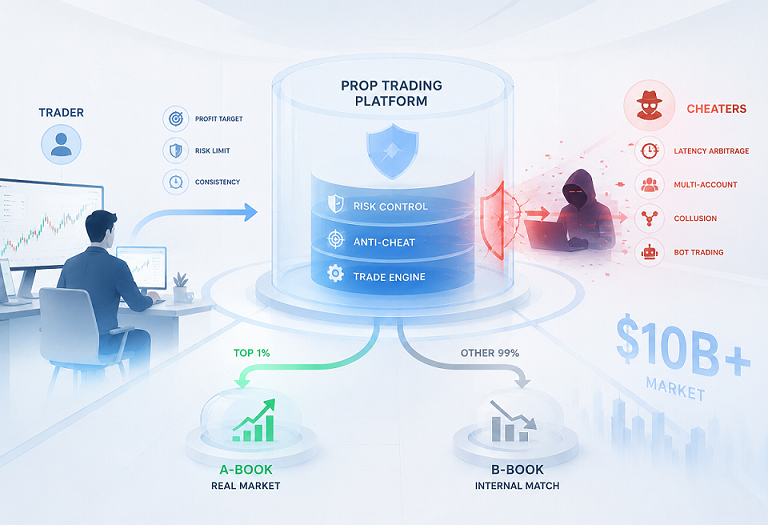
The proprietary trading (prop trading) sector has exploded into a billion-dollar arena, luring retail traders with the promise of “your skill, our capital.” But behind this seemingly win-win evaluation lies a sophisticated game of economic engineering. A deep dive reveals the mechanics: millisecond-level surveillance systems act as “smart exam rooms,” while black-hat operators deploy latency arbitrage and group hedging in an endless cat-and-mouse battle. The real revenue engine is the “fee economy” and internal B-book absorption, with only the top 1% of proven geniuses ever graduating to real market (A-book) flow.
Industry Analysis
This model thrives on a structural asymmetry. Platforms monetize the aspiration of traders, collecting exam fees while managing risk internally. The technology stack is the true moat: real-time risk monitoring, latency detection, and behavioral analytics are critical to filter out cheaters and identify genuine edge. However, the arms race is escalating. Coordinated syndicates use delayed data and cross-platform hedging to farm payouts, forcing platforms into a perpetual upgrade cycle. The economics are also shifting—regulatory pressure on B-book practices and the demand for transparency are pushing innovation toward on-chain prop trading, where smart contracts could automate payouts, immutably record performance, and even tokenize trader equity.
Forward-Looking Perspective
The future of prop trading lies in its on-chain evolution. By leveraging blockchain’s transparency, platforms can prove their risk models and payout fairness, attracting both top talent and institutional liquidity. Smart contracts could eliminate counterparty risk, while decentralized identities and verifiable track records would create a global, meritocratic trading floor. Yet, challenges remain: latency constraints of current L1s, regulatory clarity for tokenized profit shares, and the need to combat sophisticated collusion in a transparent yet pseudonymous environment. The platforms that master this transition will not just be examiners but architects of a new, trustless performance market.