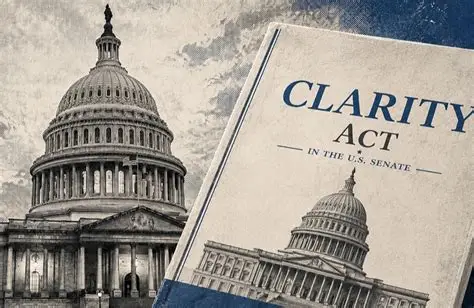
The CLARITY Act Fails to Advance — But the Story Is Bigger Than One Bill
The CLARITY Act, the most ambitious attempt yet to draw a clear line between digital commodities and securities in the United States, has failed to pass. For an industry that has spent years waiting for legislative certainty, the outcome is a genuine setback. But framing it as the start of a regulatory retreat would be a mistake. What is unfolding instead is a more complex phase of the game — one where the balance of power between Congress, the SEC, the CFTC, and the courts is being renegotiated in real time.
Why the Bill Stalled
CLARITY was never just a technical fix. It sought to assign jurisdiction over crypto assets, define when a token transitions from a security to a commodity, and give exchanges a workable registration path. That scope made it a magnet for competing interests:
- Industry infighting: Centralized exchanges, DeFi protocols, and token issuers each wanted different rules, and their lobbying never converged.
- Regulatory turf: The SEC and CFTC both saw their authority at stake, and neither wanted to cede ground without a fight.
- Political timing: An election cycle made lawmakers reluctant to hand opponents a ready-made attack line on crypto.
The result is a bill that satisfied no single bloc enough to push it over the finish line.
What Actually Changes
Nothing about the underlying market structure changes overnight. Enforcement-driven regulation remains the default. That means:
- Token issuers still face case-by-case uncertainty on whether their assets are securities.
- Exchanges continue to operate under a patchwork of state and federal expectations.
- DeFi protocols remain exposed to the argument that they are unregistered broker-dealers or exchanges.
But the failure also accelerates a shift that was already underway: market participants are pricing in regulatory risk through legal structuring, offshore entities, and compliance-heavy product design rather than waiting for Congress.
The Deeper Game
The real signal is not that CLARITY died — it is that the legislative path is now harder than the judicial and administrative paths. Court rulings have started to constrain the SEC’s more expansive theories, while the CFTC has quietly expanded its footprint in derivatives and prediction markets. In that environment, a stalled bill is less a defeat than a redirection of energy.
For founders, the practical takeaway is unchanged: build assuming enforcement risk, document compliance decisions, and avoid structures that depend on a single regulator’s goodwill. For investors, the takeaway is that U.S. crypto policy will remain volatile and headline-driven — a source of both risk and opportunity — until a durable statutory framework emerges.
The CLARITY Act did not fail because the idea was wrong. It stalled because the fight over who gets to write the rules is only now entering its most contested stage.