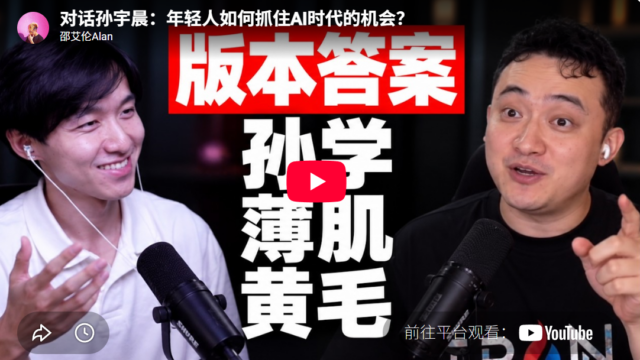
TREE NEWS reports: Why would someone who already has vast wealth still want to go to work?
In a conversation with Allen Shao lasting over four hours, Justin Sun mentioned that he wants to work at a top AI company. According to his explanation, the reason isn’t the salary: he has long viewed companies from the perspective of an entrepreneur and boss, but lacks firsthand experience of working inside another company.
This point is more worth pondering than the grand judgments about wealth and the future in the interview.
Many people want to make money so they can finally stop working. He, however, explains why after becoming wealthy, he still needs to enter an environment he is unfamiliar with.
Money can buy many things, but it cannot buy a perspective that one has not yet acquired.
The interview ranges from fitness to AI, from career choices to financial freedom, and finally back to life experience. The topics seem scattered, but behind them the same question repeatedly emerges:
When the world keeps changing, how can a person avoid being trapped by their own past experience?
For ordinary people, this may be more useful than “where is the next big trend?”
01 Where AI Is Truly Useful Is Hidden in the Unremarkable Everyday
At the beginning of the interview, Justin Sun talked about his approach to health management.
He records diet, training, and sleep, hands the information to AI to organize, and then adjusts based on the feedback. He also mentioned keeping records in his own documents, making them easy to use continuously and to continue processing after switching tools.
The most noteworthy thing here is not which model he uses, but what he keeps.
Most people still use AI in an ad-hoc question-and-answer way:
Today they ask how to improve efficiency, tomorrow how to improve life. Each time they get a seemingly good suggestion, but a few days later they return to their original state.
The problem often lies in the fact that the suggestion lacks real context and has no follow-up results.
You say your work efficiency is low, but is it because there are too many tasks, unclear goals, or constant interruptions from messages? You say you want to change careers, but what have you already tried, which skills are transferable, and which constraints cannot be changed for now?
If this information is not recorded, AI can only give a generic answer around a vague question.
A continuously updated real record is closer to the starting point of changing your life than a hundred vague questions.
Applying this method to work is equally valid.
Writers can save topics, first drafts, reasons for revisions, and reader feedback; salespeople can organize customer questions, deal obstacles, and follow-up results; people seeking a new career can record job requirements, interview feedback, and their own skill gaps.
Over time, you don’t just get a database; you can also see recurring patterns:
Which problems always slow you down? Which practices actually work? Have the things you always thought were important really produced results?
AI can help organize and analyze this information, but it won’t automatically complete the change for you. What truly makes a difference is the continuous process between recording, trying, feedback, and adjusting.
Ordinary people don’t need to start with “AI-ify your entire life.” Choose one specific, recurring problem that troubles you, and let this process run first—that alone is meaningful.
Figure 1 Recording and Feedback
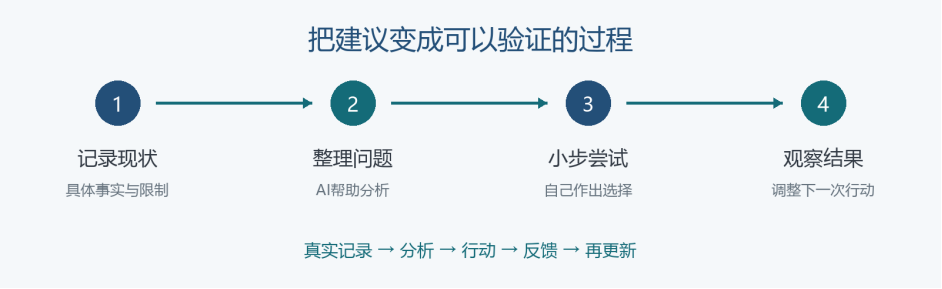
Start with a specific problem, and let each attempt provide information for the next judgment. The illustration is an original conceptual diagram for this article, not an original interview image or statistical data.
02 One Step Before Hard Work Is Seeing Clearly What Problem You Are Solving
A very vivid phrase in the interview is “scouting the map.”
Justin Sun used strategy games as a metaphor: some people immediately frantically build troops at their base, while others first send out scouting units to see where resources are and what the opponent is doing, and then decide how to invest.
In reality, we can easily become the former type.
Want to change careers? Sign up for a course first. Want to start a business? Rent a space and build a product first. Want to do independent media? Imitate popular accounts first and post dozens of pieces of content in a row.
Action is fast, investment is heavy, but an earlier question has not been answered:
What demand actually exists here? Who will pay time or money for it? Why am I qualified to do it better?
Hard work can increase the speed of action, but it cannot confirm the direction for you.
The value of “scouting the map” lies in making investment happen after a fuller understanding.
Suppose you want to enter a new industry. Instead of rushing to buy a “masterclass,” first read a batch of real job postings to see what companies actually need; talk to a few practitioners to understand the most time-consuming and difficult things in the work; then do a small project to test whether you are suited to it.
AI can help you organize materials, compare paths, and prepare questions. But when it comes to income, market size, and industry prospects, you still need to return to original sources and real scenarios.
Otherwise, the map may look complete, but you don’t know which roads in it don’t exist at all.
Of course, scouting the map has its boundaries.
You can’t wait until all information is complete before you start living. Constant research can also become a more respectable form of procrastination.
A better rhythm is: for high-cost, hard-to-reverse decisions, do more investigation; for low-cost, correctable attempts, act as early as possible.
Understand first, then validate in small steps. Let the next judgment be built on the information gained from this action.
In this way, investigation and action push each other forward instead of replacing each other.
Figure 2 Scouting the Map and Validation
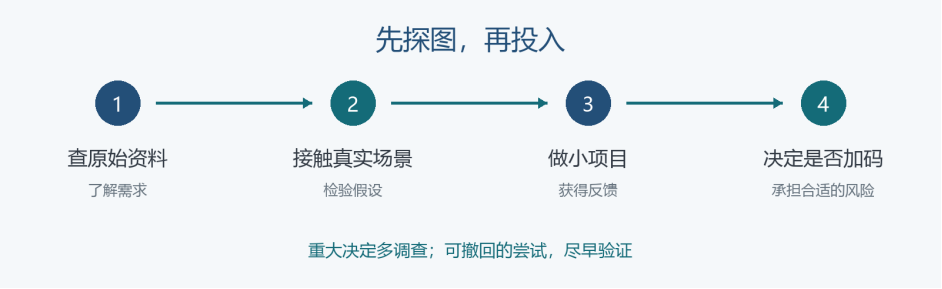
Materials, interviews, and small projects complement each other, and investment gradually increases with evidence. The illustration is an original conceptual diagram for this article, not an original interview image or statistical data.
03 So-Called Freedom Must Come Down to What Choices You Still Have
In the interview, Justin Sun once again explained his understanding of financial freedom: freedom first, wealth second.
This sentence can easily be turned into an inspirational quote, and can easily be misunderstood as “as long as you figure it out, you can have money.”
But in ordinary people’s lives, there is rent, children, parents, and income that cannot be easily interrupted. Cognition cannot change all real constraints.
More worth learning from is another concept he discussed at the same time: mobility.
He used “following water and grass to live” to describe his own choices—wherever one can better realize value, consider going there.
This does not mean everyone should quit their job, move, or reject marriage and buying a home. For different people, family, stability, and long-term relationships may themselves be important values.
The question is: when making a decision, do we see the opportunities it will bring, as well as the choices it will close off?
A well-paying job may allow you to accumulate abilities, or it may gradually make you lose the habit of engaging with the external market. A seemingly respectable consumption may improve your life, or it may increase ongoing expenses and make it harder for you to withstand career changes.
The cost of a decision includes not only the money paid out, but also the possibilities you give up because of it.
For ordinary people, increasing choice often starts from very small places:
Keep expenses within what you can afford; continuously maintain a skill that can be taken elsewhere; build connections outside of work; occasionally test whether your skills are still in demand in the market.
These things are not as exciting as “turning the game around,” but they will play a role when change comes.
You may not leave your current life immediately, but knowing you still have other paths will affect how you negotiate terms, how you face loss, and whether you are willing to try.
Freedom thus has a more concrete meaning:
You can seriously choose to stay, and you also have the ability to leave when necessary.
Figure 3 Preserving Optionality
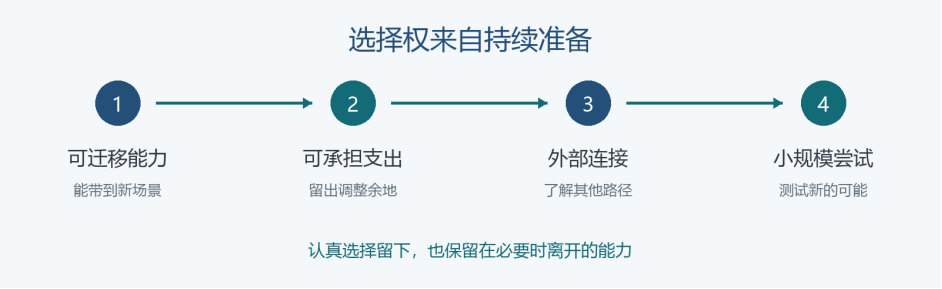
Abilities, expenses, connections, and experiments together affect room for adjustment; it does not mean everyone needs to leave their current life. The illustration is an original conceptual diagram for this article, not an original interview image or statistical data.
04 The Hardest Update Is Admitting That the Methods You Are Familiar With Are No Longer Enough
In the interview, Justin Sun and Allen Shao repeatedly talked about the “small self,” that is, minimizing self-defense and being willing to accept new information.
This point is especially worth placing before “cognitive upgrading.”
Because exposure to new knowledge is usually not difficult; what is difficult is allowing it to change you.
Someone who has done traditional business for many years may think AI-generated things are not professional enough; someone who previously earned returns through a certain experience may interpret new changes as temporary noise; someone who has long been good at something may be unwilling to go through the clumsiness of a beginner again.
These reactions are normal.
Past experience helped us build abilities, and also built identity. Admitting that a new method is more effective sometimes feels like admitting that what you were once proud of is no longer so scarce.
But the environment will not stop changing just because we are uncomfortable.
Past achievements prove that you once adapted to an environment; future performance depends on whether you are willing to learn again.
This also reminds us that when reading interviews with successful people, we should retain our own judgment.
A person’s business achievements do not mean his understanding of medicine, scientific research, or family relationships is equally reliable. You can seriously learn his method of observation while also checking his specific claims.
Similarly, using AI requires this attitude.
In the interview, Justin Sun expressed a high degree of trust in AI. But for ordinary people, a more practical approach is to let AI help propose options, find loopholes, and organize evidence, while you bear the final judgment yourself.
Especially in health, investment, and major life choices, a fluent answer cannot replace professional evidence.
True openness is being willing to let evidence change you. It includes both accepting new tools and promptly adjusting after discovering that a tool has made mistakes.
The ability to update must ultimately be reflected in behavior.
Knowing that a method is good and actually doing something differently next time are still a long way apart.
Figure 4 From Learning to Action
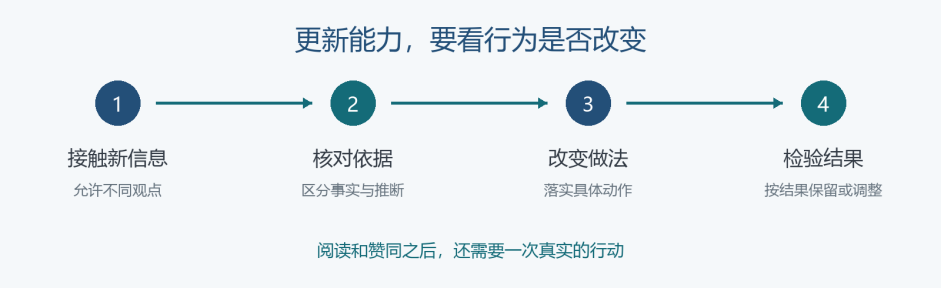
Turn new information into practice, then use actual results to judge whether it is worth keeping. The illustration is an original conceptual diagram for this article, not an original interview image or statistical data.
05 Why Did a Conversation About Opportunities End Up Talking About the Body?
The interview spent a considerable amount of time discussing fitness and health.
Some of the numbers about lifespan and definitive judgments about training results should not be taken directly as medical conclusions. But there is a layer of meaning worth bringing back into ordinary people’s lives:
We always treat the body as a tool for achieving goals, but rarely count it as part of the goal itself.
To increase income, stay up late for a long time; to avoid missing messages, attention is constantly interrupted; for the sake of future life, continuously overdraw the present state.
Then we expect to make it all back at once after reaching some income threshold.
The problem is, even if the opportunity arrives, you need to be in good enough condition to recognize it, bear it, and keep completing it.
A person’s usable time cannot be calculated only in hours; it also depends on how much energy in those hours can truly be invested.
This is also why the body deserves to be included in long-term plans.
It is not about requiring everyone to pursue the same physique, nor is it saying fitness can guarantee longevity. Rather, it is about starting to take seriously the habits that continuously affect quality of life: sleep, activity, diet, as well as the professional examinations and treatments that should be accepted.
Income is an easily visible result, but condition determines how we use that result.
Having more money while finding it increasingly difficult to concentrate, enjoy relationships, and try new things is not the life most people originally wanted.
The meaning of health management lies precisely here: to give the choices you have fought for a chance to actually be used.
06 Don’t Live Life as an Infinitely Postponed Payoff Day
In the latter half of the interview, the topic shifted from how to obtain wealth to how to live after obtaining it.
Justin Sun described himself as a player still exploring. He did not give a final answer to the meaning of life, but emphasized experience and understanding the world from different perspectives.
This echoes the earlier “entrepreneur who wants to go to work.”
Many people’s lives have a payoff day that has not yet arrived:
Wait until I’ve earned enough money, then do what I like; wait until I’m not busy, then take care of my health; wait until I’m ready, then try a new direction; wait until I’ve thought it through completely, then decide how to live.
But some answers can only be obtained through action.
If you have never done a real job, it is hard to know from a description alone whether you like it; if you have never served a specific customer, it is hard to understand so-called market demand; if you have never continuously created something, it is hard to judge whether you are willing to turn it into a long-term career.
Information can help you get closer to a scenario; experience will tell you how it feels to be in it.
Part of life’s direction is walked out.
But experience does not have to be expensive, and there is even less need to imitate others’ paths.
Doing a small project, seriously interviewing someone from an unfamiliar industry, learning a new skill, or trying to publicly express your judgment can all bring new understanding.
At the end of the interview, Justin Sun also talked about the need to balance creation and consumption. He did not ask people to work all the time, and acknowledged that rest and enjoyment can help recovery.
For ordinary people, a question worth asking is:
In the past period, besides having seen many things and agreed with many views, what have I left behind?
An article, a piece of work, a service, a validated method—even if small—will give you feedback from reality.
It may not succeed, but it will leave experience that can be used again next time.
In Closing: Turn an Interview into a Real Change
After reading a conversation of over four hours, there is no need to accept every judgment of Justin Sun, nor to copy his life.
What is more worth taking away are several methods that can be verified on yourself:
Record real problems, so that advice has context; before making important decisions, understand the choices first; leave some room for trying new directions; when facts change, allow your methods to change accordingly.
If you want to start today, you can do just one thing.
Choose a problem that repeatedly troubles you and write it clearly: what is the current situation, what have you already tried, what limitations exist, and what kind of improvement you hope to see.
Let AI help you organize a few options, verify the important evidence among them, and then choose one action with controllable cost to do.
After some time, come back and record the result.
This step will not guarantee wealth, nor will it immediately solve life. But it can turn “I understood” into “I made a change.”
One ability ordinary people are worth accumulating is continuously turning new information into better next actions.
When this ability gradually takes shape, an interview, a book, or a new tool will not bring only short-lived excitement.
They will enter your life and leave traces.
This article is based on “Allen Shao × Justin Sun Four-Hour Podcast Transcript,” with a conversation length of about 4 hours and 22 minutes. The extended analysis of action methods for ordinary people in the article is the author’s interpretation, not the guest’s verbatim words.