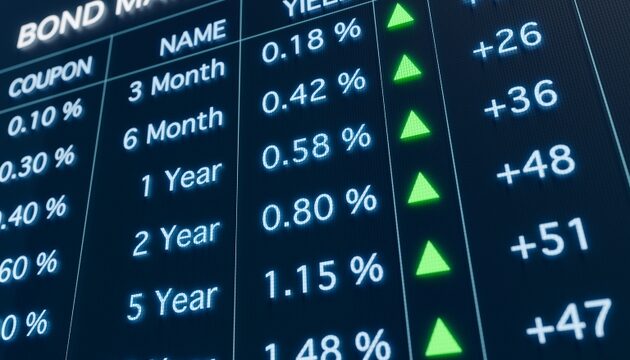
US Treasury Yields Break 5%: The Second Stage of the Debt Crisis Begins
US Treasury yields have punched through the 5% mark following their largest single-day drop in roughly 18 months, a violent swing that is forcing a fundamental repricing of global capital costs. The move signals that the market is no longer treating the long end of the curve as a safe harbor, but as a source of volatility in its own right.
A Regime Change in Global Capital Costs
The breach of 5% on the long bond is more than a headline number. It resets the risk-free rate that underpins every discounted cash flow model, every corporate borrowing decision, and every emerging-market sovereign’s refinancing plan. When the anchor of global finance moves this fast, the transmission is immediate and uneven.
- Emerging markets: Dollar-denominated debt service costs climb, pressuring currencies and forcing central banks into defensive rate hikes.
- Equities: Analysts now flag a potential “crash threshold” in the 5.5%–6.0% range, where the equity risk premium collapses and valuation support gives way.
- Credit: Corporate refinancing walls become more expensive precisely as growth slows.
Why the “Second Stage” Matters
The first stage of the debt crisis was about supply — who buys all this issuance. The second stage, now unfolding, is about price discovery under stress. Rapid moves in yields, rather than high absolute levels, are what destabilize markets. Goldman Sachs has warned that if volatility accelerates too quickly, equity markets will be forced to pay close attention, because disorderly rate moves break the mechanical relationships that portfolios rely on.
Implications for Digital Assets
For crypto and real-world-asset (RWA) markets, a 5%+ risk-free rate is a double-edged sword. Tokenized Treasury products become far more attractive as a yield-bearing on-chain primitive, accelerating the convergence of TradFi and DeFi. At the same time, higher discount rates compress speculative appetite, pressuring long-duration crypto assets and leveraged DeFi positions. Stablecoin yields and money-market tokenization stand to benefit most as capital seeks safety with on-chain liquidity.
Forward-Looking Perspective
The key question is not whether yields are high, but how fast they move. If the 10-year and 30-year settle into a 5%–5.5% band, markets can adapt. If they lurch toward 6%, the equity “crash threshold” becomes live, and the resulting risk-off wave will test crypto’s correlation to macro. Investors should watch the pace of change, not just the level — and position for a world where the risk-free rate is no longer free of risk.