Aave V4 Brings Tokenized Equities into DeFi Lending
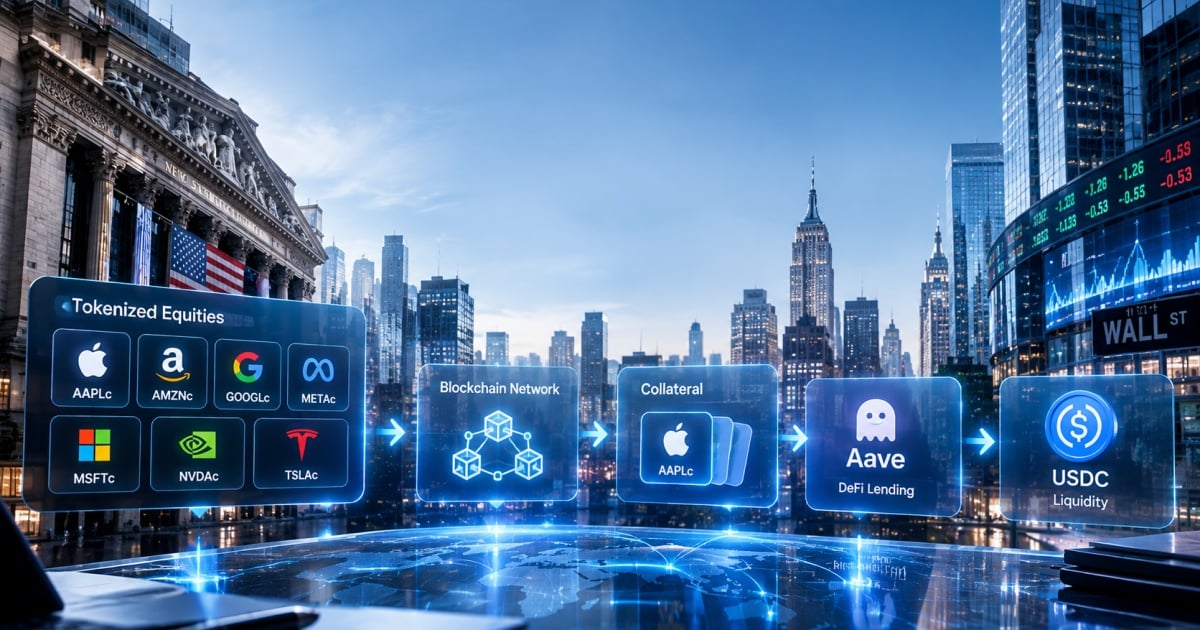
On September 25, Aave V4 launched its Equities Hub on Base, allowing eligible non-U.S. users to use seven tokenized U.S. stocks issued by Coinbase as collateral to borrow USDC. The assets include Apple, Amazon, Alphabet, Meta, Microsoft, Nvidia, and Tesla. This marks the first time these equities enter a mainstream lending protocol in a manner closer to native DeFi assets.
From Tokenization to Composability
The significance is not simply that U.S. stocks can be represented on-chain. The real shift is that tokenized equities are now treated as financial assets that can be further composed. By serving as collateral, they move beyond static representation and become productive within DeFi. This enables holders to access liquidity without selling their equity exposure, unlocking new capital efficiency.
Coinbase’s tokenized stocks provide the regulated wrapper, while Aave supplies the permissionless lending infrastructure. The Base network offers low-cost settlement. Together, they create a bridge between traditional equity markets and decentralized finance. For non-U.S. users, this opens access to dollar liquidity against tech-heavy portfolios, a service previously confined to prime brokerage clients.
Implications for DeFi and TradFi Convergence
- Collateral diversification: DeFi lending has long relied on crypto-native collateral. Tokenized equities introduce assets with different risk profiles, potentially reducing systemic correlation.
- Regulatory tightrope: By restricting access to non-U.S. users, Aave and Coinbase navigate securities laws carefully. The geographic limitation underscores the compliance challenges of tokenized securities.
- Market structure evolution: If successful, this model could expand to ETFs, bonds, and other traditional assets, further blurring the line between TradFi and DeFi.
However, risks remain. Tokenized stocks depend on custodial arrangements and may face liquidity constraints during market stress. Oracle pricing for equities outside trading hours is another challenge. Aave’s risk parameters will be critical in managing volatility.
Forward-Looking Perspective
The Equities Hub is a proof of concept for a broader trend: the financialization of tokenized real-world assets. As regulatory clarity improves, expect more protocols to accept tokenized securities as collateral. This could lead to a parallel lending market where traditional assets and crypto assets coexist, offering users unprecedented flexibility. The key question is whether demand for leveraged equity exposure will drive adoption, or whether compliance burdens will keep it niche. Either way, the composability of tokenized stocks is no longer theoretical—it is live on-chain.