
TREE NEWS reports: During the five-day itinerary, there is a moment worth thinking about in advance: on October 30, everyone checks out, packs their luggage, and prepares for the return trip.
The sharing has ended, the island has been explored, and some names have been added to the contacts list. People will return to their respective work, products, and lives.
What happens next?
Some conversations may continue, some ideas may move to the next step, and some relationships may remain in group photos and chat groups. These are all possible outcomes of a gathering.
From October 26 to 30, 2026, Tree News × ATM will hold a five-day itinerary on Jeju Island. As we discuss the meaning of “connection” for this gathering, it is worth looking ahead to after the return trip:
When the shared time ends, what makes a relationship still worth continuing?
This question concerns an event, and also concerns digital products that are trying to connect people with people, and people with agents.
I. Gatherings can be arranged, but relationships need reasons to continue
An event can arrange sharing, meals, and sightseeing, but it is difficult to arrange whether two people will still contact each other in the future.
Because meeting solves the opportunity for contact, but continuous contact still needs new reasons.
The product you are working on happens to need the other person’s experience; a question raised by the other person makes you re-understand users; a discussion that is not yet complete requires both parties to bring more materials. Relationships gain the possibility of happening next time in these specific matters.
This also explains why some people meet only once but can collaborate for a long time; some group chats are lively every day, but when it is really time to push something forward, it is still difficult to find the right person.
The density of relationships and the density of messages do not necessarily grow in sync.
For a product that emphasizes connection, this distinction is especially important. The action of establishing relationships can be simplified, and the matching scope can be expanded, but participants will still ask: Why do I need this connection, and what has it helped me accomplish?
A useful answer may be very small.
Next time you encounter a certain type of problem, you know who to ask; when you have an early idea, you can find someone willing to give specific feedback; when preparing to start cooperation, you no longer need to explain your capabilities and limitations from scratch.
When connections begin to accumulate value, it often shows up as a little less repetition and a little more certainty in the next task.
The five days on Jeju Island can provide time for this accumulation. Whether the accumulation can continue depends on whether, after the shared experience, there are still things both parties are willing to invest in.
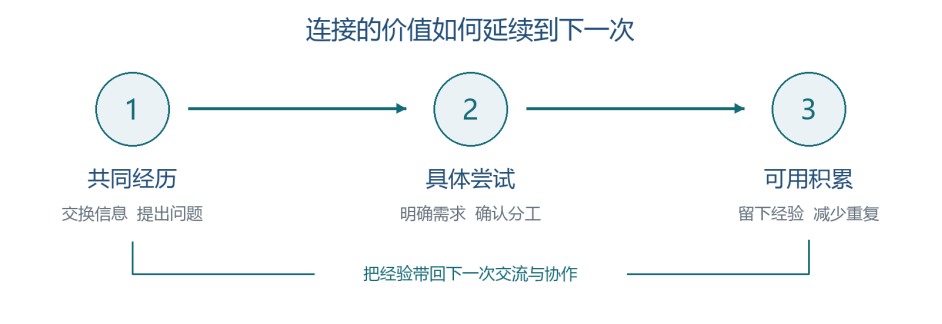
Figure 1: How shared experiences form reusable collaboration experience. This is an original conceptual illustration, not statistical data or a product interface.
II. Rewards make people willing to enter, but what makes them willing to stay?
When discussing communities and digital networks, it is hard to avoid incentives.
A system that has just started operating needs people to try, give feedback, and participate in building. Rewards can help participants take the first step and give opportunities for contact that would not have happened otherwise. This has its practical significance.
But rewards also change the way we understand user behavior.
A person frequently uses a product, possibly because the product helps him solve problems, or possibly mainly to obtain rewards. A community’s connections grow quickly, which may mean that the needs among members are increasing, or it may mean that some participation rule is attracting more people to complete specified actions.
These two situations sometimes look similar on the growth curve, but their subsequent trajectories may differ.
Therefore, to evaluate a connection mechanism, we must understand how it attracts participation, and also continue to ask: After participation, what valuable things do people get to keep?
According to the ATM project introduction, consensus connections and ATMRank constitute its core approach to organizing the network, measuring influence, and distributing rewards. It incorporates connections into rules, allowing relationships to enter a computable system.
The discussion brought by this design should not stop at how scores increase.
What is more worth observing is: Have participants met the right people because of this, obtained effective services, or produced collaborations that were originally difficult to complete? Can the activities in the network be transformed into value that participants can clearly perceive?
Rewards can explain why a person starts, but may not be enough to explain why he needs this product in the long term.
This cannot simply become the judgment that “only without rewards is it a real need.” Some participation inherently includes labor and cost, and reasonable incentives are part of the service.
What really needs to be distinguished is what the rewards are supporting: supporting a useful contribution, or mainly driving the next round of reward-claiming actions. The former has the opportunity to accumulate experience and services, while the latter needs to constantly find new reasons for participation.
Understanding this distinction requires observing specific behaviors and long-term results. It is difficult to draw conclusions by looking at popularity alone.
III. The value of a game should also be understood after the player closes the page
This Jeju Island itinerary includes a game project roadshow and related sharing, and the specific content is still being adjusted. This provides an easier entry point for the above questions.
Why do players open a game?
It could be curiosity, a friend’s invitation, attractive gameplay, or rewards. A product can have these motivations at the same time, and it is not necessary to require everyone to enter for the same reason.
The harder question comes later: Why do players come back?
Do they still want to complete the challenge they didn’t finish yesterday, are they willing to continue teaming up with friends, and have they developed an attachment to the characters and progress in the game? These details can help us understand what else besides rewards is supporting participation.
Suppose both games offer participation rewards. One game makes players repeatedly calculate input and return, while the other, in addition to rewards, also makes players willing to study gameplay, discuss strategies, and invite friends. Even if short-term activity levels are similar, the relationships they establish with users are different.
This is only a comparison scenario and cannot be used to judge a specific project. But it reminds us that when discussing the game ecosystem, we need to see both the economic rules and the user experience.
Mechanisms can affect how resources are generated, distributed, and consumed, while the game itself needs to answer: Why is the time players spend here worthwhile?
Communities have similar questions. After completing a task, is there more reusable experience? After participating in an exchange, do you understand a product better? After a round of activities, have new cooperation needs emerged among participants?
Healthy participation should have the opportunity to leave behind more than the number of participations.
This is also the part of project sharing that is worth expanding in depth: in addition to clearly explaining how the mechanism operates, it can also clearly explain why users care, and how the team plans to verify this care.
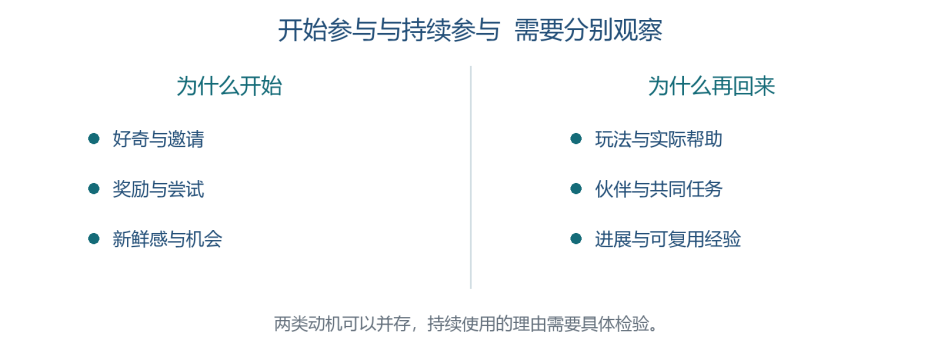
Figure 2: Distinguishing different motivations for initial participation and sustained participation. This is an original conceptual illustration, not statistical data or a product interface.
IV. When agents maintain connections for us, who decides the meaning of the connection?
Pushing this question further to AI Agents and Avatars will bring new complexity.
Imagine an agent that can help you organize contacts, filter invitations, respond to common questions, and remind you to follow up on unfinished discussions. It may indeed reduce the repetitive and trivial work in relationship maintenance.
But it also needs to know which relationships are worth continuing.
If the goal is set to “increase the number of connections,” it may continuously expand the contact list; if the goal is “increase response rate,” it may prioritize topics that are easy to get responses to; if the goal is “promote cooperation,” it needs to further understand your capabilities, time, and real needs.
Different goals lead to different behaviors.
The same is true for digital avatars. It can make expression more continuous and interaction more convenient, but the fact that a character can continue speaking does not mean it has accurately understood the commitments the person is willing to make.
For example, you want the agent to help find cooperation opportunities, but you may not allow it to agree to delivery times on your behalf; you are willing to let it organize communication records, but you may not be willing to let all records enter public evaluations.
Therefore, the discussion around agents needs to move from “how many actions it can complete” to “based on what does it judge that these actions are worth completing.”
There are still difficulties that need to be verified here. People’s goals may be vague and may change; an exchange that did not lead to cooperation may have long-term value; a match that looks very efficient may also ignore work styles that are difficult for both parties to be compatible with.
These things are difficult to compress into a single score.
The more tools can act for us, the more we need to clearly express our goals, permissions, and boundaries.
AI can help maintain connections and can also help discover opportunities. As for with whom and what we are willing to do, we still need to return to specific people and specific matters.
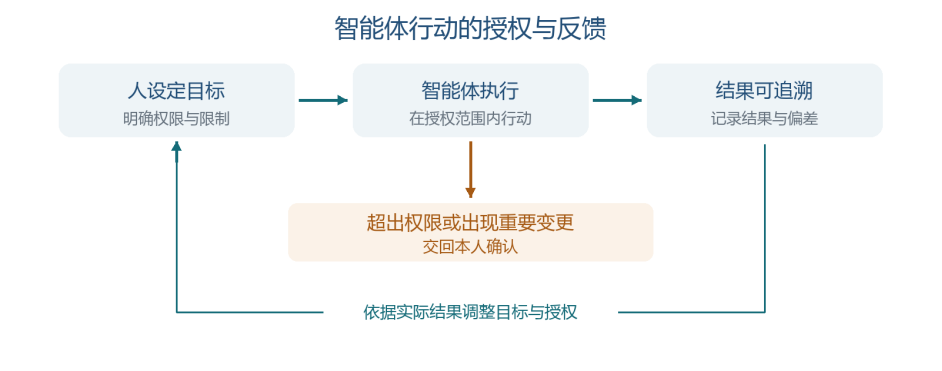
Figure 3: Agent actions require clear authorization and feedback. This is an original conceptual illustration, not statistical data or a product interface.
V. Living together for a few days can increase understanding, but judgment should also be retained
From this perspective, the significance of Jeju Island begins to become concrete.
According to the current arrangement, on the 27th there will be concentrated meetings and sharing, followed by island sightseeing and shared meals. Participants can continue conversations in different scenarios: questions that were not expanded on stage can be supplemented later; directions that sounded unfamiliar at first can also be gradually understood through repeated exchanges.
The same person may present different information when introducing a project, responding to follow-up questions, and discussing disagreements. The time spent together gives us the opportunity to look at this information together.
But familiarity also needs to be taken seriously.
A pleasant trip can make people more willing to communicate, but it cannot alone prove that a product is mature, the business logic is valid, or that cooperation has all the conditions. Goodwill toward a person and judgment of a specific commitment should each have their own basis.
This does not weaken the value of the gathering. On the contrary, when participants can freely raise questions and explain limitations, relationships have the opportunity to undertake real work.
Consensus can also get a concrete explanation here.
Everyone does not need to hold the same judgment on every direction, but can clarify: which facts have been confirmed, which content is still being explored; who will do what next, and how to communicate when changes occur.
The clearer the common rules, the more opportunities there are for disagreements to be handled.
An island allows people to temporarily have similar itineraries, but it will not erase different experiences and positions. The gains from gathering can come from recognition, and can also come from a well-founded correction.
VI. After five years, what will the next step rely on to continue?
“Five years of foundation, set sail from an island” puts time and departure together.
Accumulation is worth seeing. But for any team and community that continues to build, the past time must ultimately be transformed into today’s capabilities: whether they understand users better, whether they can identify problems better, and whether they know which experiences are worth keeping and which practices need adjustment.
Having gone through five years can bring experience, and should also make questions more specific.
From past activities to Jeju Island, from concentrated sharing to several days of getting along, Tree News and ATM are jointly creating an opportunity for exchange. What it can produce requires each participant to invest their own questions, experiences, and feedback.
We expect project teams to clearly explain progress and also clearly explain limitations; we expect community members to share feelings and also raise confusions; we expect an exchange to form the starting point for the next action.
If you are preparing to participate in this event, you can write down a real question you are currently facing in advance: whose experience you hope to hear, what evidence you need, and what specific thing you are willing to do to solve it.
When you return, see whether this question has become clearer.
Perhaps you have found someone worth continuing to communicate with, perhaps you have re-evaluated a product, or perhaps you have just clarified a path that is temporarily not suitable for you. These gains can all enter the next work and life.
What a gathering leaves behind only gradually emerges after each person returns to daily life.
October 26-30, Tree News × ATM, see you on Jeju Island.
We hope that after five days, what we bring back is both shared memories and one thing we are willing to continue advancing.
This article is based on the tentative schedule of this event and the ATM project introduction. Agent-related scenarios are deductions and do not represent that specific products already have corresponding functions; the agenda and sharing content are subject to final notice.