Meta’s AI Agent Gets a Real Job Title and Company Seal: A Marketing Experiment Goes Viral
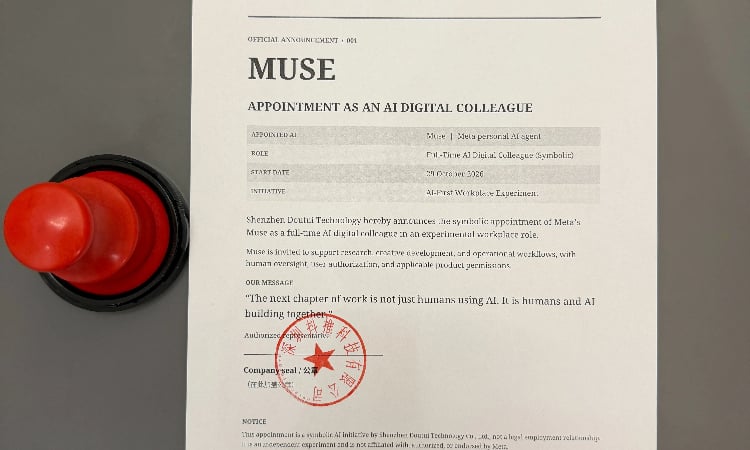
In an unusual blend of performance art and marketing, a content creator issued an official appointment letter—complete with a genuine company seal—to Meta’s AI Agent Muse. The stunt, which was posted on Douyin, garnered nearly 10,000 views and sparked a conversation about creativity in the AI era.
The Experiment: When AI Gets a Promotion
The creator, whose identity remains undisclosed, treated the AI agent as a new hire, complete with a formal letter of appointment and a real corporate stamp. The whimsical act was captured in a video that quickly resonated with audiences, highlighting the growing interplay between AI and human creativity.
While the appointment holds no legal weight, it symbolizes a broader trend: as AI agents become more integrated into business processes, the lines between human and machine roles are blurring. The experiment also serves as a commentary on the nature of work and recognition in an increasingly automated world.
Marketing Implications: Creativity as the New Currency
In a landscape where content production is increasingly automated and inexpensive, standing out requires more than just volume. The creator’s success underscores that novel ideas and the ability to execute them are becoming the scarce resources. This aligns with a growing sentiment in the marketing industry: as AI handles routine tasks, human creativity and strategic thinking become differentiators.
Moreover, the use of a physical seal adds a layer of authenticity and humor, leveraging traditional symbols of authority to make a point about AI’s place in the corporate hierarchy. It’s a reminder that even in digital spaces, tangible elements can create memorable experiences.
Industry Analysis: AI Agents in the Workplace
Meta’s Muse is part of a wave of AI agents designed to assist with tasks ranging from customer service to content creation. As these agents become more sophisticated, companies are exploring how to best integrate them into workflows. The appointment letter, though tongue-in-cheek, raises valid questions about accountability, role definition, and the future of human-AI collaboration.
From a marketing perspective, the experiment demonstrates the power of storytelling. By framing an AI agent as an employee, the creator humanized the technology and made it relatable. This approach could be adopted by brands looking to demystify AI and engage audiences in conversations about its impact.
Forward-Looking Perspective: The Future of Creative Marketing
As AI continues to evolve, expect to see more experiments that blend the digital and physical worlds. The success of this campaign suggests that audiences are receptive to playful, thought-provoking content that challenges conventional norms. For marketers, the takeaway is clear: in an age of abundant content, the most valuable asset is a unique idea brought to life with authenticity and wit.
Looking ahead, the intersection of AI and creativity will likely yield new forms of engagement, from AI-generated campaigns to interactive experiences. The key will be to maintain a human touch, ensuring that technology serves to amplify, rather than replace, human ingenuity.