
TREE NEWS reports: A skilled work capability often comes from long-term accumulation. How to judge a client’s needs, how to complete a piece of research, how to organize scattered information into useful content—these experiences are usually hidden in specific people and repeated practices.
If one day we could organize part of these experiences into skills that AI Agents can call upon, allowing them to repeatedly play a role in different tasks, how would the value of this capability change?
From using AI to complete work, to thinking about which experiences are worth consolidating into skills—this is the discussion we hope to unfold at this Hangzhou stop.
Following the Jeju Island stop, the exchange between Tree News and ATM will continue in Hangzhou. This event, themed “RGST · Intelligence Fusion” with the subtitle “Skill Era · Setting Sail in Hangzhou,” will bring together partners interested in AI applications, agent development, and the skill economy through ecosystem sharing, application demonstrations, roundtable discussions, and a networking dinner.
This time, we will further focus on Agents and skills: which real-world scenarios agents can enter, how a skill can form sustained value, and where ordinary people in the midst of the AI economic transformation can start participating.
The discussion will unfold from specific applications.
For users, understanding a technology often begins with their own questions: can a repetitive task be made less time-consuming, can a complex process get help, can a task that previously could only be done by oneself be broken down into parts that can be handed over to tools.
When these questions enter product design, the concerns of developers and users will also meet. The former needs to understand which capabilities are worth building, while the latter needs to judge whether these capabilities suit their work. The value of an application gradually becomes clear in this contrast.
According to the current schedule, Kevin will share the ATM ecosystem, Marissa will present related applications through ecosystem demonstrations and game sessions, and Mike will provide an interpretation around ClawCreek and RGST. Participants can move from the ecosystem introduction into specific experiences, and then, combined with their own needs, understand what problems the related explorations are trying to solve.
Watching demonstrations is also an opportunity to re-examine products with one’s own work experience. Which capabilities are worth further understanding, which steps still require human judgment, which ideas still need improvement before daily use—all these can become starting points for on-site exchange.
Moving forward from applications, the discussion will enter the development of Agents.
When we push AI’s role from providing answers further toward executing tasks around goals, we need to think about more things: how does it understand goals, how does it call appropriate capabilities, and how does it make execution results meet human expectations?
This is also an important reason why this event focuses on Agents. A tool being able to complete a certain step and an agent being able to organize multiple steps into a task involve different capability requirements. Understanding this difference helps us judge which work is suitable to hand over to Agents, and what kind of human participation needs to be retained.
And skills happen to connect capabilities and tasks.
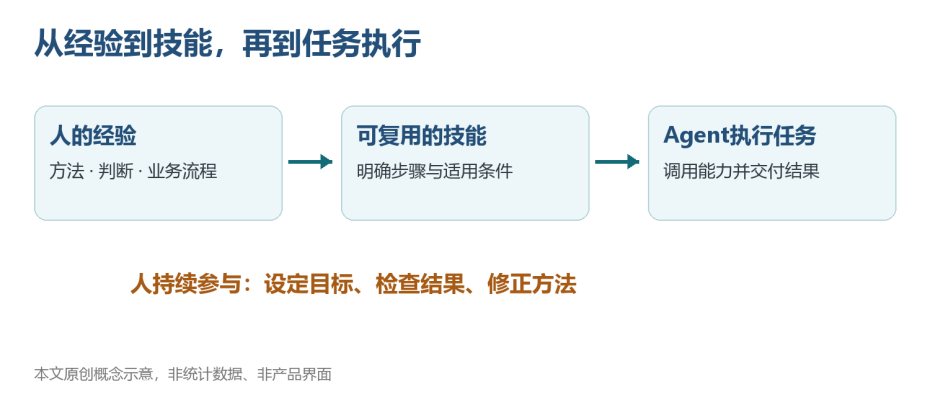
Figure 1: The relationship between experience, skills, and tasks. This is an original conceptual illustration, not statistical data or a product interface.
In this discussion, a Skill can be understood as a capability that Agents can call upon to help complete specific tasks. A skill may carry a certain work method, or it may organize experience, processes, and ways of using tools. Its meaning needs to be understood in the context of specific needs and actual use.
If such capabilities can be repeatedly called upon, personal experience has the opportunity to gain broader usage space. But moving from “can be used” to “worth continuously accumulating” still requires answering questions about demand, effectiveness, maintenance, and contribution.
Skills as assets—what is worth discussing is precisely this possibility of continuous accumulation: how experience can be preserved, how capabilities can be reused, and how contributions can be reflected in use.

Figure 2: Two perspectives on the value of skills. This is an original conceptual illustration, not statistical data or a product interface.
The afternoon roundtable will be themed “Skills are both tools and assets—what should we do in the era of AI economic transformation?” and will unfold along four levels.
First, starting from the application of AI in the industry, discuss what real needs deserve priority response; then, move into the development and future of Agents, understanding what roles agents may play in people’s work and lives; further discuss the significance of skills as assets, thinking about which capabilities are worth long-term accumulation; finally, return to the situation of ordinary people, seeking a position from which to start taking action.
Project builders will answer based on their own directions and practices, while external guests will provide complementary perspectives from industry experience and personal judgment. People in different positions exchanging around the same question can help the audience see both construction ideas and usage needs at the same time.
This discussion also hopes to respond to a real question: How can people without a development background participate in AI?
Beyond technical capabilities, familiarity with industry processes, understanding of user needs, and methods formed through long-term work can all become materials for exploration. The key is whether one can find a specific problem from one’s own experience, articulate it clearly, and then through attempts judge which parts can be completed with the help of AI.
Therefore, the last question of the roundtable will be left to action. We hope the suggestions given by the guests can help participants turn their attention into a small-scale attempt, giving their understanding of AI a concrete starting point.
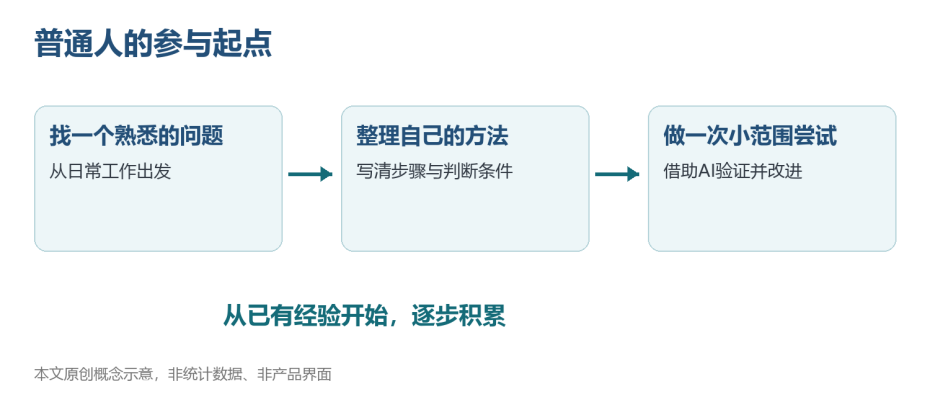
Figure 3: A small-scale attempt starting from one’s own experience. This is an original conceptual illustration, not statistical data or a product interface.
After the afternoon’s concentrated sharing, the dinner will leave a more relaxed space for exchange. Community partners will share experiences, and voluntarily registered performances will be interspersed. The viewpoints heard during the day, the questions arising from experiences, and the needs in each person’s work can all continue to unfold at the table.
For those encountering related directions for the first time, this is a time to learn about products and meet practitioners; for partners who have already started trying, it is also an opportunity to exchange experiences and find questions worth further research.
From Jeju Island to Hangzhou, the exchange will continue to deepen along new propositions. We look forward to hearing specific needs, different judgments, and feedback from practice here.
RGST · Intelligence Fusion, Skill Era · Setting Sail in Hangzhou.
If you are thinking about how AI can enter your work, want to further understand the relationship between Agents and skills, or hope to find a starting point for participation that suits you, welcome to join us in Hangzhou.