I. Payment Tools Behind a Glass Wall
TREE NEWS reports: Data from Bessemer Venture Partners shows that real stablecoin payment volume reached $400 billion in 2025, double the previous year, with about 60% occurring between businesses—covering supplier payments, employee salaries, and cross-border invoices. Stablecoins have become an everyday tool for enterprises, and enterprises naturally place great value on confidentiality.
Currently about 90% of USDT circulates on Tron and Ethereum, but every transfer on these two chains is public. Once an address is linked to a company—for example, because the company has deposited funds to an exchange or issued a public invoice—anyone can open a block explorer and trace all of its activity:
- Competitors can estimate how much the company pays in salaries each month and how many employees it has;
- Suppliers can see how much the company pays other suppliers and the price of each transaction;
- Anyone can see how much money remains in the company’s account and on which day each large expenditure occurred.
In traditional finance, bank statements are visible only to the bank and the customer; on a public blockchain, that statement is effectively disclosed to everyone.
II. What Workarounds Exist Today
To get around this problem, individuals and businesses have tried several approaches, but each comes at a cost:
- Mixers. Mixers pool funds from many users and then send them separately to new addresses, so outsiders cannot tell who paid whom. But for regulated companies, using mixers carries too much legal risk and is simply not viable. The most typical example is Tornado Cash: in August 2022, the U.S. Treasury Department added it to its sanctions list, a measure that was not lifted until March 2025 following a court ruling.
- Privacy coins. Monero and Zcash hide amounts and addresses at the protocol level, at the cost of uncertain exchange listing: OKX delisted Monero and Zcash in January 2024 (Zcash was relisted in November 2025), and Binance delisted Monero in February 2024. When it is uncertain whether an asset can even be traded on exchanges, it is hard for companies to use it to pay salaries—and privacy coins’ prices are not pegged to the dollar in the first place.
- Using a new address for every payment. New addresses make tracing harder, but far from impossible. On Ethereum and Tron, transferring USDT requires paying a small fee, and the fee can only be paid in that chain’s native coin: ETH on Ethereum, TRX on Tron. A new address that has just received USDT salary has no ETH or TRX, so the address owner must first transfer a small amount of native coin into it before the USDT can be sent out. This ETH or TRX usually comes from the owner’s own old address or from their exchange account. The transfer funding the fee remains on-chain forever, and anyone can see which address sent funds to the new address, thereby linking the two addresses. Even without such a transfer, chain-analysis firms can group addresses based on patterns: similar transaction times, matching amounts, and the same recipients.
These three approaches either try to hide data after it has already been made public, or they step outside the regulated financial system.
III. Transferring Stablecoins Privately on Bitcoin
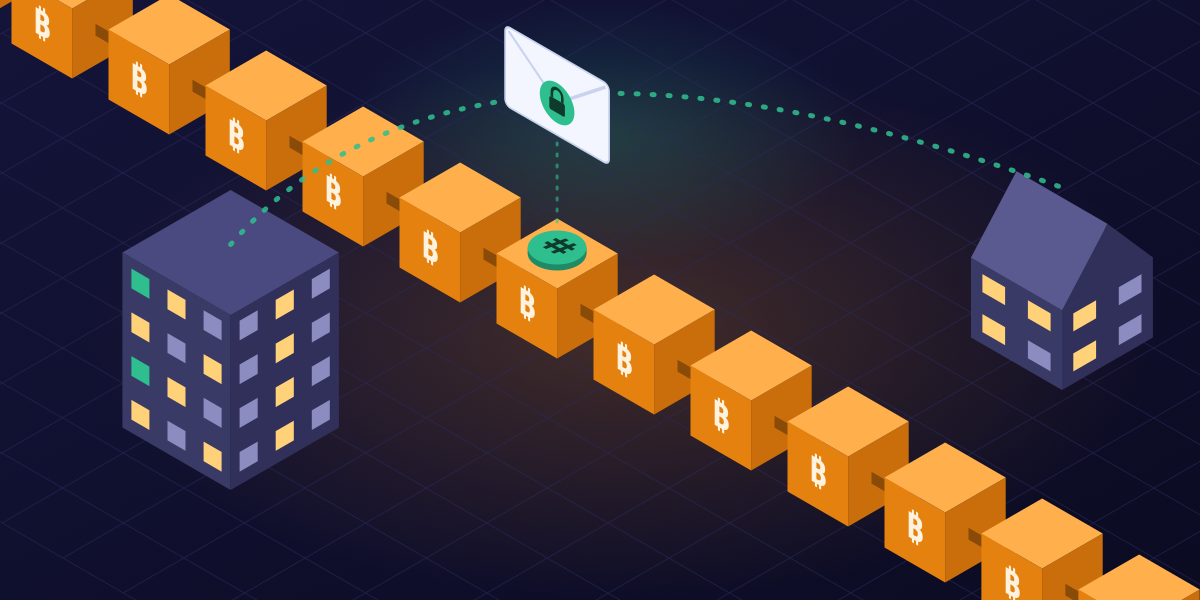
The client-side validation model used by the RGB protocol on Bitcoin offers a better approach. RGB supports issuing and transferring assets on Bitcoin, including stablecoins, and USDT on RGB has already been announced. Under client-side validation, transfer data never goes on-chain in the first place.
On a public blockchain, every node must verify and store every transaction, with amounts and recipient addresses visible to all.
Yet to verify a payment, the recipient does not actually need to know the entire chain’s history—only two things matter:
- The last transfer sent to them;
- The chain of transfers preceding that transfer.
Client-side validation starts from this point: each party verifies only the segment of history relevant to itself, and transfer data is passed only among the parties involved in the transfer, not disclosed publicly.
To leave a record of the transfer, this scheme writes only a commitment to the Bitcoin blockchain. The commitment is like a cryptographic “proof” of this data, just a few dozen bytes (some commitment schemes require no additional bytes at all). The recipient can check whether the data it received matches the commitment on Bitcoin, while everyone else sees only a string of bytes that reveals no information.
In practice, the sender hands the transfer data directly to the recipient. In the words of the RGB documentation: “Ideally, no one other than Bob and Alice holds the Consignment and the witness transaction.” So on a block explorer, it looks like an ordinary Bitcoin transaction—you cannot tell what asset it is, how much was transferred, or to whom.
For a company paying with USDT on RGB, a salary payment is known only to the company and the employee, and a supplier payment only to the buyer and seller.
IV. Without a Public Ledger, What About Compliance?
RGB gives asset transfers privacy—so what about compliance?
Banks, auditors, and regulators still need a way to verify the source of funds.
On RGB, this verification is delegated to the recipient. Each payment carries the full history of the asset: from issuance—the moment the asset was created—up to the most recent transfer. The recipient must first verify all of these records before accepting the payment.
At Origin Seoul 2026, Federico Tenga of the Bitfinex research and development team discussed what verifying asset history means for regulated companies.
Before accepting a transfer, a company can verify the source of funds itself or use a service provider to do so; if the source is problematic, it can simply refuse the payment. On Ethereum, funds enter a wallet directly whether the wallet owner wants it or not. Tenga noted that sanctioned entities sometimes exploit this loophole by deliberately sending small payments to a company just to get that company into trouble with sanctions screening.
RGB is different: no payment can enter an RGB wallet without the recipient’s consent, and the company can refuse at any time. In addition, the data for each transfer is stored by the company itself, and the company decides who can view payment records. The documentation notes that transfer details “can be selectively disclosed to different recipients.” That is, a company can give records to auditors or regulators while everyone else sees nothing.
V. What to Watch Out for When Using Stablecoins on Bitcoin
Before moving payments to RGB, companies should keep a few things in mind.
History travels with the asset. To verify a payment, each recipient must verify the asset’s full history, and therefore also sees previous transfers. Recipients can still protect themselves: by giving the sender a blinded UTXO, i.e., hiding the Bitcoin output where the funds will be held in the future. However, when those funds are later transferred to someone else, the next recipient will be able to see that output.
Keep your data safe. Proof of asset ownership is not on the blockchain but in the Stash—client-side data stored by the user. Backing up wallet data is as important as backing up private keys.
Issuer. USDT remains a token issued by a company and backed by its reserves. Client-side validation protects the data of each transfer, but the stablecoin issuer can still freeze funds, just as on any other chain.
VI. Conclusion
Stablecoins have become a payment tool for enterprises, and enterprises need the kind of confidentiality that bank statements provide. The workarounds on public chains either leave the regulated financial system or patch things up only after data has been made public. Client-side validation keeps data off-chain from the start while delegating compliance verification to the recipient.
USDT on RGB has been announced, but as of publication there is no official launch date. In my view, paying salaries and supplier invoices will be the first real-money test of this model.
Sources
Market data
- Bessemer Venture Partners, Stablecoins: from DeFi primitive to global financial infrastructure (April 2026): https://www.bvp.com/atlas/stablecoins-from-defi-primitive-to-global-financial-infrastructure
- DefiLlama, USDT supply by network (data as of October 2, 2026: Tron 50.2%, Ethereum 40.1%): https://defillama.com/stablecoins
Workarounds
- U.S. Treasury lifts sanctions on Tornado Cash, March 21, 2025 (Decrypt): https://decrypt.co/311103/us-treasury-lifts-sanctions-tornado-cash
- Binance delists Monero, announcement of February 6, 2024 (The Block): https://www.theblock.co/post/276176/binance-delisting-monero
- OKX delists Monero, Zcash, and Dash, January 5, 2024 (The Block): https://www.theblock.co/post/269613/okx-privacy-coins-delisting
- OKX relists Zcash, November 24, 2025 (MEXC News): https://www.mexc.com/news/183902
RGB
- RGB documentation, Client-side Validation: https://docs.rgb.info/distributed-computing-concepts/client-side-validation
- RGB documentation, Contract Transfers: https://docs.rgb.info/annexes/contract-transfers
- RGB documentation, State Transitions (Transition Bundle): https://docs.rgb.info/rgb-state-and-operations/state-transitions#transition-bundle
- RGB documentation, Components of a Contract Operation (Seal Definition, blinding): https://docs.rgb.info/rgb-state-and-operations/components-of-a-contract-operation
- Federico Tenga’s talk at Origin Seoul 2026 (video): https://x.com/ORIGINseoulBTC/status/2107368624164089981
- RGB Info, summary of the Origin Seoul 2026 talk (Chinese): https://rgb.info/zh/bitebi-wendingbi-yinsi-origin-seoul/