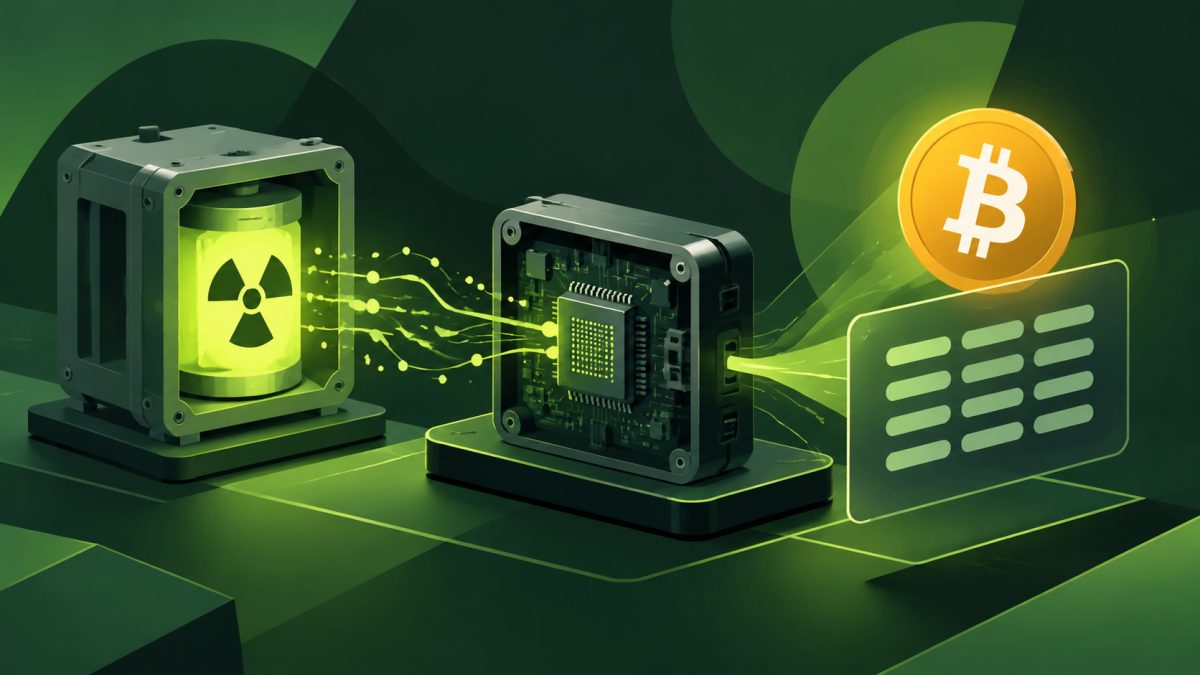
Entropy32 Plus Turns Nuclear Physics into Wallet Security
TREE NEWS reports: A developer has open-sourced Entropy32 Plus, a hardware device that uses radioactive decay as the entropy source for generating Bitcoin mnemonic phrases. The device employs a Geiger counter to record the time intervals between decay events, processes that data through SHA-256, and maps the result into BIP-39 compliant seed words. The project is now available for public review and replication.
Why True Randomness Matters
Every Bitcoin wallet ultimately rests on a single secret: the seed phrase. If that seed is generated with insufficient randomness, an attacker can brute-force it and drain funds. Most consumer wallets rely on pseudorandom number generators seeded by system clocks or mouse movements—sources that are theoretically predictable. Radioactive decay, by contrast, is a quantum-level phenomenon widely considered to be genuinely random, making it an attractive foundation for cryptographic entropy.
The Entropy32 Plus design is not the first attempt to use physical phenomena for seed generation. Previous projects have experimented with lava lamps, camera noise, and even cosmic rays. But by packaging a Geiger counter with open-source firmware and a clear BIP-39 output path, this project lowers the barrier for hobbyists and security researchers who want to audit or reproduce the process.
Open Source as a Double-Edged Sword
Open-sourcing the design allows the community to verify that no backdoors or predictable patterns exist in the entropy pipeline. However, it also means attackers can study the exact hardware and firmware to look for side-channel weaknesses—such as timing leaks in the Geiger counter interface or flaws in the SHA-256 implementation. The project’s credibility will depend on independent security audits and reproducible builds.
For the broader crypto industry, the device highlights a growing awareness that self-custody is only as strong as its weakest link. As institutional and retail adoption expands, demand for verifiable, high-assurance key generation could rise. Projects like Entropy32 Plus may inspire a new class of open-hardware security tools, bridging nuclear physics and blockchain cryptography.
Looking Ahead
Whether or not radioactive decay becomes a standard entropy source, the conversation it sparks is valuable. The crypto community needs more transparency around how keys are created, stored, and backed up. If Entropy32 Plus passes community scrutiny, it could become a reference design for future hardware wallets and cold-storage solutions—proving that even the most esoteric physics can serve everyday financial sovereignty.