South Korea Commits $120 Billion to Build 8 Nuclear Reactors on US Soil
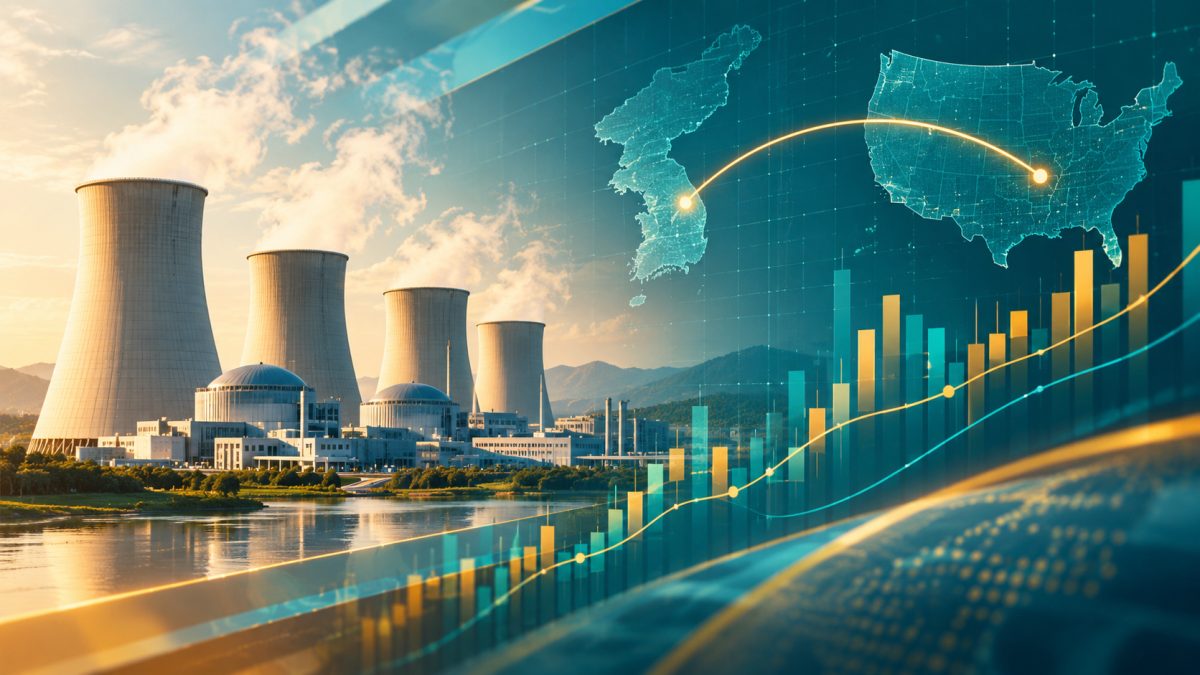
TREE NEWS reports: The South Korean government has formally announced a landmark overseas energy investment plan: roughly $120 billion to construct eight nuclear reactors inside the United States. The program is explicitly aimed at building out American nuclear power infrastructure while expanding the overseas footprint of Korean firms through capital export and technology cooperation. The scale of the commitment — cross-border capital flows on a multi-decade horizon, plus a long-term energy supply chain build-out — is expected to pull along equipment manufacturing, engineering and construction, and operations and maintenance service chains.
Why This Is a Macro Story, Not an Energy Footnote
At $120 billion, this is one of the largest single-nation infrastructure commitments ever directed at US soil. For macro traders, the signal matters more than the headline number:
- Capital flows: A commitment of this size implies years of dollar-denominated outflows from Korea and inbound FDI into the US, with implications for the won, Treasury demand, and the current-account picture on both sides.
- Industrial policy convergence: Washington has been courting allied capital for strategic infrastructure — semiconductors, batteries, now nuclear. Seoul’s move cements a pattern where allied governments, not just private markets, underwrite US industrial capacity.
- Energy as a strategic asset: Nuclear baseload power is increasingly framed as the answer to AI data-center electricity demand. Eight reactors is a direct bet on that thesis.
The AI-Energy Nexus
The timing is not accidental. Hyperscalers and AI labs are signing long-dated power purchase agreements at a pace that outstrips new generation. Nuclear offers firm, carbon-free baseload that intermittent renewables cannot match. If these reactors advance, they become foundational infrastructure for the next decade of compute build-out — which in turn shapes where data centers, and eventually on-chain compute networks, physically locate.
Winners Across the Chain
Korean engineering, procurement, and construction firms, reactor vendors, turbine and grid-equipment makers, and long-cycle maintenance contractors all stand to benefit. US utilities and grid operators gain new capacity without bearing the full capital burden. The flip side: execution risk is enormous. Nuclear projects routinely run over budget and behind schedule, and a program spanning eight units across multiple sites invites regulatory, political, and financing friction.
Forward-Looking Perspective
Watch three things: the financing structure (sovereign, corporate, or blended), the siting and permitting timeline, and whether the deal becomes a template for other allied nations. If it does, expect a broader repricing of nuclear supply chains and a durable bid for energy infrastructure as a strategic asset class. For markets, the story reinforces two themes that will define the decade: allied capital financing US reindustrialization, and electricity becoming the binding constraint on the AI economy.