Trump Expected to Name Jay Clayton as White House AI Czar
TREE NEWS reports: President Donald Trump is expected to appoint Jay Clayton, the current Director of National Intelligence and former Chairman of the U.S. Securities and Exchange Commission, as the White House’s AI czar. The move would place one of the most consequential figures in recent U.S. securities regulation at the center of the administration’s artificial intelligence policy — a role that increasingly overlaps with the crypto industry’s own ambitions around AI agents, decentralized compute, and on-chain data markets.
A Familiar Face for Digital Asset Markets
Clayton led the SEC from 2017 to 2020, a period that included the agency’s landmark enforcement action against Telegram’s TON token sale and the early framing of the Howey test’s application to digital assets. His tenure was marked by a preference for clarity through guidance rather than sweeping rulemaking, and he repeatedly signaled that Bitcoin was not a security while leaving broader token classification open.
For crypto markets, Clayton’s elevation to AI policy carries several implications:
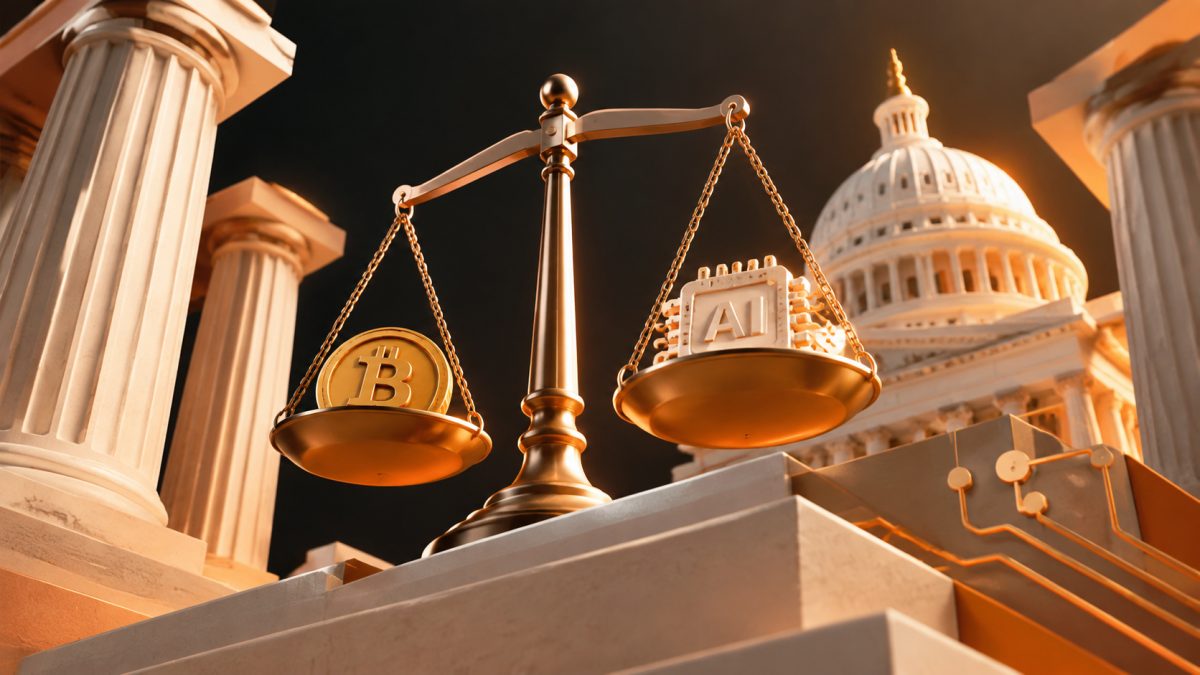
- Convergence of AI and crypto oversight: AI agents transacting on-chain, decentralized GPU networks, and tokenized model inference all sit at the intersection of securities law and emerging AI rules. Clayton’s dual background could accelerate a coherent framework rather than fragmented agency turf wars.
- Enforcement philosophy: His SEC record suggests a pragmatic posture — tough on outright fraud, more open to innovation-friendly structures — which could benefit compliant AI-crypto projects.
- National security lens: As DNI, Clayton has overseen intelligence assessments of foreign AI and crypto threats. That perspective may shape export controls, compute restrictions, and cross-border data rules affecting blockchain firms.
Industry Implications
The appointment arrives as decentralized AI networks — ranging from GPU marketplaces to on-chain inference protocols — have attracted billions in venture funding. A White House AI czar with deep securities expertise could clarify how tokens tied to compute, data, and model access are treated, reducing the regulatory ambiguity that has kept many institutional players on the sidelines.
It also signals that the administration views AI and crypto as linked strategic domains rather than separate silos. That framing could benefit projects building verifiable AI, decentralized identity, and privacy-preserving data markets — areas where U.S. policy leadership is seen as lagging the EU’s MiCA and AI Act.
Forward-Looking Perspective
If confirmed, Clayton’s first priorities will likely include coordinating federal AI standards, addressing compute supply chains, and defining guardrails for autonomous agents that interact with financial systems. Crypto founders should watch for guidance on token classification for AI-related assets, disclosure requirements for decentralized compute providers, and any national security screening of foreign participation in U.S. AI-crypto infrastructure.
The bigger story is structural: the White House is consolidating AI policy under a figure who understands securities markets intimately. For an industry long frustrated by regulatory ambiguity, that may be the most consequential signal yet that Washington intends to write the rules — and that crypto will be written into them.