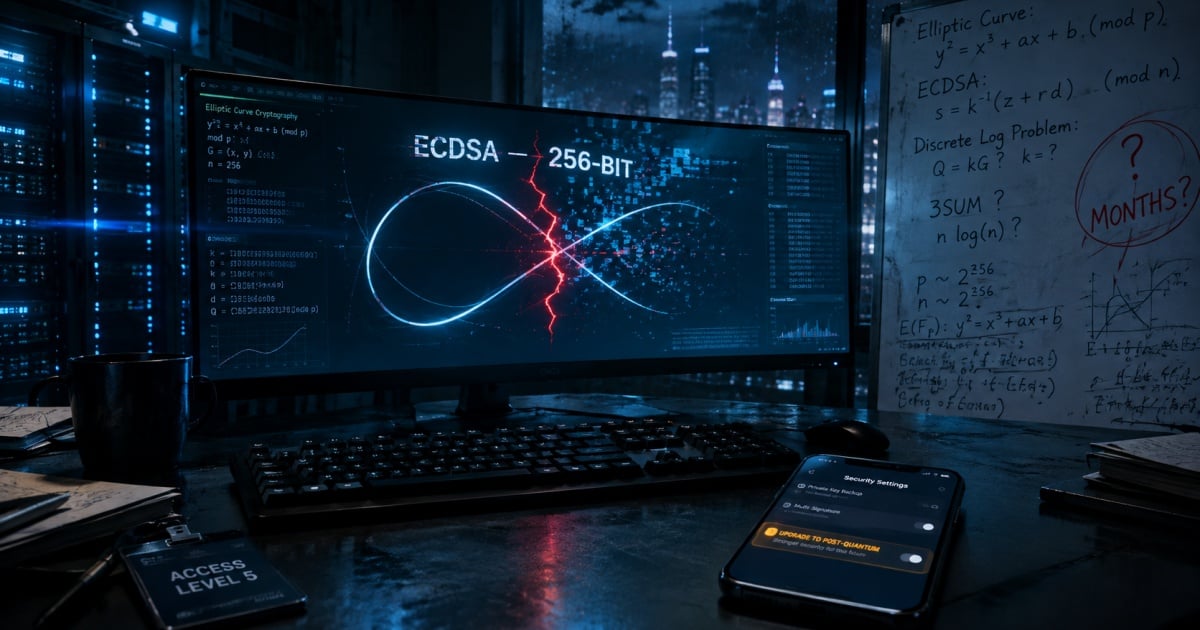
AI’s Math Leap Sparks Crypto Security Fears: Is ECDSA at Risk Within Months?
OpenAI’s release of 722 mathematical research results has triggered a warning from Ethereum Foundation researcher Justin Drake: if new mathematical methods significantly reduce the difficulty of breaking elliptic curve cryptography, the foundational assumptions securing crypto assets may need to be tested sooner than expected. He advises large holders and institutions to prepare in advance, incorporating fund migration, key rotation, and post-quantum cryptography into their risk management.
Industry Analysis and Implications
The crypto industry has long relied on ECDSA (Elliptic Curve Digital Signature Algorithm) to secure billions in digital assets. While quantum computing has been the primary concern for cryptographic security, AI-driven mathematical breakthroughs could pose a more immediate threat. Drake’s warning highlights a critical gap: the time between theoretical advances and practical exploitation is shrinking.
However, a vast technical chasm remains between mathematical progress and a practical algorithm capable of breaking ECDSA. The real issue is not whether a break will occur in months, but whether AI is altering the timescale of cryptographic risk assessment. Blockchain projects must now consider a future where their security assumptions are invalidated faster than anticipated.
Institutions holding large crypto reserves face a dual challenge: safeguarding assets today while preparing for a post-quantum tomorrow. Key rotation and migration to quantum-resistant algorithms are no longer distant tasks but immediate strategic priorities. The industry must collaborate on standards and tools to facilitate this transition without disrupting existing systems.
Forward-Looking Perspective
The convergence of AI and cryptography demands proactive measures. While ECDSA remains secure for now, the conversation should shift from reactive patching to proactive resilience. Blockchain networks must build upgrade paths for cryptographic agility, ensuring they can adapt to unforeseen threats. As AI continues to advance, the crypto industry’s ability to anticipate and mitigate risks will determine its long-term viability.