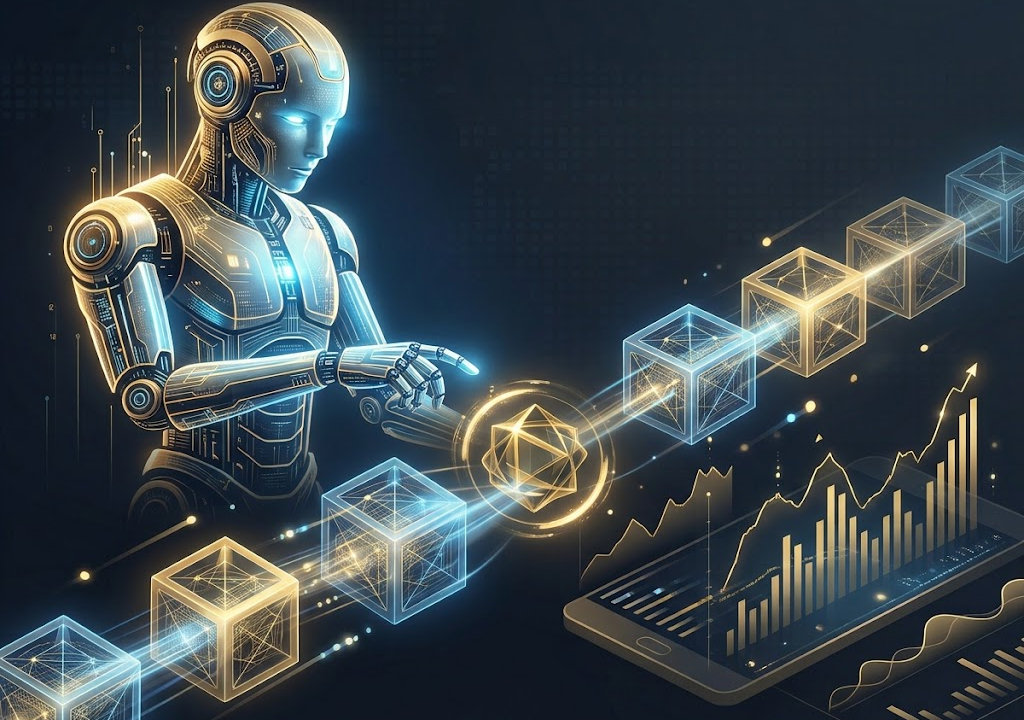
The Silicon Economy Is Coming, and It Doesn’t Need Humans in the Loop
TREE NEWS reports: Intelligent agents are beginning to replace human labor in transaction execution, settling value in seconds rather than days. As this shift accelerates, blockchain is emerging not as a niche financial tool but as the only viable settlement channel between machines that cannot trust each other, cannot wait for banking hours, and cannot rely on human intermediaries to clear their obligations.
From Human Labor to Machine Clearing
The core thesis is straightforward: when software agents transact with other software agents at machine speed, traditional financial rails — T+2 settlement, batch processing, manual compliance review — become structurally obsolete. Blockchain’s native properties — atomic settlement, programmable escrow, 24/7 operation, and cryptographic finality — map directly onto the requirements of an economy where the counterparties are silicon, not carbon.
Tokenization extends this logic beyond money. Information, identity, energy, storage, and compute capacity all become readable, priceable, and tradable data packages. A GPU-hour, a kilowatt of solar output, a verified identity credential, a trained model’s inference call — each can be represented as a token and settled on-chain. This constructs a global market oriented not toward goods but toward information itself.
Who Captures the Value?
The distributional implications are stark. If intelligent agents perform the labor, wealth flows to those who own the machines and the infrastructure they run on — GPU clusters, energy contracts, data pipelines, and the settlement layers themselves. Human economic participation shifts from selling labor to holding equity in the underlying systems. This is not a distant speculative scenario; it is the logical endpoint of trends already visible in decentralized compute networks, on-chain AI agent frameworks, and tokenized real-world asset platforms.
For crypto builders, the strategic question is whether current infrastructure can handle machine-to-machine settlement at scale. Sub-second finality, near-zero fees, and robust identity primitives are not luxury features — they are table stakes for an economy where agents negotiate, contract, and settle without human oversight.
The Road Ahead
The convergence of AI agents and blockchain settlement is still early. Regulatory frameworks have not caught up, and the technical stack for agent-to-agent commerce remains fragmented. But the direction is clear: as silicon-based economic activity grows, the chains and protocols that provide fast, cheap, trustworthy settlement will become the foundational infrastructure of a post-labor market. The real mission of cryptocurrency may not be to replace banks — it may be to become the native financial system of machines.