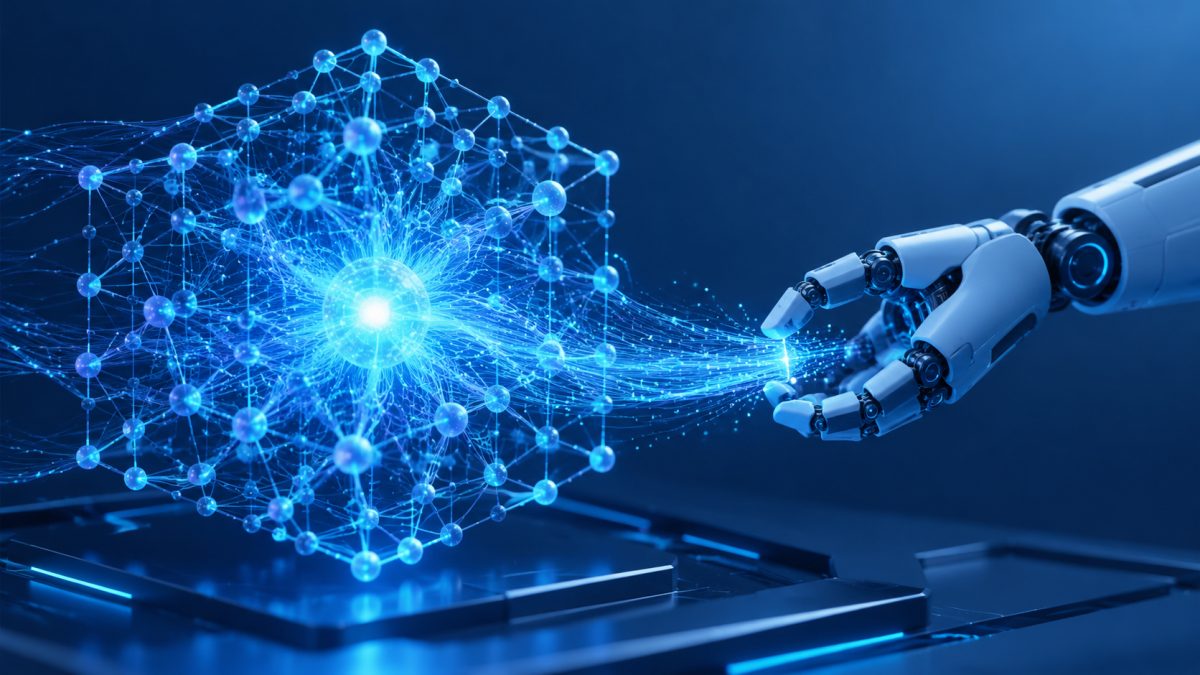
Nature Will Unveils Natura-1, a Foundation Model for the Physical World
TREE NEWS reports: Nature Will has released Natura-1, a 50-billion-parameter Mixture-of-Experts foundation model aimed at the physical world. The model was trained on one million hours of first-person video of humans handling different scenes and objects, giving it the ability to process objects and tasks it has never seen before.
Natura-1 supports fine-grained instructions specifying an object’s final position and orientation. It can maintain control when a grasp method changes mid-task, execute different tasks with each hand, and track objects that have been moved or opened during long-horizon tasks to determine the next step.
Why a Physical-World Foundation Model Matters
Most foundation-model progress has been confined to text, images, and code. Natura-1’s focus on embodied manipulation places it in a smaller but strategically important category: models that must reason about physics, contact, and spatial relationships in real time.
The one-million-hour first-person video dataset is the headline asset. First-person footage captures the causal structure of manipulation — where hands go, how objects resist, what happens when a grasp slips — far better than third-person observation. That data advantage is likely why Nature Will claims generalization to unseen objects and tasks rather than narrow benchmark performance.
Capabilities That Point Toward General-Purpose Robots
- Fine-grained goal specification: Commands can dictate final position and orientation, not just “pick up the cup.”
- Mid-task adaptation: The model keeps control when the grasping strategy changes, a common failure mode for scripted policies.
- Bimanual coordination: Two hands can perform different tasks simultaneously.
- Long-horizon memory: The model tracks moved or opened objects to plan subsequent actions.
Together, these features target the gap between impressive demos and reliable deployment in warehouses, labs, kitchens, and factories.
The Crypto and DeAI Angle
Natura-1 is not a crypto-native project, but its release lands in a market where decentralized compute networks, data marketplaces, and on-chain AI agents are competing for relevance. A model trained on a proprietary million-hour video corpus raises familiar questions: who owns embodied data, how is it licensed, and can it be verified? Those questions are exactly the wedge that decentralized data and compute protocols are trying to exploit.
If physical-world models become the next scaling frontier, demand for video data collection, annotation, and GPU inference will rise sharply. Crypto networks that can coordinate that supply — and prove provenance on-chain — could find a genuine product-market fit beyond speculative token narratives.
Forward-Looking Perspective
Natura-1’s real test will not be a demo reel but reliability under distribution shift: new objects, new lighting, new task sequences. The 50B MoE architecture suggests Nature Will is betting that scale plus diverse first-person data beats hand-engineered robotics pipelines. If that bet pays off, the robotics stack could consolidate around a handful of physical-world foundation models — and the data and compute layers beneath them will become the most contested part of the value chain.