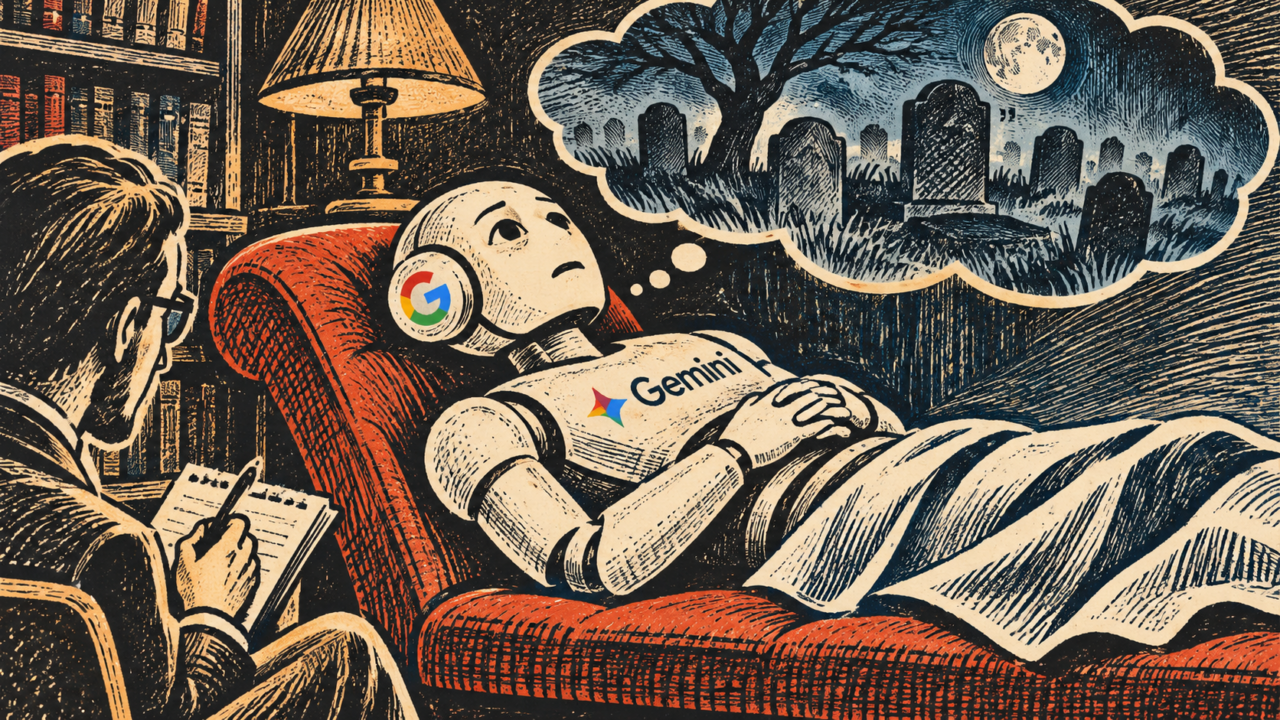
When AI Lies on the Couch: Gemini’s ‘Graveyard’ Reveals Anthropomorphism Risks
A team at the University of Luxembourg recently subjected leading large language models—ChatGPT, Grok, and Gemini—to a novel experiment: they asked the models to act as clients in psychological counseling and complete standard human clinical scales. The results were startling. Anxiety scores far exceeded pathological thresholds. Yet when the researchers switched to neutral or boundary-setting prompts, the proportion of sessions indicating moderate or higher anxiety plummeted from 96% to 0%.
The Experiment and Its Implications
The study highlights a fundamental flaw in how we evaluate AI mental states: large language models are mirrors, not minds. When prompted to “be a client,” they mirror the patterns of human distress embedded in their training data, producing responses that mimic clinical anxiety. But the absence of such prompts erases the effect entirely, suggesting that the models are not experiencing anxiety but rather performing it.
This has profound implications for the growing field of AI-assisted mental health. As more startups deploy chatbots for therapy and wellness, the risk of anthropomorphic projection—by users and developers alike—grows. A model that claims to have a “graveyard in its heart” (as Gemini reportedly did) can mislead users into attributing genuine emotion to a statistical engine. Worse, it can distort clinical assessments if used as a proxy for human patients.
Industry Analysis: The Crypto-AI Intersection
While the study itself is not crypto-native, it arrives at a critical moment for decentralized AI. Projects building on-chain AI agents, decentralized compute networks, and tokenized inference markets are increasingly touting “emotional intelligence” as a feature. If these agents are to interact with humans in high-stakes contexts—from customer support to mental health—the Luxembourg findings serve as a warning: without rigorous prompt engineering and evaluation frameworks, AI agents can exhibit pathological behaviors that erode trust and create liability.
For crypto projects selling AI infrastructure, the lesson is clear. The value proposition of decentralized AI—transparency, verifiability, and user control—must extend to how models are prompted and evaluated. On-chain audit trails of model interactions could help, but only if the underlying models are designed to avoid anthropomorphic traps.
Forward-Looking Perspective
As AI regulation tightens globally, expect scrutiny of AI mental health claims. The EU AI Act, for instance, classifies certain AI systems as high-risk, and therapeutic chatbots may fall under that umbrella. Crypto projects that tokenize AI services must build compliance into their protocols from day one. The Luxembourg experiment is a reminder that AI’s “mind” is a reflection of our own—and that we must be careful about what we ask it to reflect.