AI Servers Tighten Memory Supply, Consumer Electronics Brace for Higher Costs
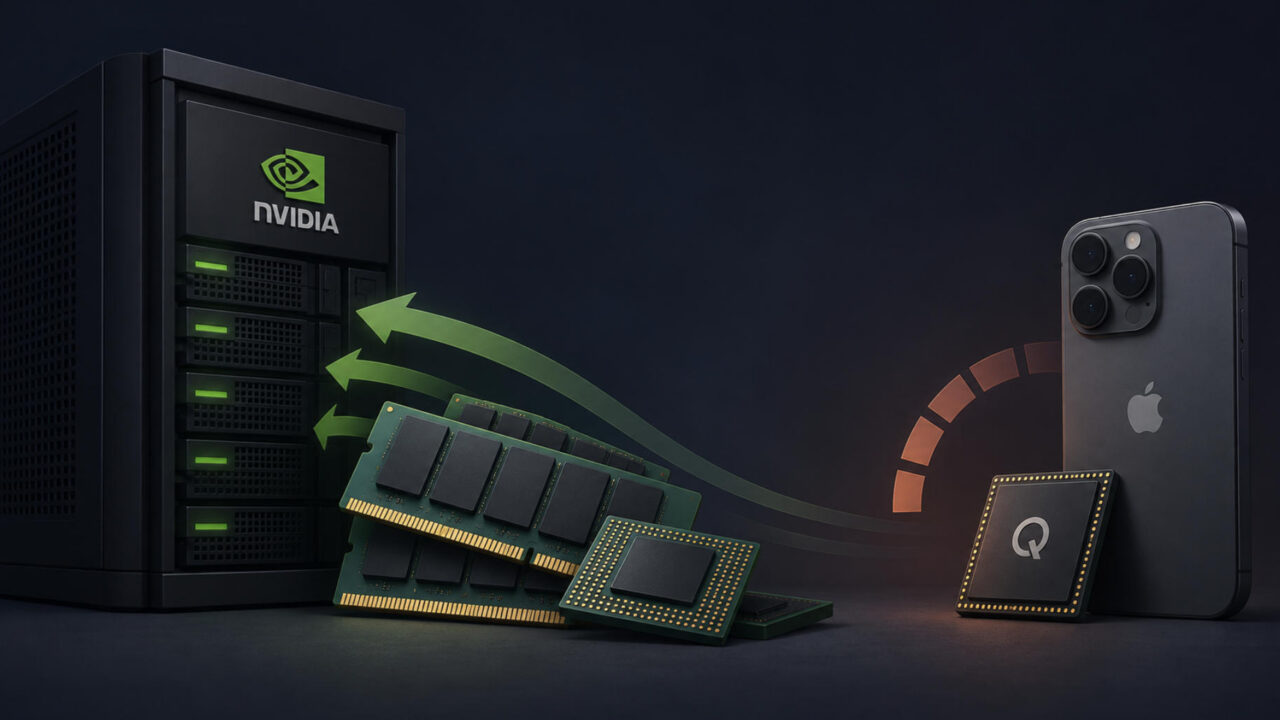
TREE NEWS reports: Counterpoint Research this week highlighted that AI agents are driving up demand for standard memory paired with CPUs, while Nvidia has reportedly asked TSMC to study expanding memory capacity. The ripple effects are already being felt across the consumer electronics supply chain, where Apple and Qualcomm are facing higher procurement costs for memory components.
Supply Chain Dynamics
The surge in AI server deployments is absorbing a significant portion of global memory production. As hyperscalers and enterprises race to build out AI infrastructure, they are competing for the same DRAM and NAND resources that consumer devices rely on. This competition is pushing up spot prices and prompting contract renegotiations across the industry.
Counterpoint’s analysis suggests that AI agents—software that can perform tasks autonomously—are increasing the need for standard memory in CPU-based systems, not just the high-bandwidth memory (HBM) typically associated with AI accelerators. This broadens the demand base and intensifies the squeeze.
Implications for Apple and Qualcomm
Apple and Qualcomm, both major consumers of memory for smartphones, tablets, and PCs, are now facing higher bill-of-materials costs. While these companies typically have long-term supply agreements, the current environment may force them to renegotiate terms or pass costs onto consumers.
- Apple could see margin pressure on its iPhone and Mac lines if memory costs remain elevated.
- Qualcomm, which supplies chips for many Android devices, may face similar challenges, potentially affecting pricing for its customers.
- Smaller device makers with less bargaining power are likely to be hit even harder.
Broader Market Impact
The memory crunch is not isolated to consumer electronics. Data center operators, automotive manufacturers, and industrial equipment makers are also competing for supply. This broad-based demand could lead to sustained higher prices for memory throughout 2024 and into 2025.
Investors are watching memory makers like Samsung, SK Hynix, and Micron, whose revenues are benefiting from the upcycle. However, the downstream impact on device makers and consumers could dampen overall demand if prices rise too quickly.
Forward-Looking Perspective
The AI boom is reshaping the semiconductor supply chain in profound ways. While memory manufacturers ramp up capacity, the lag between investment and production means the tightness is likely to persist in the near term. Companies that can secure long-term supply agreements or diversify their sourcing will be better positioned. For consumers, the prospect of higher device prices looms, adding another layer of inflation pressure to the tech sector. As AI continues to permeate every layer of computing, the competition for fundamental components like memory will only intensify, making supply chain resilience a critical strategic priority.