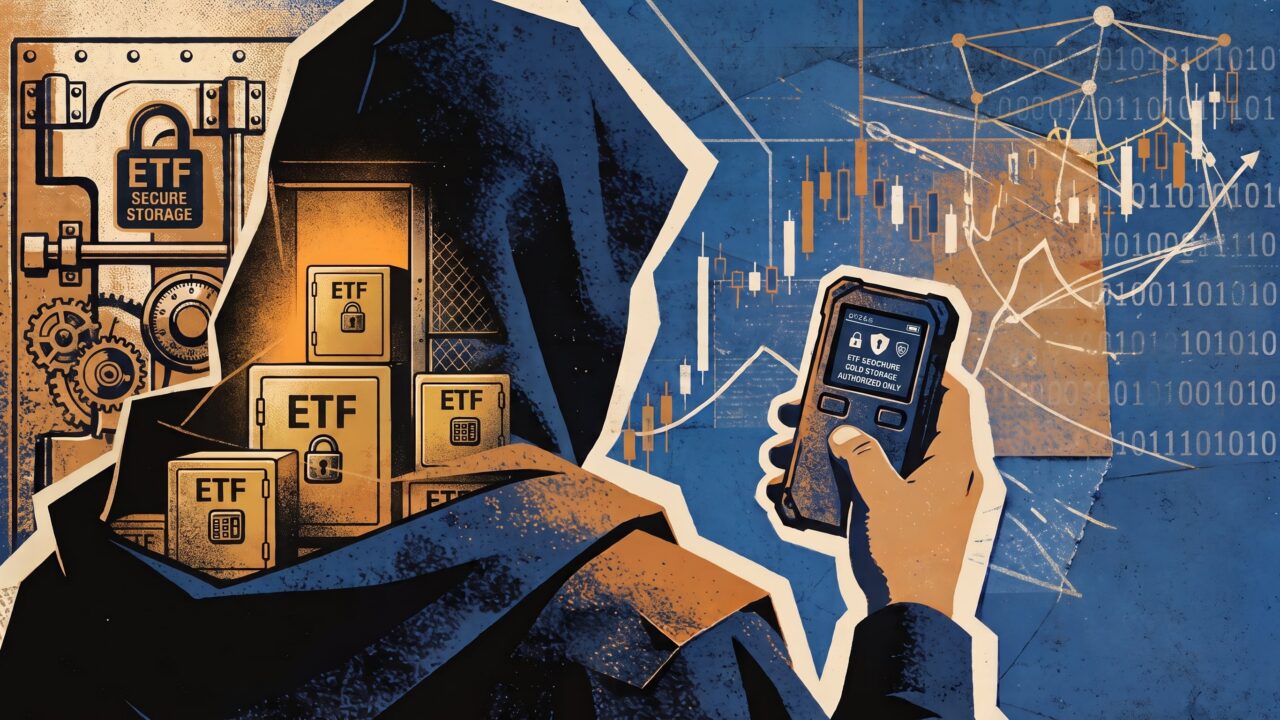
Self-Custody Under Siege
A growing number of Bitcoin whales are moving their holdings into spot ETFs, a shift driven less by yield-chasing than by a creeping fear: that holding your own keys may no longer be the safest way to store wealth. The trend has been accelerated by a string of wrench attacks, wallet exploits, and exchange security incidents that have made physical and digital self-custody feel increasingly perilous.
For years, the crypto ethos has been built on the mantra “not your keys, not your coins.” But as Bitcoin’s price has climbed, so too has the incentive for criminals to target known holders. High-profile home invasions, kidnapping attempts, and sophisticated phishing campaigns have turned private key management into a liability for some of the market’s largest participants.
The ETF Safety Trade
Spot Bitcoin ETFs, now offered by major asset managers, provide a regulated custody alternative. For whales managing nine-figure positions, the trade-off is clear: they surrender direct control and pay management fees, but gain institutional-grade security, insurance, and the ability to hold BTC within traditional brokerage and retirement accounts.
This migration is visible in on-chain data and ETF flow reports. Custodians like Coinbase Institutional have reported growing demand from high-net-worth clients seeking to offload operational security burdens. The appeal is particularly strong for older holders, family offices, and those without technical expertise to manage multi-signature setups safely.
A Community Divided
Not everyone is celebrating. Bitcoin purists argue that ETF ownership undermines the core value proposition of the asset—decentralization and individual sovereignty. If large swaths of supply end up in a handful of custodians, the network’s resilience and censorship resistance could be called into question. There are also concerns about rehypothecation, regulatory capture, and the precedent of institutional gatekeeping.
Yet the counterargument is gaining ground: security is a spectrum, and for many holders, a regulated custodian with audited cold storage and legal recourse is safer than a hardware wallet in a home safe. The wrench attack threat is real, and no amount of ideological purity can protect against physical coercion.
What Comes Next
The whale migration to ETFs is likely to continue as long as security concerns persist and institutional infrastructure matures. This could lead to a bifurcation of the Bitcoin market: a “custodial” layer dominated by ETFs and regulated entities, and a “sovereign” layer for those who prioritize self-custody and can afford the operational overhead.
For the industry, the challenge will be to improve self-custody tooling—better multisig UX, social recovery, and insurance products—so that the choice to hold one’s own keys remains viable, not just ideological. The security anxiety spreading through crypto is a warning sign: if the ecosystem cannot make self-custody safe and usable, the market will vote with its feet, and the keys will keep moving to Wall Street.