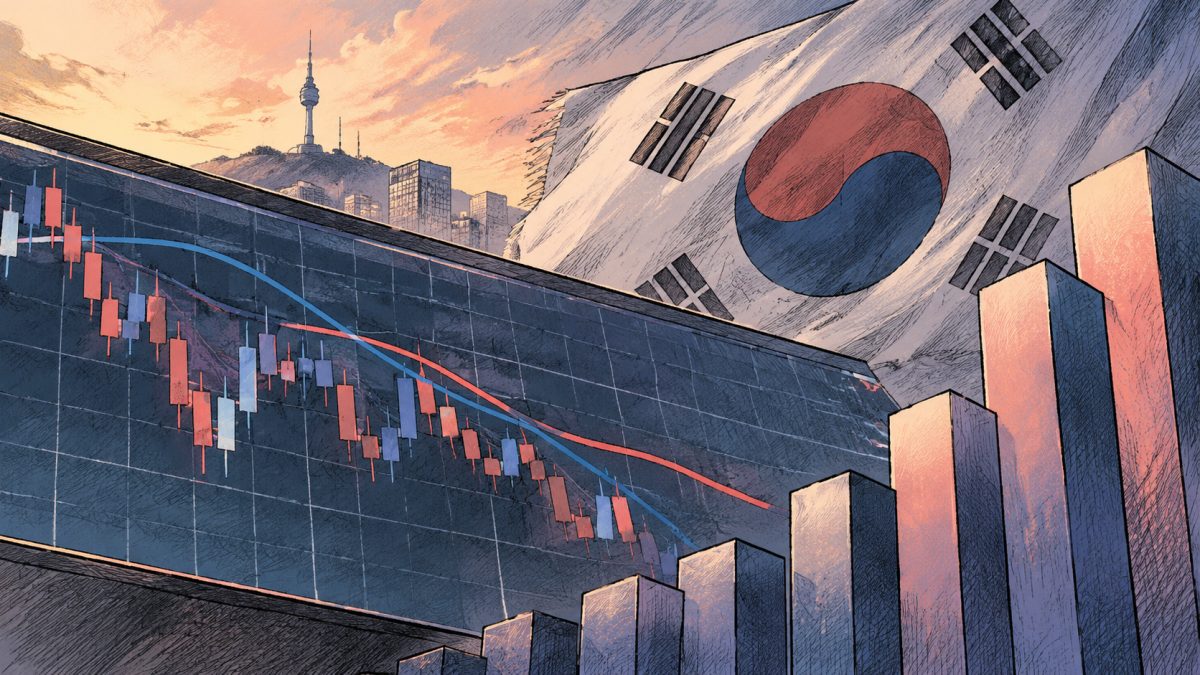
Korean Stocks Plunge as Samsung, SK Hynix Death Crosses Signal Deeper Selloff
TREE NEWS reports: South Korea’s KOSPI index tumbled overnight to its lowest level since the start of the AI-driven correction, with heavyweight chipmakers Samsung Electronics and SK Hynix both breaking key support and confirming bearish “death cross” patterns. The selloff comes as hedge funds exit the Korean market at the fastest pace in over a decade, though Goldman Sachs argues that current valuations already price in an extreme earnings collapse.
Technical Breakdown Accelerates
The KOSPI closed at a fresh low for the current downturn, with momentum indicators deteriorating sharply. The index has no meaningful support until the 4,200 level, and the 100-day and 200-day moving averages have formed a significant bearish crossover. Weekly RSI has fallen to its lowest since October 2022, and the index is testing its 100-week moving average.
Samsung Electronics broke major support and closed at its lowest since March, with its own death cross now in effect. SK Hynix printed two consecutive large bearish candles, fully activating the death cross flagged last week. Its first meaningful support is approaching, but the more critical level sits near 800,000 won.
Hedge Fund Exodus
Asia-focused fundamental long/short hedge funds have slashed net leverage by 47.4 percentage points in a month to just 10%, the lowest reading in more than a decade of data. Net allocation to Korea has dropped to 2.3%, the 11th percentile over the past year, with Korea and Taiwan continuing to lead selling across Asia.
While the positioning reset has been brutal, it may not be complete: on a five-year lookback, Korean exposure remains relatively elevated.
Valuation Already Prices Doomsday
Goldman Sachs’ scenario analysis suggests that even if forward earnings forecasts were cut by 70%, current valuations would still imply a modest positive return. Korean semiconductor stocks trade at about 0.7 times 2028 book value, a historically low level that has often coincided with cycle bottoms and attractive forward returns.
Additionally, Goldman expects Korean share buybacks to exceed $130 billion in 2027, providing a growing corporate bid that could offset foreign selling once the liquidation wave subsides.
Key Takeaways for Investors
- Technical indicators are deeply bearish, but extreme pessimism is already reflected in prices.
- Hedge fund positioning has reset sharply but may not be fully cleansed, leaving room for further volatility.
- Valuations in Korean semiconductors are at levels historically associated with cycle troughs, offering a potential contrarian opportunity.
- Corporate buybacks could provide a structural tailwind as selling pressure fades.