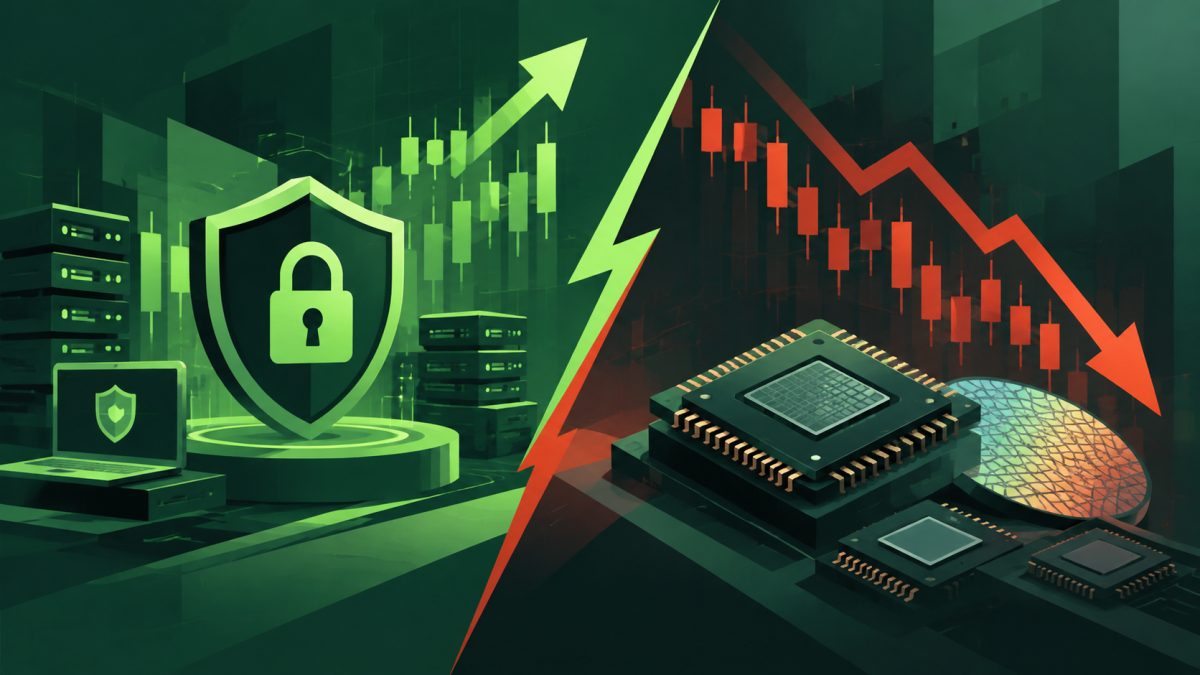
Cybersecurity Rallies While Chip Stocks Retreat
TREE NEWS reports: Nasdaq 100 constituents traded in sharply divergent directions intraday, with cybersecurity and enterprise software names posting double-digit gains while the semiconductor complex came under broad selling pressure. The split underscores a market increasingly discriminating between defensive-growth software and cyclical hardware exposure.
Winners: Security and SaaS
CrowdStrike jumped 14.47%, leading the index, while Palo Alto Networks climbed 13.00% and Fortinet added 7.82%. The synchronized move across endpoint, platform, and hardware security vendors suggests investors are rotating toward subscription-based, mission-critical software with recurring revenue. Enterprise software also participated: Autodesk rose 5.77%, Intuit gained 4.32%, Workday advanced 4.29%, and Adobe added 3.73%. Netflix and Thomson Reuters rounded out the leaders, reflecting demand for information services and streaming resilience.
Losers: Semiconductors and Storage
The downside was concentrated in chips and related infrastructure. Teradyne fell 11.46%, Astera Labs dropped 10.07%, Arm slid 9.86%, and Lumentum lost 9.54%. Equipment makers Lam Research, Applied Materials, KLA, and ASML each declined roughly 5.7% to 7.1%. Memory names Micron and Western Digital fell 6.16% and 5.29%. AI-infrastructure proxy CoreWeave dropped 5.85%, while Constellation Energy shed 6.43% — a notable signal that the power-and-compute trade tied to AI data centers is being repriced.
What the Rotation Signals
This is not a simple risk-off day; it is a rotation. Capital is moving from capital-intensive, cycle-sensitive hardware into asset-light software with predictable cash flows. The breadth of the semiconductor decline — spanning test equipment, EDA, IP licensing, memory, and GPU cloud — points to concerns about order visibility and the sustainability of AI-driven capital expenditure rather than a single company’s miss.
Forward-Looking Perspective
For digital-asset markets, the read-through matters. Semiconductor and GPU-cloud weakness can pressure valuations of crypto-adjacent compute plays, including decentralized GPU networks and miners pivoting to AI hosting. Conversely, strength in cybersecurity and enterprise software may reinforce the narrative that blockchain security, compliance tooling, and tokenized enterprise infrastructure remain durable demand pockets. Traders should watch whether the chip selloff broadens into a sustained de-rating or proves to be a single-session rotation — the answer will shape risk appetite across both equities and token markets in the weeks ahead.