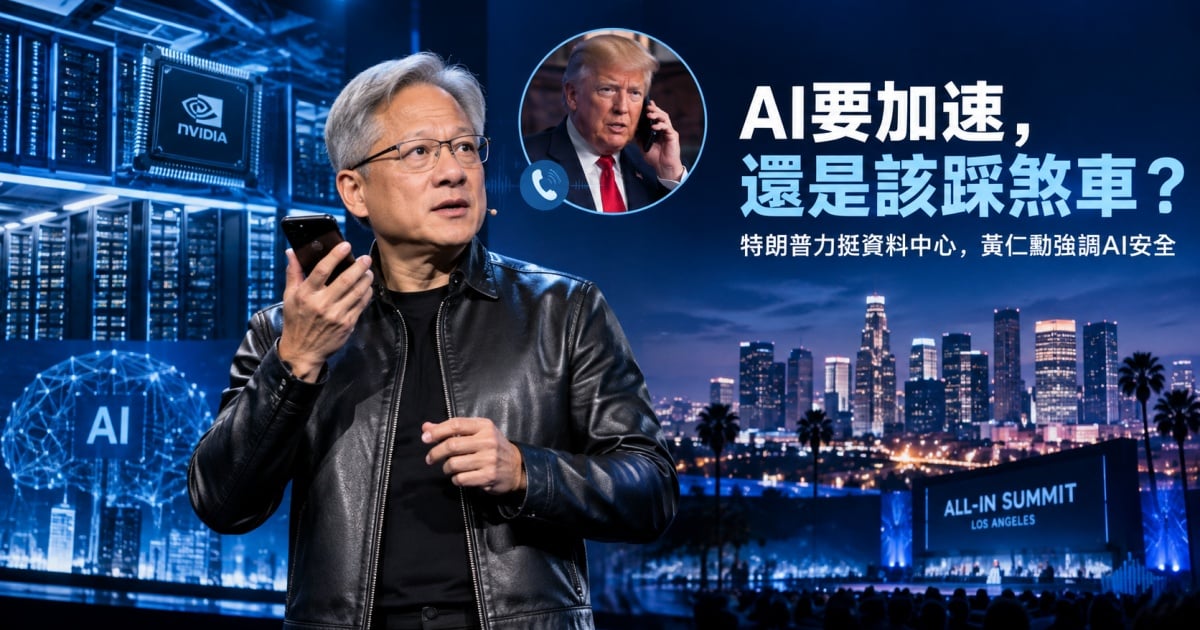
A Phone Call That Exposed the Fault Lines
A sudden phone call into a summit hall brought the central contradiction of America’s AI industry into plain view. Donald Trump framed data centers as the “new oil” of the next 20 to 25 years, arguing the United States cannot afford to slow down out of fear over AI risks. Jensen Huang, while equally dismissive of the “AI will inevitably destroy humanity” narrative, insisted that safety warnings deserve to be taken seriously. On the surface, this is a dispute over AI doomerism. Deeper down, it is a question of how the United States balances infrastructure expansion, industrial competition, public risk, and the boundaries of regulation.
Compute as Strategic Infrastructure
The framing of data centers as “new oil” is not merely rhetorical. It reflects a genuine shift in how policymakers view compute: not as a private cost center, but as strategic infrastructure comparable to energy grids or ports. That view has direct implications for crypto and decentralized compute networks.
- If compute is treated as critical national infrastructure, GPU networks settled on-chain and decentralized inference marketplaces move from niche experiments to potential strategic assets.
- Energy siting, grid interconnection, and permitting become the binding constraints — the same bottlenecks that have shaped bitcoin mining’s geography.
- Tokenized compute and AI data marketplaces could attract regulatory attention as critical infrastructure rather than as speculative crypto products.
Safety Warnings as a Competitive Variable
Huang’s more measured stance is telling. Acknowledging safety warnings without endorsing doom scenarios is a pragmatic middle path: it preserves room for rapid deployment while keeping the door open to standards that could become trade barriers or moats. For the crypto-AI intersection, this matters because decentralized compute networks often pitch themselves as censorship-resistant alternatives. If safety and auditability become baseline expectations, protocols that can demonstrate verifiable inference and provenance may gain an edge over purely cost-driven rivals.
The Regulatory Boundary Is the Real Battleground
The debate is less “should we build AI” and more “who sets the rules, and how fast.” Infrastructure expansion, industrial policy, and public risk management are being negotiated simultaneously. Crypto firms selling AI infrastructure should expect to be pulled into that negotiation — through energy policy, export controls, and emerging safety frameworks — rather than treated as a separate industry.
Forward Look
Watch three signals: whether data centers receive infrastructure-style incentives, how safety standards get codified, and whether on-chain compute networks are classified as strategic assets or speculative instruments. The outcome will shape not just AI, but the next phase of decentralized infrastructure.