Alibaba Unveils Sweeping AI Infrastructure Roadmap at Cloud Summit
TREE NEWS reports: Alibaba Group CEO Eddie Wu used the company’s annual cloud summit in Hangzhou to announce the most aggressive AI infrastructure buildout in its history, spanning custom silicon, frontier model training, and a global data center expansion target that would place the company among the world’s largest compute operators. Wu framed machine intelligence as the most profound transformation since the Industrial Revolution and positioned Alibaba at the center of what he called a “super grid” for the AI era.
The News: 20GW by 2032, 10T-Parameter Models, and the Zhenwu V900
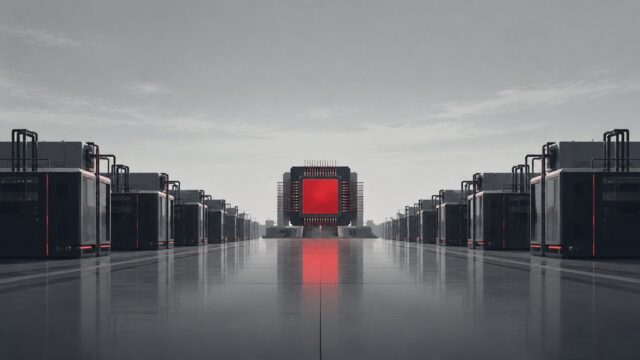
The headline numbers are striking. Alibaba Cloud aims to operate more than 20 gigawatts of global data center capacity by 2032. The Qwen team is targeting a next-generation model with 5 to 10 trillion parameters, alongside multimodal systems that unify understanding and generation. On the hardware side, chip unit T-Head released the Zhenwu V900, which Alibaba claims is China’s highest-performance AI chip, delivering three times the compute of the prior M890 and scaling to clusters of 500,000 cards. Management expects annual AI chip shipments to rise substantially.
Wu was candid about the supply-demand imbalance driving this capex: “Medium- to long-term industry demand far exceeds our supply capacity. The global shortage in the AI data center supply chain is limiting how fast we can add compute.” Alibaba’s Hong Kong-listed shares rose more than 4% intraday, touching a one-month high.
Market Implications
Equities
The announcement reinforces the bull case for the broader AI infrastructure complex. Suppliers of power equipment, cooling systems, optical interconnects, advanced packaging, and high-bandwidth memory stand to benefit from a multi-year, multi-gigawatt procurement cycle. Alibaba’s own capex guidance implies sustained spending that flows to both domestic and global vendors. Investors should watch whether peers like Tencent, Baidu, and ByteDance respond with comparable commitments, which would amplify the supply chain bid.
Semiconductors
The Zhenwu V900’s claimed performance and 500,000-card cluster scalability matter for two reasons. First, it signals that domestic Chinese chip design is closing the gap at the system level, even if per-chip performance trails leading global accelerators. Second, it reduces Alibaba’s dependence on restricted imports, insulating its cloud roadmap from export-control shocks. This is a medium-term negative for foreign accelerator vendors’ China revenue and a positive for China’s domestic semiconductor ecosystem.
Commodities and Energy
Twenty gigawatts is a colossal power requirement. If realized, it implies enormous demand for electricity, transformers, grid infrastructure, and possibly natural gas and nuclear baseload. Copper, a key input for data center power distribution, could see incremental structural demand. Energy markets in regions hosting these facilities will feel the strain, and power procurement may become a competitive bottleneck.
Crypto and Digital Assets
There is no direct crypto angle here, but the second-order effects are worth noting. Decentralized compute and GPU networks compete for the same scarce hardware and power. A hyperscaler of Alibaba’s scale locking up supply chains could tighten availability for smaller compute providers, potentially raising the value proposition of distributed networks that aggregate idle capacity. AI-themed tokens may trade on sentiment around the buildout, though the fundamental linkage remains loose.
Currencies and Rates
Aggressive capex by a major Chinese tech issuer could pressure free cash flow and, at the margin, affect credit spreads on Alibaba’s debt. A weaker yuan would raise the cost of imported equipment, complicating the buildout math. On the macro side, sustained AI capex is a modest inflationary force in power and construction inputs, a theme central banks are beginning to monitor.
Key Takeaways for Investors
- Infrastructure over applications: Alibaba is explicitly prioritizing the “power plant” layer — chips, data centers, and models — over near-term application monetization. This is a multi-year, capital-intensive thesis.
- Supply chain scarcity is the trade: Management named global supply chain tightness as the binding constraint. Companies that relieve that constraint — power, cooling, memory, packaging — capture value regardless of which model wins.
- Domestic substitution accelerates: The Zhenwu V900 strengthens the case for China’s self-sufficient AI stack, with implications for both Chinese chipmakers and foreign vendors exposed to China revenue.
- Watch the power trade: 20GW is an energy story as much as a technology story. Utilities, grid equipment, and copper are levered plays on this theme.
- Execution risk is real: Ambitious targets spanning a decade invite skepticism. Track quarterly capex, chip shipment data, and cloud revenue acceleration as validation milestones.