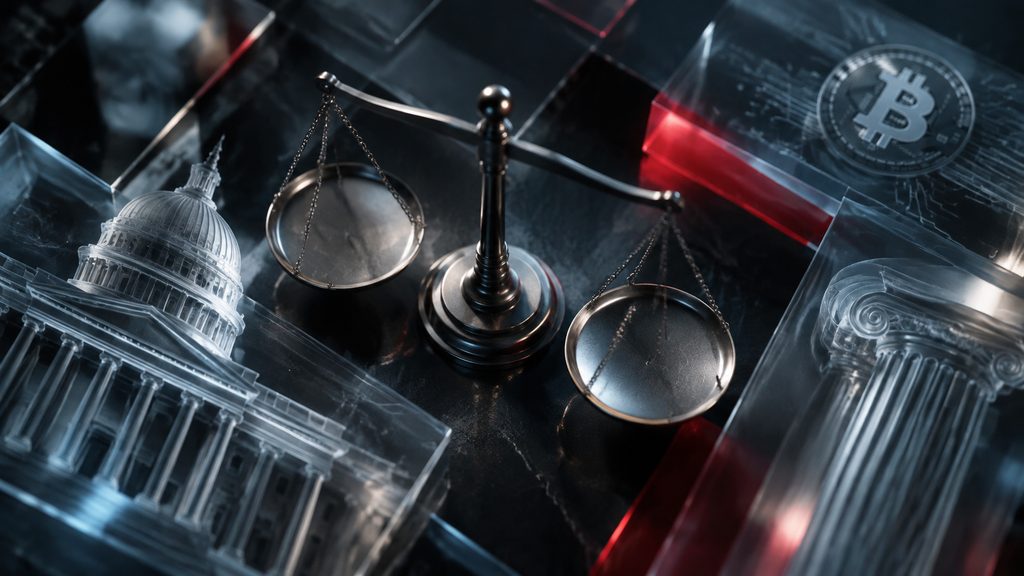
US Crypto Framework Advances Even as CLARITY Act Stalls
The CLARITY Act, the most comprehensive US crypto market-structure bill of this Congress, failed by a single vote, 49-50. Within days, the SEC, CFTC and OCC moved to fill the void: the SEC issued exemptions, the CFTC sent rules to the Federal Register, and the OCC granted three trust charters to crypto firms. The message is that the US regulatory apparatus is no longer waiting for Congress to define digital-asset oversight.
A Regulatory Relay Race
The failure of a 49-50 vote is less a defeat for crypto than a signal of how narrowly divided the legislative path has become. The executive agencies have effectively taken over. SEC exemptions can reduce registration friction for certain token offerings and intermediaries; CFTC rule filings push derivatives and spot-market oversight toward a clearer framework; and OCC trust charters give digital-asset custodians a federally recognized banking-adjacent status.
For market participants, this is a double-edged sword. Rules delivered by agencies are faster but less durable: they can be reversed by a new administration or challenged in court. A legislative framework would provide the certainty that institutional allocators say they need before deploying large balance sheets.
Macro Backdrop Tightens
The Federal Reserve raised rates for the first time since 2023, a hawkish turn that complicates the risk-asset picture. Stablecoin supply held flat at $305.1 billion, suggesting capital is not yet rotating aggressively into crypto liquidity. Circle’s Arc mainnet launch, however, gives stablecoin infrastructure a new institutional-grade settlement layer — a structural positive even in a tighter macro environment.
Payments and TradFi Keep Converging
- India’s UPI began charging a 0.4% merchant fee, a significant shift for the world’s largest real-time payments system.
- Walmart and roughly a thousand merchants opposed a card-fee settlement, signaling continued friction over payment economics.
- Grab agreed to acquire Atome for $1.49 billion, deepening the super-app’s fintech and BNPL footprint in Southeast Asia.
These moves matter for crypto because they show the same battle lines — fees, settlement speed, and who controls the rails — playing out in traditional payments. Stablecoin networks are positioning as the low-cost alternative, but they need regulatory clarity to win enterprise adoption.
What to Watch
The next 90 days will test whether agency-level rules can substitute for legislation. Key indicators: whether the SEC exemptions are broad enough to unlock tokenized securities, whether the OCC charters survive legal challenge, and whether stablecoin supply breaks out of its $305 billion plateau if the Fed’s rate path stabilizes. For now, the US is regulating crypto by enforcement-adjacent improvisation — faster than Congress, but far less predictable.