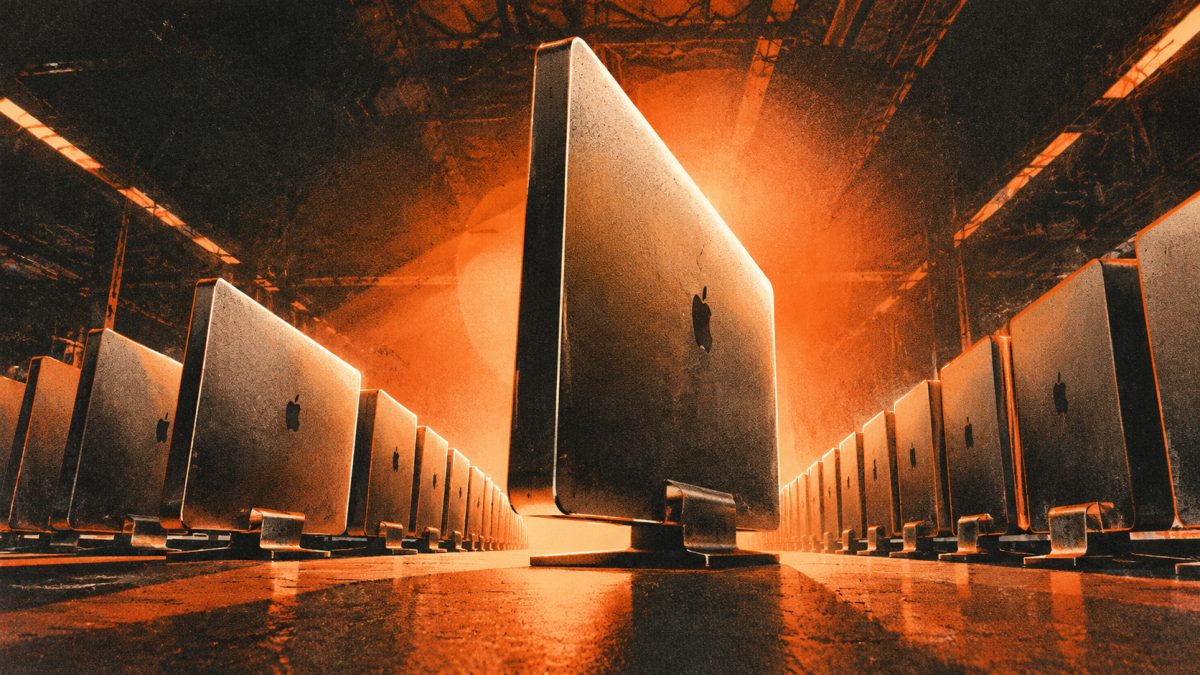
Apple’s New Mac Lineup Lands With an Unmistakable AI Subtext
TREE NEWS reports: Apple has begun shipping a refreshed Mac lineup built around its latest Apple Silicon generations. The M5 Max-powered Mac Studio starts at $2,499, while the M5 Ultra configuration begins at $5,499. On the desktop side, the M6-equipped Mac mini enters at $899, and the M5 Pro version is priced at $1,699.
On the surface, this is a routine hardware refresh. Read through the lens of decentralized AI infrastructure, however, and the pricing tiers tell a more interesting story: Apple is now selling unified-memory machines at price points that overlap directly with the GPU rigs and cloud credits that crypto AI networks depend on.
Why This Matters for Decentralized Compute
Decentralized compute and GPU networks — the sector that tokenizes idle hardware and settles inference or training jobs on-chain — have long been bottlenecked by two things: supply of capable silicon and the economics of attracting operators. Apple’s unified memory architecture, which lets a single machine address large memory pools without discrete VRAM constraints, has quietly become a favorite among independent AI developers running local models.
That matters because a meaningful share of decentralized inference demand is not frontier-scale training. It is mid-sized model serving, fine-tuning, and agent workloads — precisely the tasks that a $899 Mac mini or a $1,699 M5 Pro machine can handle at low power draw and near-silent acoustics. For node operators in token-incentivized compute marketplaces, the total cost of ownership math just shifted.
- Lower entry barriers: Sub-$1,000 hardware expands the pool of potential node operators beyond professional mining farms.
- Power efficiency as yield: In networks where rewards scale with uptime and utilization, lower wattage per unit of compute directly improves operator margins.
- Consumer-grade supply: Retail availability means decentralized networks can scale capacity without competing for datacenter-grade GPUs.
The Counterargument
Skeptics will note that Apple Silicon remains a closed ecosystem with limited support for the CUDA-based toolchains that dominate AI development, and that on-chain verification of Apple hardware attestation is still immature. Those are real frictions. But the direction of travel is clear: as inference demand explodes and centralized cloud pricing stays elevated, the marginal supplier of compute is increasingly a desktop-class machine sitting in someone’s home office.
Forward Look
Watch for decentralized compute protocols to publish hardware compatibility lists that explicitly target Apple’s M5 and M6 families, and for token-incentive programs to weight energy efficiency alongside raw throughput. If that happens, the Mac mini stops being a consumer product and starts being infrastructure — and Apple, whether it intends to or not, becomes a supplier to the crypto AI economy.