Nvidia’s Stunning Two-Day Slide
TREE NEWS reports: Nvidia shares fell sharply for a second straight session on Tuesday, at one point dropping more than 6%, bringing the two-day market capitalization loss to nearly $430 billion. The decline has erased almost $2 trillion from the company’s peak value, with $1.2 trillion lost in just the past ten trading days. The selloff was more severe than among other mega-cap technology stocks, making Nvidia the biggest drag on the tech sector.
The broader market also felt the pressure. The S&P 500 fell about 0.4%, while the Nasdaq 100 dropped 0.6%. Notably, the Nasdaq 100 has declined roughly 2% since the U.S. election, underscoring the tech sector’s vulnerability. Microsoft briefly overtook Nvidia intraday to become the world’s second-most valuable company, but later saw its losses deepen after Anthropic announced a new office suite, leaving it behind Nvidia once again. Nvidia’s market cap has now fallen back to levels comparable with Apple and Microsoft, sharply narrowing its once-commanding lead.
Legal and Governance Risks Add to the Pressure
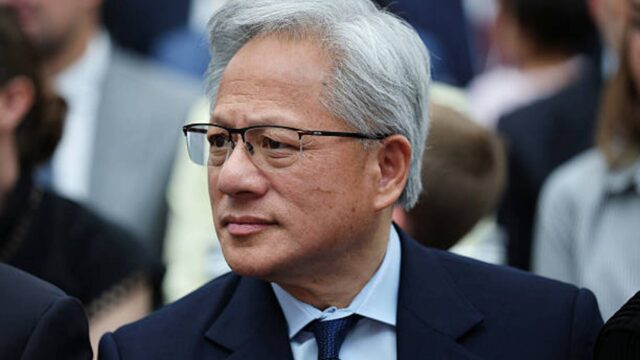
Compounding the stock’s woes, a shareholder filed a class-action lawsuit in California on Monday, accusing Nvidia and CEO Jensen Huang of misleading investors in prior disclosures and responses. The suit alleges that the company and Huang failed to fully disclose certain relationships and the risks they posed, causing investors to buy shares without full knowledge. The plaintiff also claims the matter could pose a material risk to Nvidia’s reputation and business prospects. The case is in its early stages, and the allegations have not been proven in court; Nvidia has not yet responded officially.
Negative news surrounding Huang mounted on Tuesday: the Nvidia board announced it had hired an independent law firm to conduct an internal investigation; House Republicans are reportedly considering subpoenaing the CEO for a closed-door briefing; reports emerged that Secretary of State Marco Rubio had briefed President Trump on Huang’s contacts with certain individuals; and the FBI is reportedly investigating Huang’s relationships with those individuals. The board said it has no reason to believe that Nvidia’s national security interests or trade secrets have been compromised, but the investigation will review all available information. Huang has expressed support for the probe and pledged full cooperation.
AI Investment Uncertainty and Management Risk
Beyond governance concerns, uncertainty over whether AI infrastructure spending can generate sufficient returns remains a core issue for the market. As the key supplier to the AI computing supply chain, Nvidia’s stock performance not only reflects its own earnings outlook but also serves as a barometer for investors’ views on the entire AI capital expenditure cycle.
On Tuesday, AI-related stocks broadly underperformed the market, with neoclouds and optical networking names leading declines. The S&P 500 excluding AI-related components was roughly flat, indicating that selling pressure was highly concentrated in the AI supply chain. The Associated Press noted that Huang has led Nvidia for 33 years, and his personal image is tightly intertwined with the company’s strategy, operations, and market perception. The investigation has therefore raised concerns about management stability and succession. Prediction market Polymarket shows traders assigning only about a 16% probability that Huang will step down by year-end, a pricing some analysts consider too low.
Goldman Sachs traders reported that Tuesday’s selling was driven more by fundamental factors, with hedge funds and long-only institutional investors both net sellers, concentrated in tech and industrial sectors. In the near term, the board investigation, the lawsuit, and management stability will be key variables for the stock, while the return outlook for AI infrastructure investment will determine long-term valuation. Goldman also estimates that commodity trading advisors (CTAs) could sell about $31 billion of S&P 500 futures over the next week regardless of market direction, adding technical downward pressure on tech stocks.
Key Takeaways for Investors
- Concentration risk is real: Nvidia’s outsized influence on the tech sector and the broader market means its troubles can ripple across portfolios. Diversification remains crucial.
- Governance matters: The lawsuit and investigations into CEO Jensen Huang introduce a new layer of uncertainty. Investors should monitor developments closely, as management stability is now a factor in the investment case.
- AI spending under scrutiny: The market is reassessing whether the massive AI capex cycle will deliver adequate returns. This could lead to volatility across the AI supply chain.
- Technical pressures: Programmatic selling by CTAs could exacerbate declines in the near term, creating potential entry points for long-term investors but also near-term risk.