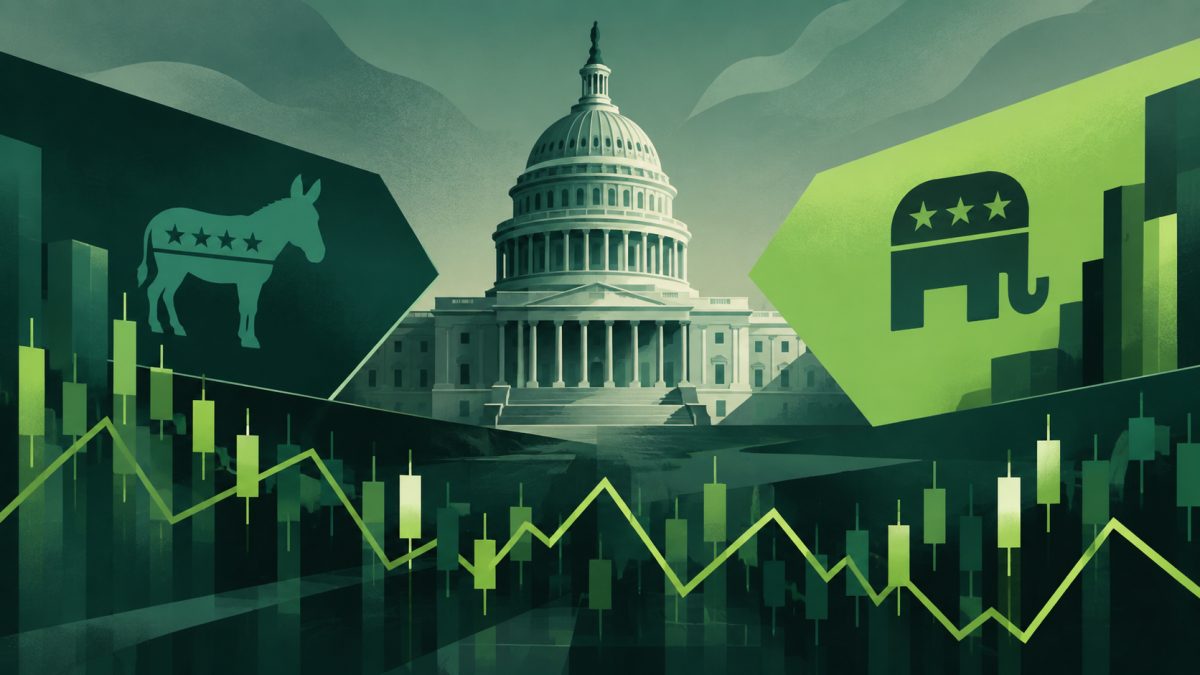
Wall Street’s Base Case: A Divided Government
TREE NEWS reports: As the U.S. midterm elections enter their final stretch, Wall Street is increasingly treating a divided Congress as its base case — and, counterintuitively, as the most benign policy outcome available in the current market environment. Investors broadly expect Democrats to retake the House of Representatives in November while Republicans hold the Senate with a narrow margin, a configuration that would sharply reduce the odds of major legislation moving quickly through Washington.
The logic is straightforward: divided government forces gridlock or compromise, which in turn caps the scope of disruptive policy shifts. Stuart Kaiser, head of U.S. equity trading strategy at Citigroup, told clients that a split government would “force gridlock or compromise,” making policy choices more moderate and allowing the stock market to refocus on corporate and economic fundamentals.
Why Gridlock Is Being Priced as the ‘Best Case’
Historical data supports the bullish framing. Research compiled by Carson Investment Research shows that since 1950, when a Republican president has faced a Congress split between the two parties, U.S. equities have averaged annual gains of 13.7%. By contrast, when either party controlled both chambers, average annual returns fell to 8.3% (Republican control) and 4.9% (Democratic control).
Brian Gardner, chief Washington policy strategist at Stifel, said investors are positioning for a divided Congress and that a Democratic House win — short of a landslide — could trigger a relief rally.
Artificial intelligence has also emerged as one of the most closely watched issues of this election cycle. As backlash over data-center construction intensifies, investors are being forced to confront rising regulatory risk to the technology that has powered a four-year bull market in U.S. equities. Under divided government, the probability of disruptive policy changes in AI, defense and healthcare falls sharply — the core rationale for why markets view this outcome as the most positive.
The Tail Risk: A One-Party Sweep
The very consensus around divided government is itself a risk. If results deviate materially from expectations, equities could swing violently.
A Democratic sweep of both chambers is not impossible. While President Trump remains the Republican Party’s biggest mobilizing force, his record-low approval ratings are a significant drag. Republicans are banking on a midterm campaign rally informally dubbed “Trumpapalooza” to avoid a repeat of the drubbing during Trump’s first term.
Strategists led by Michael Hartnett at Bank of America noted last month that a strong Republican showing — including a successful re-election bid by Texas Governor Greg Abbott — would be a clear boost to AI-linked trades. Conversely, a Democratic Senate win alongside an Abbott defeat would deal stocks a “sharp selloff,” they wrote.
Phil Wool of Rayliant argued that a Republican sweep would favor sectors benefiting from further deregulation, with energy and financials as potential winners, while a Democratic “blue wave” could lift renewable energy and healthcare service providers.
Institutions Hedge, but Long-Term Strategy Holds
Markets are preparing for volatility around the vote. Futures tied to the Cboe Volatility Index (VIX) show a marked rise in demand for protection on the S&P 500 in early November.
Still, not every institution believes the midterms warrant a change in long-term investment strategy. Omar Aguilar, CEO of Schwab Asset Management, said that while political outcomes unsettle clients, most election results have limited real impact on long-term market trajectories. He acknowledged that short-term volatility in specific sectors may rise but views that as an opportunity to adjust portfolios rather than a signal to overhaul strategy.
“Clients are paying attention, just like they pay attention to $100 oil,” Aguilar said. “But does that mean they have to change their strategy? Our advice has always been: no, just stay the course.”
Key Takeaways for Investors
- Base case: A split Congress (Democratic House, Republican Senate) is widely expected and priced as a moderating, market-friendly outcome.
- Historical edge: Divided government has coincided with the strongest average annual equity returns since 1950.
- Sector implications: Republican sweep favors energy and financials; Democratic wave favors renewables and healthcare services; divided government favors AI, defense and healthcare by reducing disruptive policy risk.
- Tail risk: A one-party sweep would likely trigger sharp volatility, given how crowded the divided-government consensus has become.
- Strategy: Despite elevated near-term hedging demand, most institutions advise staying the course rather than repositioning around election outcomes.



