A Divided Fed: What a Split FOMC Vote Means for Stocks, Bonds, Crypto and the Dollar
TREE NEWS reports: When the Federal Open Market Committee meets next week, the headline decision on interest rates may matter less than the vote count behind it. Market participants are openly debating how fractured the committee has become, with several policymakers signaling discomfort with further tightening while others warn that inflation remains too sticky to declare victory. A narrow or split vote would send an unusually loud signal about the limits of consensus at the world’s most powerful central bank.
The debate is not academic. The FOMC sets the federal funds rate, the anchor for borrowing costs across mortgages, corporate credit, and emerging-market debt. When the committee speaks with one voice, markets price policy with confidence. When it splits, that confidence frays — and volatility tends to rise across nearly every asset class.
Why the Vote Count Matters More Than the Decision
Rate decisions are forward-looking instruments. Investors do not merely ask what the Fed did; they ask what the Fed will do next. A unanimous hold signals a committee comfortable with its trajectory. A 9-3 or 10-2 split tells the market that the next move is genuinely contested — and that incoming data on inflation, employment, and growth could swing policy sharply in either direction.
That uncertainty feeds directly into rate expectations. Futures markets reprice the path of cuts or hikes, and the two-year Treasury yield — the most policy-sensitive point on the curve — becomes a battleground. A hawkish dissent can push short-end yields higher even if the committee holds rates steady, steepening or flattening the curve depending on how the long end responds.
Market Implications Across Asset Classes
- Equities: A divided Fed typically raises realized volatility. Rate-sensitive sectors — real estate, utilities, small caps — are most exposed, while mega-cap tech can wobble on discount-rate math. Cyclicals may benefit if the dissent is dovish and signals earlier cuts.
- Bonds: Expect wider intraday ranges in Treasuries. A hawkish split lifts the front end; a dovish split compresses it. Credit spreads could widen modestly if investors read division as policy paralysis.
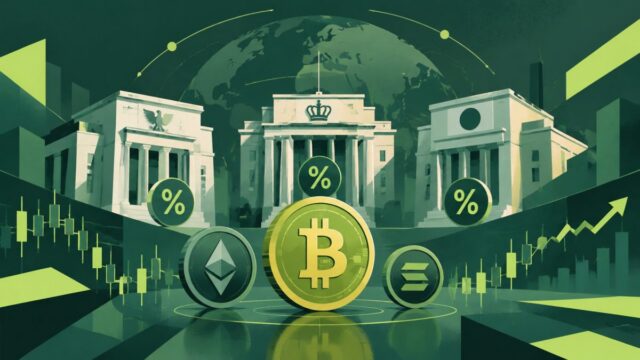
- Crypto: Digital assets remain highly sensitive to dollar liquidity and real yields. A split that markets interpret as a slower path to easing could pressure bitcoin and altcoins in the short term, while a dovish dissent could reignite risk appetite.
- Commodities: Gold tends to catch a bid when policy uncertainty rises. Oil is more focused on demand and geopolitics, but a weaker dollar on a dovish read would be supportive.
- Currencies: The dollar index is the cleanest expression of Fed uncertainty. A hawkish split supports the greenback; a dovish one weakens it, with the yen and euro the primary beneficiaries.
The Bigger Picture
Division inside the FOMC is not a bug — it reflects a genuinely ambiguous economy. Inflation has cooled from its peak but remains above target in key services categories. Labor markets have softened at the margins without breaking. Growth has been resilient but uneven. In that environment, reasonable people disagree, and the vote count is the clearest window into how strongly.
For investors, the practical takeaway is to expect more two-sided risk around the meeting. Positioning for a single outcome is dangerous when the committee itself cannot agree on one. Hedges, diversified duration exposure, and a bias toward quality balance sheets are the rational responses to a Fed that is no longer speaking in unison.
Key Takeaways
- The size of the dissent may matter more than the rate decision itself.
- Short-end Treasury yields and the dollar are the cleanest ways to trade the split.
- Crypto and rate-sensitive equities carry the highest short-term volatility risk.
- With the committee divided, data releases between meetings take on outsized importance.
- Investors should favor hedged, quality-tilted positioning over directional bets.