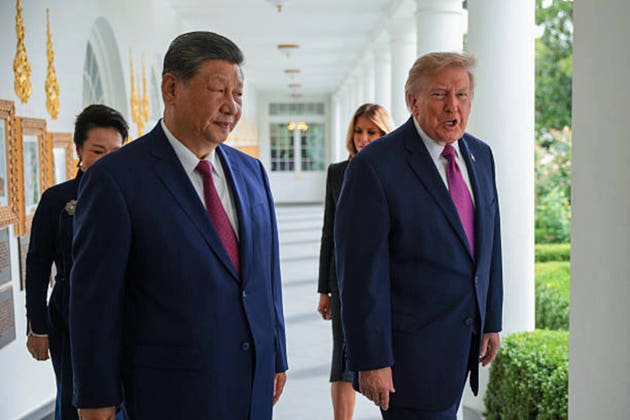
Trump and Xi Agree to Open ‘Super Intelligence’ Talks as AI Race Reshapes Global Markets
TREE NEWS reports: President Donald Trump and Chinese President Xi Jinping have agreed to launch formal discussions on “super intelligence,” a sweeping bilateral dialogue covering frontier artificial intelligence, its national-security implications, and the rules that will govern the next generation of computing. The understanding, described as an opening rather than a finished deal, marks the first time the world’s two largest economies have committed to a dedicated channel on advanced AI — a domain that sits at the intersection of trade policy, defense, semiconductors, and energy demand.
The announcement lands amid mounting anxiety in Washington and Beijing over the speed of AI development, the concentration of compute capacity, and the risk that a technological breakthrough by one side could deliver a decisive economic or military edge. No timetable, agenda, or participant list has been published, and officials on both sides signaled that the talks are exploratory.
Why the Two Powers Are Talking Now
Three forces are converging. First, the compute supply chain remains deeply entangled: US-designed accelerators, Taiwanese fabrication, Dutch lithography equipment, and Chinese assembly and rare-earth processing form a single fragile network that neither side can fully replace in the near term. Second, both governments face domestic pressure to show they are managing AI risk rather than merely racing toward it. Third, energy demand from data centers is becoming a fiscal and grid-planning problem in both countries, giving each an incentive to coordinate on standards, safety testing, and infrastructure.
Market Implications
Equities. Semiconductor and AI-infrastructure names are the most directly exposed. A credible dialogue reduces the tail risk of a sudden escalation in export controls, which would support chip designers, foundries, and equipment makers. Conversely, any hint that Washington might loosen restrictions on advanced chips sold into China would pressure the thesis behind domestic-only supply-chain beneficiaries, while lifting multinationals with large China revenue exposure. Hyperscalers and data-center REITs stand to benefit from any framework that lowers the risk of bifurcated technical standards.
Bonds. The macro read-through is subtler. If talks lower geopolitical tension, the term premium embedded in long-dated Treasuries could compress modestly. But if the dialogue produces a joint commitment to massive AI infrastructure spending, the supply of government debt needed to fund energy and grid buildouts could rise, pushing yields the other way. Net effect: a small, sentiment-driven easing in risk premia, offset over time by fiscal supply.
Crypto. Digital assets trade as a high-beta liquidity proxy, so a de-escalation headline is typically modestly supportive. The more interesting linkage is decentralized compute and GPU networks, which have positioned themselves as an alternative to centralized AI capacity. If US-China talks legitimize cross-border AI coordination, demand for permissionless compute marketplaces could rise — or regulators could decide those networks deserve the same scrutiny as chip exports, a two-sided risk.
Commodities. Rare earths, gallium, germanium, and copper are the physical chokepoints of the AI buildout. Any sign of a durable truce reduces the probability of Chinese export bans on critical minerals, capping speculative premium in those markets. At the same time, a coordinated AI investment push would be unambiguously bullish for copper, uranium, and natural gas tied to data-center power demand.
Currencies. A thaw tends to weaken the dollar against the yuan and other trade-sensitive currencies, as it lowers demand for the dollar’s safe-haven premium. The offshore renminbi would be the cleanest expression. The yen could also firm if global risk appetite improves and carry trades unwind.
Key Takeaways for Investors
- Treat this as optionality, not a deal. No framework, enforcement mechanism, or timeline exists yet. Position for reduced tail risk rather than a completed détente.
- Watch the semiconductor complex first. Export-control language is the fastest-moving transmission channel between the talks and prices.
- Own the physical layer. Copper, uranium, rare earths, and grid equipment are levered to AI buildout regardless of who wins the diplomatic round.
- Mind the two-sided crypto trade. Decentralized compute benefits from AI demand but could attract export-control-style regulation.
- Expect headline volatility. Talks of this scope generate repeated “progress” and “setback” news cycles. Size positions accordingly.
The dialogue is best understood as a recognition that AI is now too economically and militarily consequential to be managed unilaterally. For markets, that recognition cuts both ways: it lowers the probability of a sudden rupture, but it also signals that governments intend to be active participants in shaping who captures the gains.



