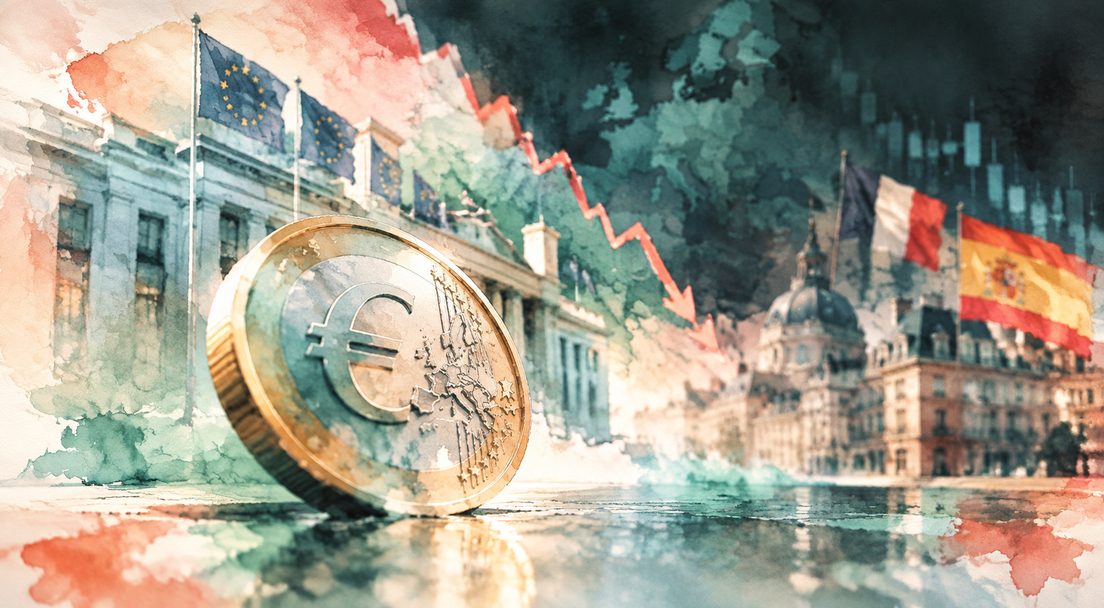
Euro Slumps to 17-Month Low as French and Spanish Political Turmoil Rattle Markets
TREE NEWS reports: The euro fell to its weakest level in 17 months on Monday, driven by a dual political crisis in France and Spain that has reignited fears over the stability of the eurozone’s fiscal framework. The single currency dropped 0.5% to 1.1204 against the dollar, its lowest since May 2025, as investors fled to safer assets. The dollar index edged up 0.1%, while European equities traded mixed — France’s CAC 40 was the region’s worst performer, falling over 1%, even as the broader Stoxx 600 managed a modest 0.14% gain after a volatile session.
Political Risks Take Center Stage
In France, a prolonged policy deadlock has intensified, triggering a sell-off in high-risk French bonds. Meanwhile, Spanish Prime Minister Pedro Sánchez announced snap elections in response to mass social protests over housing, raising concerns that fiscal stress could spread across the bloc. Analysts at XTB noted that Europe is losing investor favor and that bond market vigilantes are closely watching the region. The question now is whether Spain could become the next flashpoint.
Asia-Pacific Tech Rallies on Easing Rate Pressure
In contrast, Asia-Pacific equities advanced, buoyed by a softer U.S. September jobs report that showed slower wage growth and fewer new hires than expected. Money markets swiftly cut the probability of a Fed rate hike in October to below 25%, reinforcing a ‘Goldilocks’ narrative. Japan’s Nikkei 225 surged 2.4%, briefly reclaiming the 70,000 level, while Taiwan’s weighted index jumped 2.7% to 49,770.66, with TSMC hitting a record high. Hong Kong’s Hang Seng Index closed up 0.28%, led by AI hardware and PCB stocks.
Brazilian Assets Soar on Election Shock
In Brazil, the first round of presidential elections delivered a surprise: right-wing Senator Flávio Bolsonaro led incumbent President Lula. Brazilian equity futures rocketed 8.3%, and the real appreciated 4.6% against the dollar, reflecting investor optimism over a potential market-friendly policy shift.
Oil Whiplash and Metals in Focus
Crude oil experienced a ‘false alarm’ swing after reports claimed Saudi Arabia’s East-West pipeline had been attacked and suspended. The rumor briefly pushed Brent above $103 per barrel, but prices retreated after Saudi Aramco confirmed normal operations. Brent settled up 0.25% at $102.51, while WTI fell 1.2% to $90.02. Gold rebounded 0.36% to $4,157.62 per ounce, and silver climbed 2.08% to $61.71. Copper rose 0.6% after a volatile session, supported by data center and renewable energy demand, though the Chinese Golden Week holiday dampened liquidity.
Key Takeaways for Investors
- Eurozone political risk is back: The French-Spanish turmoil could keep the euro under pressure and widen peripheral bond spreads. Investors should monitor upcoming Spanish elections and French budget negotiations.
- Fed policy remains data-dependent: The weak U.S. jobs report has eased rate-hike fears, benefiting tech and growth stocks, particularly in Asia. However, a single data point does not make a trend.
- Brazil offers a potential opportunity: The election surprise has boosted Brazilian assets, but the political landscape remains fluid. Consider hedging currency exposure.
- Commodities are sensitive to geopolitics: The oil pipeline rumor underscores how quickly supply concerns can move prices. Gold continues to act as a safe haven amid European uncertainty.
As markets digest these developments, the interplay between political instability in Europe, monetary policy expectations in the U.S., and commodity supply risks will likely drive volatility in the days ahead.