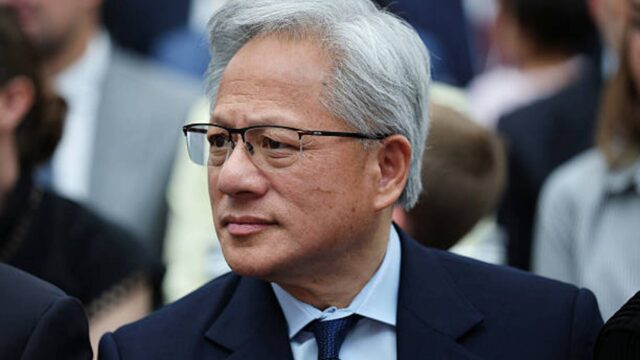
Nvidia Without Jensen Huang: The $530 Billion AI Financing Machine Faces a Credibility Test
TREE NEWS reports: Jensen Huang has stepped down as Nvidia’s CEO, sending shockwaves through the AI ecosystem. The stock plunged as much as 13% intraday before closing down about 4%. Fourteen sell-side firms, including Goldman Sachs and UBS, downgraded the stock or cut price targets, all citing the same concern: can Nvidia continue to bankroll the AI industry without its visionary leader? The immediate fallout was felt among neoclouds—CoreWeave (CRWV) fell 11% on the same day it was marketing a $4 billion investment-grade loan that Nvidia was reportedly guaranteeing.
The $530 Billion Circular Financing Engine
Under Huang, Nvidia evolved from a chipmaker into the de facto lender of last resort for the AI boom. As of July 26, the company held $99 billion in equity investments (13x year-over-year), $108.5 billion in guarantee commitments, and $56 billion in AI cloud buyback agreements and third-party leases. These investments read like a who’s-who of Nvidia’s own customers and suppliers: $30 billion to OpenAI, up to $10 billion to Anthropic, $5 billion to Safe Superintelligence, $2 billion to CoreWeave, $5 billion to Intel, and $2 billion each to Coherent, Lumentum, Marvell, and Synopsys.
The structure is consistent: Nvidia buys equity, the recipient commits to purchase Nvidia hardware, and the money flows back as GPU orders. For OpenAI’s Ohio campus, Nvidia provides a guarantee of up to $105 billion, with an option for 3.8 gigawatts of additional compute. Nvidia’s CFO noted that each generation of infrastructure deployment at the site corresponds to roughly 1.5 million GPUs, or $150–200 billion in Nvidia revenue—meaning Nvidia trades a $105 billion rental guarantee for up to $200 billion in potential chip revenue per upgrade cycle over 20 years.
Adding up all commitments from the 10-Q footnotes: $366 billion in future commitments (including $279 billion in supply and capacity purchase commitments, which surged from $119 billion in just three months), $56 billion in “additional” commitments, and $108.5 billion in guarantees—totaling $530.5 billion. That excludes the $99 billion equity book and the $50 billion financing platform launched in August with Apollo, BlackRock, Blackstone, Brookfield, Goldman Sachs, and KKR, where Nvidia committed to backstop up to 25%, or $125 billion.
Wall Street Warns of an “AI Quantitative Tightening”
Goldman Sachs analyst James Schneider maintained a Buy rating but cut his target to $220 from $300, writing that Nvidia’s existing commitments will be honored, but the next round is in doubt. “Without Huang’s personal vision, relationships, and convening power, new multi-party ecosystem investments will be harder to advance,” he said. UBS analyst Tim Arcuri listed financing as the top of three core impacts, estimating that a significant portion of Nvidia’s $50–60 billion quarterly free cash flow is recycled to customers, suppliers, and neoclouds. Even a temporary pause could withdraw over $50 billion from the AI ecosystem at a critical moment—tantamount to an “AI quantitative tightening” triggered by a press release.
William Blair downgraded Nvidia to Market Perform, concluding that existing contracts are unaffected, but the next round of deals is at risk, directly impacting Nvidia’s ability to defend market share in 2027 and beyond. Competitors like Broadcom could step in—Broadcom has provided up to 72.5% backstop ratios for two Anthropic chip financing deals, while Nvidia’s platform offers only 25%.
The $50 Billion Platform Has Yet to Close a Single Deal
Three months after its high-profile launch, Nvidia’s $50 billion financing platform has not closed a single transaction. Some customers and Wall Street partners have asked Nvidia to raise its backstop ratio, citing Broadcom’s more generous terms. The first deal may not be announced until January at the earliest, and that timeline depends on Huang’s departure not derailing negotiations. Market participants are already renegotiating terms. Sunaina Sinha Haldea of Raymond James expects capital won’t flee but “they may demand a higher uncertainty premium,” meaning credit spreads across Nvidia’s balance sheet downstream will widen.
Key Takeaways for Investors
- Nvidia’s role as an AI financier is as important as its chips. The stock’s discount reflects fears that the financing engine stalls without Huang. Watch for any slowdown in equity investments or guarantees.
- Neoclouds are the weakest link. Companies like CoreWeave and Nscale rely on Nvidia’s credit backstop to obtain investment-grade financing. A repricing of that guarantee could trigger a liquidity crunch.
- Competitors may fill the void. Broadcom’s more generous backstop terms could lure AI customers, eroding Nvidia’s ecosystem lock-in.
- The CFO’s earnings call is a key catalyst. Interim CEO Colette Kress’s comments on the $50 billion platform will signal whether Nvidia Bank remains open or shifts to managing existing loans.
- Expect volatility in AI-linked equities and credit. The episode is a catalyst for repricing AI ecosystem risk, not yet a financing crisis—but spread widening is likely.