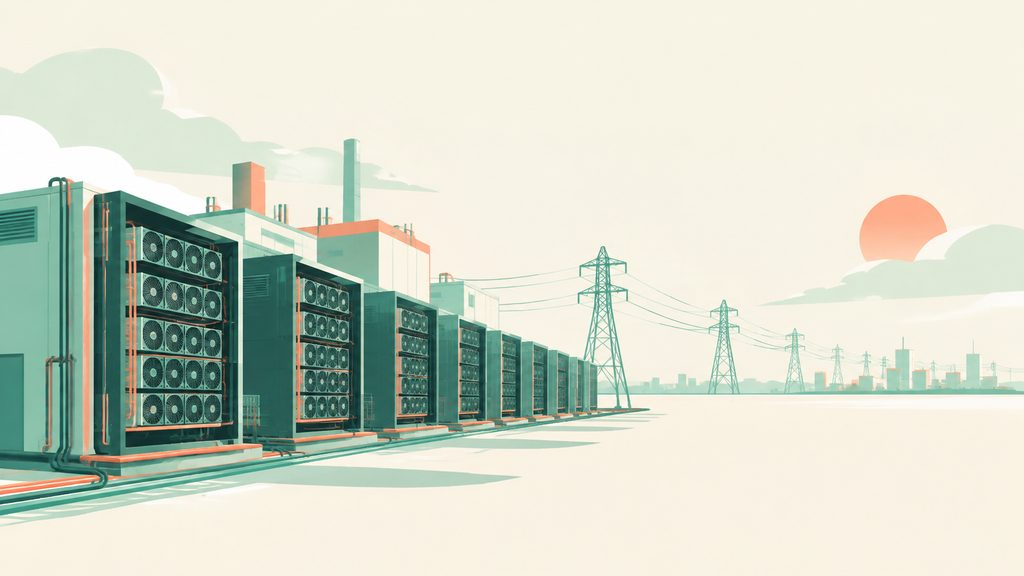
AI’s Power Crunch: Musk Warns of 15GW Electricity Gap by 2027, Crypto Miners and Data Centers Vie for Grid
TREE NEWS reports: News Summary: At the G20 summit, Elon Musk warned that global AI development is hitting a power bottleneck, projecting a minimum 15-gigawatt (GW) shortfall in electricity for AI chips by 2027. He highlighted that AI chip production capacity is growing at 40–50% annually, while power supply growth outside China lags at 10–20%, creating a core constraint. Musk noted that Google and Anthropic have already rented compute from SpaceX, which built its own power plants to scale rapidly. He suggested that while China has ample power, GPU export controls hinder its AI expansion, and other countries could capitalize by building power infrastructure to host AI data centers and reap tax revenues.
Industry Analysis
Musk’s warning underscores a structural mismatch between the exponential growth of AI compute and the linear expansion of global power grids. This gap has profound implications beyond AI—crypto mining, which is already energy-intensive, will face even stiffer competition for electricity. As AI data centers bid up power prices and secure long-term contracts with utilities, crypto miners may be squeezed out of cheap energy regions, accelerating their migration to stranded or renewable sources.
The mention of SpaceX building its own power plants signals a trend toward vertical integration: tech giants may increasingly co-locate with or construct dedicated energy infrastructure to guarantee supply. This could lead to a bifurcation in the energy market—captive power for hyperscalers versus merchant power for others. For crypto miners, this means either partnering with energy producers or pivoting to flexible load management to sell curtailed power back to the grid.
Musk’s emphasis on China’s power abundance but GPU export restrictions highlights geopolitical dimensions. If China cannot access advanced chips, its AI growth is stunted, but its power surplus could be redirected to crypto mining, which is already a major industry there. Meanwhile, countries with surplus power—like Iceland, Norway, or parts of the Middle East—could become attractive destinations for both AI and crypto data centers, but they must balance local energy needs and environmental concerns.
Forward-Looking Perspective
The 15GW gap by 2027 will likely spur policy shifts: governments may fast-track grid upgrades, incentivize small modular reactors (SMRs), and streamline permitting for renewable projects. For the crypto sector, this is a double-edged sword. On one hand, higher power costs could compress mining margins, forcing efficiency gains. On the other, the push for energy innovation could lead to more abundant and cheaper green power in the long run, benefiting all high-energy industries.
Moreover, the convergence of AI and crypto—such as decentralized compute networks—could emerge as a solution. By tokenizing compute and energy resources, projects could dynamically allocate power where it’s most needed, smoothing demand peaks and reducing waste. This would not only alleviate the electricity crunch but also create new markets for energy trading.
Ultimately, the AI power crisis is a wake-up call for global energy policy. Whether through nuclear, renewables, or grid-scale storage, the race is on to close the gap. For crypto, the key will be adaptability: miners that can flexibly curtail or relocate will survive, while those locked into rigid contracts may struggle. The next few years will test the resilience of both AI and crypto ecosystems as they compete for a finite resource.