China’s Auto Market Diverges Sharply in H1 2026
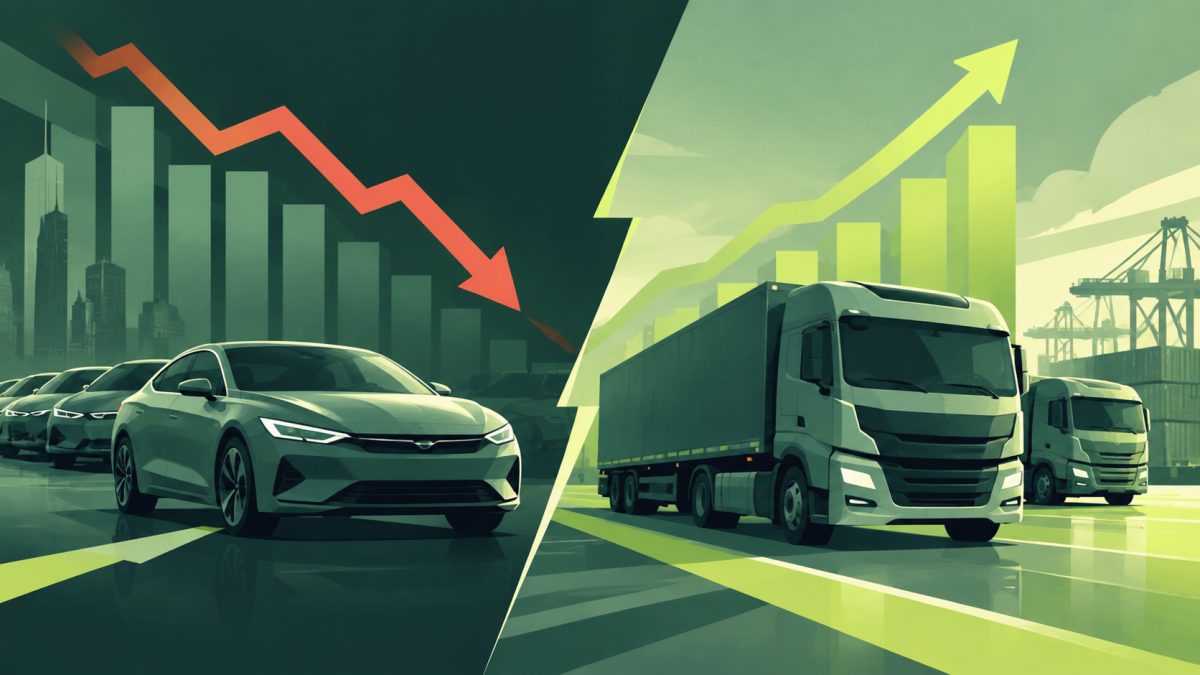
TREE NEWS reports: China’s automotive industry is experiencing a stark divergence in profitability between passenger vehicle (PV) and commercial vehicle (CV) manufacturers. While PV makers struggle with model changeovers and intensifying competition, CV producers are reaping the benefits of a replacement cycle, export growth, and electrification.
Data from the China Association of Automobile Manufacturers (CAAM) shows that in the first half of 2026, passenger vehicle sales fell 6% year-on-year to 12.72 million units, while commercial vehicle sales rose 8.3% to 2.297 million units. The profit gap is even more dramatic: 15 major PV makers reported a combined net profit attributable to shareholders of approximately 20.2 billion yuan, down 45% from 36.6 billion yuan a year earlier. Eight of these companies fell into losses. In contrast, eight CV makers posted combined net profit of 9 billion yuan, up 19% year-on-year, with all remaining profitable.
The Profit Mechanics Behind the Split
The divergence reflects two different business models at opposite points in their cycles. Passenger vehicle makers are bearing the costs of transitioning to new models: clearing old inventory depresses transaction prices, while ramping up new models increases manufacturing and marketing expenses. R&D, personnel, and channel costs remain rigid, amplifying sales volatility into profit swings.
Seres Group exemplifies this pressure. Its revenue fell 7.87% to 57.49 billion yuan, swinging from a profit of 2.94 billion yuan to a loss of 1.72 billion yuan. R&D expenses jumped 27.44% to 3.73 billion yuan, and operating cash flow turned negative. The company cited product mix changes, model transitions, and rising costs for batteries and chips as key factors. It also recorded an impairment charge of approximately 1.57 billion yuan on intangible assets.
Li Auto also swung to a loss of 3.98 billion yuan from a profit of 1.74 billion yuan. Together, these two companies accounted for a 10.4 billion yuan reduction in profits, highlighting the synchronized impact of model transitions on revenue, expenses, and cash flow.
Even among profitable PV makers, margins are under pressure. BYD’s net profit fell 20.54% to 12.33 billion yuan despite a 0.84 percentage point increase in gross margin to 18.85%. Geely’s gross margin rose 1.6 percentage points to 17.9%, but net profit declined slightly. Foreign exchange losses and impairment charges are widening the gap between reported profits and core operating performance.
Commercial Vehicles: A Different Story
Commercial vehicle makers are benefiting from a replacement cycle, export demand, and the declining operating costs of new energy vehicles. China Heavy Duty Truck Group (Sinotruk) reported net profit of 4.33 billion yuan, accounting for nearly half of the sample’s total and about 63% of the profit increment. Its heavy truck sales reached 188,500 units, with exports of 108,400 units and export revenue up 54% to 30.91 billion yuan.
Foton Motor’s medium and heavy truck sales rose 39.3%, driving a 16.54% increase in net profit. FAW Jiefang returned to profitability on an adjusted basis. New energy commercial vehicles are also contributing: domestic sales rose 40.2%, with penetration reaching 30.4%, as the total cost of ownership for electric trucks in high-mileage, fixed-route scenarios falls below that of diesel equivalents.
Market Implications
For investors, the divergence underscores the importance of focusing on profit quality rather than sales volume alone. The passenger vehicle sector faces a prolonged period of margin pressure as companies invest in electrification and intelligent features while managing legacy assets. The commercial vehicle sector offers more stable earnings, but its growth is heavily dependent on exports and the heavy truck replacement cycle.
Export growth is a common theme: total vehicle exports rose 65.3% to 5.096 million units, with new energy vehicle exports surging 120% to 2.355 million units. However, as exports scale, competition is shifting to overseas operational quality, including shipping costs, tariffs, local distribution, and after-sales service.
Key Takeaways
- Passenger vehicle makers face a 45% profit decline due to model transitions, price wars, and rigid costs.
- Commercial vehicle makers benefit from replacement demand, exports, and electrification, with profits up 19%.
- Export growth is a key support for both sectors, but profitability depends on managing overseas operational costs.
- Investors should prioritize companies with strong cash flow, stable pricing, and effective cost control over those with high sales volume but weak margins.



