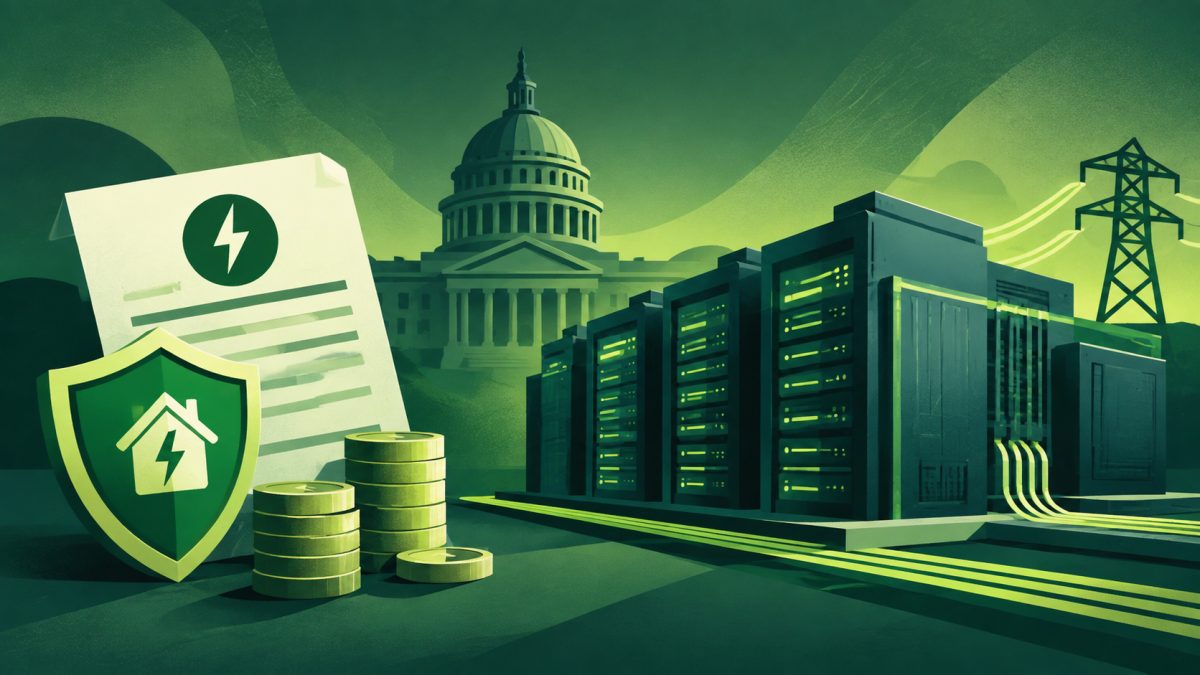
Senate Republicans Move to Fast-Track Data Center Electricity Cost Bill
TREE NEWS reports: Senate Republicans are considering an expedited legislative procedure to pass a bipartisan bill before the November elections that would force AI data centers to bear the cost of their massive electricity consumption. The Ratepayer Protection Act (H.R. 9340) aims to codify the White House’s earlier “Ratepayer Protection Pledge,” which has already garnered support from several major technology companies. The House is expected to pass the bill as early as Tuesday with broad bipartisan backing, directing states to consider mandating that data centers pay for the substantial power they require and for related infrastructure upgrades, rather than passing those costs onto ordinary households and businesses.
The Senate version of the bill is sponsored by Ohio Republican Senator Jon Husted, who is currently locked in a tight re-election race against former Democratic Senator Sherrod Brown. Senate Majority Leader John Thune of South Dakota indicated this week that senators will give the legislation “serious scrutiny” and explore whether it can be advanced through unanimous consent—a procedural move that may be necessary given the chamber’s packed agenda. With only three weeks of session scheduled before the November elections, and with presidential nominations and college sports legislation also competing for floor time, the window for action is narrow.
Market Implications: Utilities, Tech, and the Cost of AI
The bill’s advancement carries significant implications across multiple asset classes. For utilities and independent power producers, the legislation could reshape the economics of serving hyperscale data centers. If data centers are forced to pay the full cost of infrastructure upgrades—including new transmission lines, substations, and generation capacity—utilities may face lower regulatory risk but also reduced demand growth if tech companies slow expansion in response to higher costs. Conversely, utilities in data-center-heavy regions like Virginia, Texas, and Ohio could see more predictable cost recovery, potentially supporting their credit profiles and dividend stability.
For technology companies, the bill introduces a new cost layer to AI infrastructure buildouts. Major cloud providers and AI-focused firms already grappling with soaring capital expenditures on GPUs and cooling systems may need to factor in higher electricity tariffs. While the White House pledge has already been endorsed by several tech giants, a legally binding requirement could accelerate investments in on-site generation, renewable energy contracts, and energy-efficient chip designs. Companies with strong balance sheets can absorb these costs, but smaller data center operators and crypto miners—who often compete for the same power—could face margin pressure.
The cryptocurrency mining sector, which is highly sensitive to electricity prices, could be particularly affected. Miners in deregulated markets where they currently benefit from surplus grid capacity may see rates rise if data centers are forced to pay infrastructure costs that were previously socialized. This could accelerate the ongoing migration of mining operations to regions with cheaper power or to jurisdictions with more favorable regulatory treatment.
On the macro side, the bill reflects growing political pressure to address consumer energy costs ahead of the November elections. If passed, it could modestly reduce headline inflation expectations by capping the pass-through of data center-driven electricity price increases to households. That, in turn, could influence Federal Reserve policy expectations, though the direct impact is likely small relative to broader inflation dynamics. Bond markets may view the legislation as fiscally neutral, with no direct federal spending implications.
For currency markets, the bill is unlikely to be a major driver, though a stronger regulatory framework for AI infrastructure could reinforce the U.S. as a destination for tech investment, offering marginal support to the dollar. Commodities, particularly natural gas and uranium, could see demand shifts if data centers accelerate investments in on-site power generation, including small modular reactors and gas turbines.
Key Takeaways for Investors
- Utilities and power producers: Watch for regional disparities. Utilities serving data center hubs may benefit from clearer cost recovery, while those in competitive markets could face demand uncertainty.
- Tech and AI infrastructure: Higher electricity costs are a new headwind for data center economics, but companies with scale and clean energy portfolios are better positioned. Energy efficiency and on-site generation become more valuable.
- Crypto miners: Expect continued pressure on margins and potential relocation. Mining stocks may trade with sensitivity to the bill’s progress and state-level implementation.
- Macro: The bill is a small but symbolic step in addressing energy-driven inflation. It reinforces the political focus on consumer costs ahead of elections, which could influence fiscal and regulatory sentiment.
- Commodities: Natural gas, uranium, and renewable energy credits could see increased demand as data centers seek to self-supply power.
While the bill still faces procedural hurdles in the Senate, its bipartisan support and the political tailwind of rising consumer energy costs make it a story worth monitoring. The outcome will shape the cost structure of the AI boom and the broader energy landscape for years to come.



