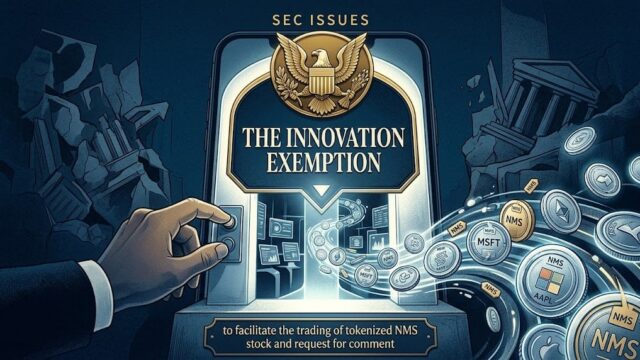
SEC Grants First-Ever Innovation Exemption for Tokenized Securities Venues
The U.S. Securities and Exchange Commission has issued an innovation exemption allowing qualifying Tokenized Securities Venues (TSVs) to trade tokenized U.S.-listed equities through automated market makers (AMMs) and liquidity pools under a licensed framework. The exemption runs until September 17, 2031, giving the industry a rare multi-year regulatory runway.
Why This Matters
Until now, tokenized equities existed in a gray zone: platforms could tokenize exposure to stocks, but secondary trading via DeFi-style mechanisms risked running afoul of exchange registration and broker-dealer rules. The exemption effectively carves out a licensed sandbox where AMM-based price discovery for tokenized securities is treated as permissible, provided venues meet conditions around custody, disclosure, and investor protection.
- Regulatory clarity: A defined legal pathway for tokenized equity trading removes a major compliance overhang.
- DeFi-TradFi convergence: AMMs — a core DeFi primitive — are now sanctioned infrastructure for regulated securities.
- Competitive pressure: U.S. venues can now compete with offshore tokenized-stock platforms that have operated without SEC blessing.
Industry Implications
For tokenization platforms and market makers, the exemption is a green light to build compliant on-chain order books and liquidity pools for equities. It also strengthens the case for tokenized treasuries, ETFs, and eventually private credit instruments to follow the same template. Brokerages and exchanges that have hesitated on tokenized products now have a regulatory anchor to justify investment.
Critically, the exemption is time-limited. That creates urgency: firms that establish compliant TSV operations before 2031 will likely shape the standards that outlive the exemption itself. Those that wait risk being locked out of a market that could define the next decade of securities trading.
Forward-Looking Perspective
The real test is liquidity and adoption. An exemption is not a mandate — institutions will only migrate if tokenized venues offer comparable execution, custody, and settlement finality to traditional markets. Watch for the first wave of TSV applications, partnerships between DeFi protocols and registered broker-dealers, and whether the SEC extends similar relief to tokenized fixed income. If the model works, the 2031 sunset could become a permanent fixture of U.S. market structure.