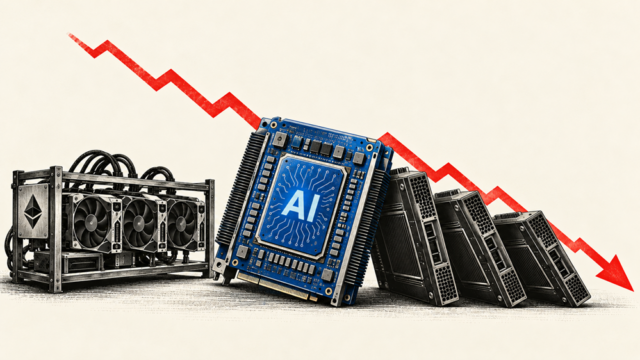
AI Arms Race Has 75% Chance of Continuing, 2027 Memory Shortage Locked In
TREE NEWS reports: The global AI arms race shows little sign of slowing, and the memory-chip supply crunch expected in 2027 is now effectively locked in, according to a new research report from Nomura’s global memory research team. The report argues that technology giants will keep pouring capital into AI infrastructure even as free cash flow turns negative, because no company wants to be the first to blink. Meanwhile, long-term supply agreements (LTAs) have already fixed 2027 volumes and prices for memory chips, providing strong revenue visibility for suppliers.
The ‘Game of Chicken’ Driving Capex
Nomura describes the current competitive dynamic as a “game of chicken”: any company that unilaterally cuts AI investment risks falling behind in the next round of competition. As long as rivals keep spending, maintaining investment becomes the more rational choice—even at the cost of persistently negative free cash flow. Recent comments from top executives underscore this trade-off. Alphabet CEO Sundar Pichai said compute for frontier model training takes priority over cloud revenue. Microsoft CEO Satya Nadella noted that if all new GPUs were allocated to Azure, cloud growth would exceed 40%. Meta CEO Mark Zuckerberg said additional compute could be redirected to advertising and recommendation systems even if superintelligence arrives later than expected.
Memory Shortage Locked In for 2027
AI demand continues to outstrip supply. TSMC CEO C.C. Wei said in mid-October that AI demand still exceeds current supply capacity. Amazon CEO Andy Jassy said that even with 2026 capex rising to $220 billion, the company cannot meet all demand for 2026-2027, and some 2028 demand has already been booked. Nomura notes that 2027 memory volumes and prices were locked in via LTAs in October 2026, with prices rebounding. Even if customers cut capex, penalty clauses—requiring deposits of 50% to 100% of annual demand value—raise the cost of cancellation. This provides suppliers with demand visibility and some margin protection, though the view applies mainly to 2027; supply and demand for 2028 and beyond will depend on the pace of AI investment.
Cash Flow Deterioration and External Financing
Capex has begun to exceed operating cash flow at some tech giants. Nomura data show Alphabet’s free cash flow was negative $5.9 billion in Q2 2026, Meta’s was negative $2.1 billion in Q3, and Amazon’s trailing 12-month free cash flow through June 2026 was negative $7.6 billion. Microsoft still had positive free cash flow of $19.6 billion in the same period, but Nomura expects it to come under pressure. Companies plan to maintain high spending: Alphabet’s 2026 capex is estimated at $195-205 billion, Meta’s at $135-145 billion, Amazon’s at about $220 billion, and Microsoft’s at about $175 billion for fiscal 2027. Financing has become a key tool to fill the gap. Alphabet raised $49.6 billion through common stock and mandatory convertible preferred shares in June 2026; Meta issued $24.9 billion in bonds in Q2 and paused buybacks; Meta’s board also approved a non-voting Class C share issuance to fund AI investment.
Three Scenarios and Risks
Nomura outlines three scenarios: the race continues (75% probability), capex slows (20%), and financing failure (5%). A closure of financing channels is the most likely trigger for a passive contraction that could break the current investment pattern. Power shortages are another risk: a Sightline Climate survey shows about 30-50% of planned data-center capacity for 2026 faces delay risk, with over 11 GW showing no sign of construction. If data centers cannot connect to power on schedule, chips may not be deployed in time, causing delivery delays and periodic order volatility. However, Nomura believes power shortages are more likely to delay and reshape demand rather than eliminate it; under power constraints, the per-watt value of next-generation chips and high-bandwidth memory (HBM) may rise further, and older GPUs could face replacement demand.
Key Takeaways for Investors
- Memory suppliers have strong visibility into 2027: LTAs lock in volumes and prices, and penalty clauses protect against cancellations, supporting earnings for memory chipmakers.
- Watch financing conditions closely: The biggest risk to the AI trade is not a lack of demand but a shutdown in financing. Deteriorating credit markets or rising rates could force capex cuts.
- Power is a bottleneck, not a demand killer: Delays in data-center power connections could push out chip deployments, but underlying AI demand remains intact. Focus on companies that can secure power.
- Differentiate between demand delay and demand destruction: As long as tech giants can keep raising capital, the AI investment race is likely to continue, benefiting semiconductor suppliers with locked-in orders.