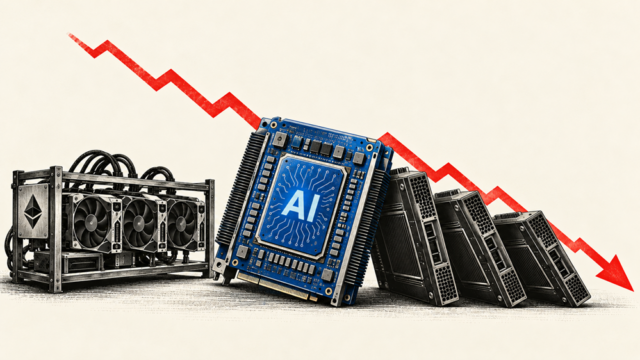
AI Trade Stalls as Meta’s Debt Spree Exposes Financing Prisoner’s Dilemma
TREE NEWS reports: The AI-driven rally that powered US equities for much of the year hit a wall last week, with a sharp selloff in AI-linked stocks and a simultaneous tightening in credit markets. The Nasdaq posted its worst single-day performance in months, while the average risk premium on US high-yield bonds climbed to a 17-month high. Yields on CCC-rated junk debt surged to their highest level since 2020. Beneath the surface of a seemingly calm index, a violent repricing of risk is underway—and the trigger is a massive debt-financing plan from Meta Platforms.
The News: Meta’s Preemptive Borrowing Spree
After reporting third-quarter earnings, Meta signaled plans to raise tens of billions of dollars in debt, with capital expenditures for 2026 projected at $135–145 billion and fourth-quarter spending alone at $49–59 billion. Free cash flow after dividends turned negative, and management indicated it would begin financing billions of dollars this autumn. In its filing, Meta noted that other companies in the AI ecosystem have already launched or plan to launch similar fundraising efforts, making capital markets increasingly less absorbent—so moving early is a practical necessity.
That rationale reveals a classic prisoner’s dilemma. Each hyperscaler has an incentive to front-run peers, but if all of them accelerate bond issuance simultaneously, the surge in new supply could push up borrowing costs and squeeze financing capacity for everyone. Barclays estimates that AI-related credit assets total roughly $680 billion, representing about 7.5% of the investment-grade bond index’s market value but contributing roughly 13% of its duration risk exposure.
Market Impact: Credit Stress Concentrates in Lower-Rated Borrowers
The stress is most visible in lower-quality credit. The average risk premium on US high-yield bonds rose to a 17-month high, and the primary market saw its largest wave of deal cancellations this year. CCC-rated junk bond yields hit 15.85%, the highest since 2020, with the spread over BB-rated debt approaching peaks last seen in 2016 and 2020. In the leveraged loan market, the volume of deeply distressed loans trading below 60 cents on the dollar reached its highest level since March 2020, while loans priced at 80 cents or below have surged nearly 90% over the past 12 months.
Notably, the broader credit market has not deteriorated in tandem, suggesting the risk is concentrated among issuers with weaker debt-servicing capacity. Even so, spreads across multiple rating tiers—from investment grade to high-yield credit derivatives to low-rated cash bonds—have touched cycle highs.
Equity markets are also showing strain beneath the surface. A Goldman Sachs basket of AI beneficiaries versus risk stocks has fallen about 55% from its June peak, erasing all year-to-date gains, while momentum strategies have suffered their sharpest drawdown since the 2008 financial crisis. On Thursday, the S&P 500 fell 1.2% even as 335 constituents advanced; the equal-weighted index rose 0.7% while the cap-weighted SPY declined. Hedge funds have deleveraged on seven of the past eight trading days, with Thursday’s selling driven entirely by long liquidations.
What It Means for Investors
The AI trade’s near-term direction now hinges on more than earnings. It depends on whether the market can absorb a dense wave of bond supply, whether credit spreads stabilize, and whether the divergence among AI issuers continues to widen. Spread dispersion among AI issuers has already risen from 24 basis points to 65 basis points over the past year, and yield curves for hyperscalers have steepened sharply—Meta’s 10-to-30-year curve spread reached 68 basis points, the steepest among peers.
- Watch credit, not just equities: The recent equity pullback reflects both a valuation reset and a clearing of crowded positioning. A sustained rebound likely requires credit stress to ease first.
- Differentiate within AI: Markets are no longer treating AI as a single credit theme. Issuers with heavy financing needs and stretched balance sheets are being penalized, while shorter-dated bonds from Microsoft, Google, and Amazon remain relatively resilient.
- Monitor supply and long-end yields: As AI capex climbs, investors must assess not only whether spending translates into revenue but also financing scale, cash-flow improvement timelines, and the impact of new bond supply on borrowing costs.
Until these pressures abate, any rally in the AI trade may remain capped by rising financing costs.