SEC Opens 5-Year Sandbox for On-Chain US Stocks Under Innovation Exemption
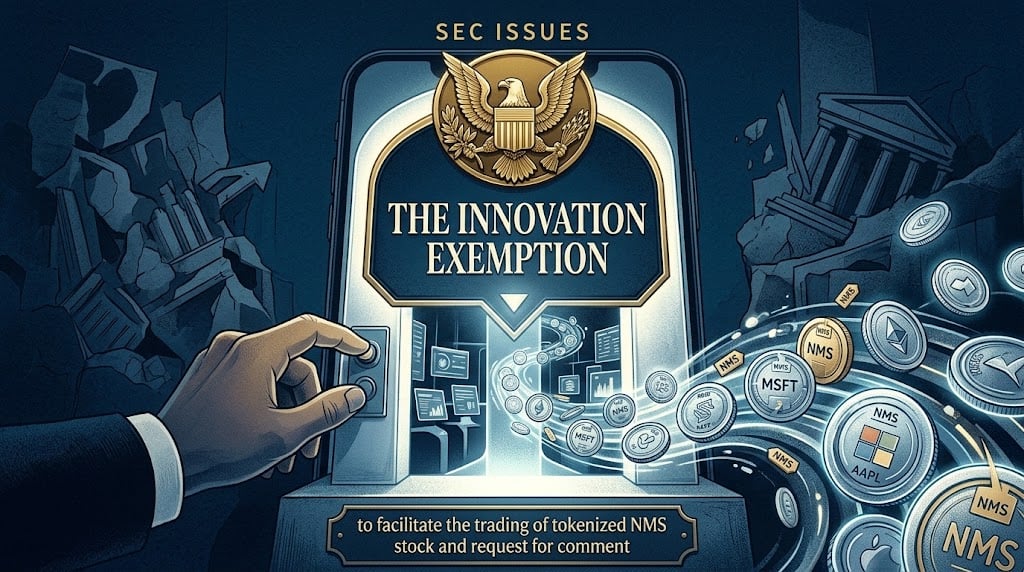
The U.S. Securities and Exchange Commission has unveiled a new “innovation exemption” framework that allows tokenized securities exchanges to pilot on-chain trading of US equities for up to five years. The program creates a time-limited regulatory sandbox in which approved venues can list tokenized versions of traditional stocks, settle trades on public or permissioned blockchains, and test new market structures without being immediately bound by the full set of existing securities rules.
What the Framework Actually Does
The exemption is structured as a conditional safe harbor rather than a blanket deregulation. Eligible exchanges must register with the SEC, meet disclosure and custody standards, and submit to enhanced reporting on how tokenized shares are issued, transferred, and reconciled against the underlying equity. The five-year window is designed to give regulators real-world data on settlement times, investor protections, and market integrity before deciding whether to make the model permanent.
- Tokenized US equity trading permitted on approved venues for a five-year pilot period
- Exchanges must meet registration, custody, and disclosure conditions
- SEC retains authority to revoke the exemption or amend terms at any time
- Reporting requirements focus on settlement, ownership reconciliation, and investor safeguards
Why This Matters for RWA and TradFi Convergence
The move is the clearest signal yet that US regulators are willing to let traditional finance and blockchain infrastructure converge inside a controlled perimeter. For the real-world asset (RWA) sector, tokenized equities have long been viewed as the missing pillar alongside tokenized treasuries, private credit, and money market funds. A functioning on-chain equity market would give DeFi protocols a new collateral class, enable 24/7 trading of blue-chip stocks, and create atomic settlement pathways that bypass legacy clearing layers.
It also puts pressure on incumbent exchanges and brokers. If tokenized venues can offer faster settlement, lower fees, and round-the-clock access, the competitive dynamic shifts. Custodians and transfer agents will need to adapt, and the DTCC’s role in US equity settlement could face its first serious structural challenge in decades.
The Road Ahead
The pilot is not a green light for a free-for-all. Expect the SEC to approve a small number of highly vetted venues first, likely partnerships between regulated exchanges and established crypto infrastructure providers. Key open questions remain: how tokenized shares interact with voting rights, dividends, and corporate actions; whether tokens can be used as DeFi collateral; and how cross-border access will be handled.
If the sandbox produces clean data and no major investor-protection failures, the five-year experiment could become the template for how all US securities eventually move on-chain. If it stumbles, the window closes and the RWA equity thesis gets pushed back another cycle. Either way, the clock has started.